
Review · OAHU
Historical Honolulu Bike Tour
Honolulu looks better from a bicycle. This four-to-five-hour ride links Waikiki, Chinatown, Kaka’ako, downtown, and the waterfront while your guide explains the island’s past and present. I like the small group of no more than 10 and the mostly flat route, which lets you cover a lot without turning the morning into a race. I also like that bikes, helmets, water, snacks, and regular photo stops are included. The one drawback is the distance: 13.5 miles still requires a moderate level of fitness, and Honolulu traffic can make some stretches less relaxed than others.
The 7:00 a.m. start is early, but it is a smart time to ride. You meet at the Kuhio Beach Banyan Tree, then head out before the day becomes too hot. Guide Kelly earns especially high marks for safety, local stories, photographs, and a steady pace that works for beginners and experienced cyclists alike. Still, bike condition matters on a tour this long. One past rider reported repeated chain trouble, so I would inspect your bicycle before setting off and speak up at once if anything feels wrong.
Five things to know before you pedal away
- The route covers 13.5 miles: You see far more of Honolulu than you would on foot, but this is an active sightseeing tour, not a short beach ride.
- Kelly is a major part of the experience: He shares historical context, local suggestions, photographs, and, at times, a video collage of the outing.
- The route is mostly flat: That makes it approachable for many riders, though traffic, heat, and the total distance still require reasonable fitness.
- Aloha Tower includes an elevator ride: You get broad views over Honolulu Harbor without climbing stairs.
- The tour mixes famous sights with everyday Honolulu: Royal buildings and statues appear alongside canoe clubs, parks, murals, markets, shops, and local food stops.
- The tour begins and ends at Kuhio Beach: You arrange your own way to the meeting point, and the activity runs in all weather unless poor conditions force a cancellation.
Why this is a useful first morning in Honolulu
This tour works best as an introduction to Honolulu. Instead of spending four hours in one historic district, you move through several parts of the city and learn how they connect. Waikiki’s resort strip gives way to canals and parks, then downtown landmarks, Chinatown, the harbor, and Kaka’ako’s mural-covered streets.
I especially like the route’s mix of old and new. You see the only royal palace on United States soil, a church built from coral blocks, and the statue of the king who united the Hawaiian Islands. Later, you pedal past street art, reclaimed parkland, modern public buildings, and the Convention Center.
The guide’s role is important here. A bicycle lets you cover the ground, but it does not automatically explain why a place matters. Kelly’s narration adds the context, and his use of a speaker system helps everyone hear while riding. That is a useful feature on a moving tour, where stopping every few minutes for a full talk would slow the outing.
The small-group limit also changes the feel. Ten people is still enough for a real group ride, but it is more manageable than a large bus excursion. Kelly can keep an eye on riders, answer questions, and take pictures without losing the whole group.
More History Bike, Segway and Tuk-Tuk Tours in the USA
- Charlotte’s Ultimate Southern Charm Historical City Cart Tour
★ 5.0 · 1,347 reviews - Asheville Historic Downtown Guided Electric Bike Tour with Scenic Views
★ 5.0 · 1,234 reviews - Private Guided Historic Electric Cart Tour of St. Augustine
★ 5.0 · 1,194 reviews
Starting under the banyan tree at Kuhio Beach
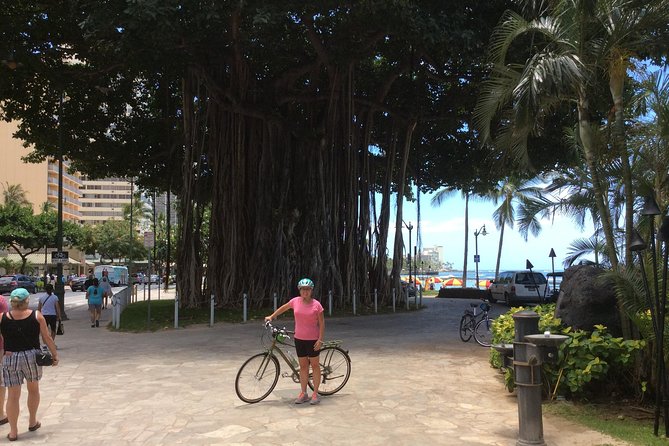
Meet at the Kuhio Beach Hula Mound beside the banyan tree at 7:00 a.m. The tour begins with a quick look at this part of Waikiki, including the free hula shows, the beach, and the tree that shades the meeting area.
This is a pleasant place to begin because it introduces Waikiki beyond the hotel frontage. You hear about the beach’s surfing and sunbathing traditions before leaving the resort district behind. Your bicycle and helmet are provided, along with bottled water and snacks.
The early start deserves a practical note. You need to arrange your own transportation to the meeting point, and the tour ends there as well. The area is near public transportation, but you should allow enough time to arrive before 7:00 a.m. A late start could affect the whole group.
Waikiki Zoo, golf course, and the Ala Wai Canals
The first miles pass the Honolulu Zoo and the edge of a popular golf course. The zoo holds more than 1,000 animals, but the tour does not include admission or a visit inside. You are seeing it as part of the city ride, while Kelly provides narration from the road.
The route then follows the Ala Wai Canals. Built in 1929, this waterway is easy to overlook when you are focused on Waikiki’s beach. From a bicycle, you get a different view of the canal and its connection to the surrounding neighborhoods.
This section helps explain why the ride is more than a string of famous photo stops. You are watching Honolulu function as a city: water channels, recreation areas, golf grounds, roads, and public paths all close together. The route is mostly flat, but you should still expect ordinary urban riding, including crossings and stretches where you need to pay close attention.
Magic Island and the waterfront route
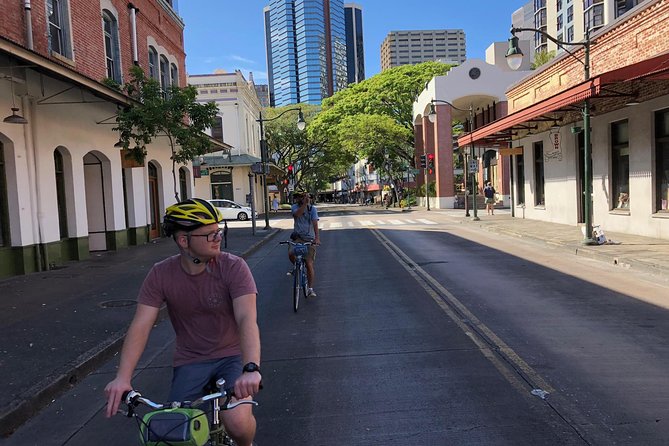
The ride continues toward the Honolulu Convention Center, Magic Island, Point Panic, and Kaka’ako Park. Magic Island is part of Ala Moana Park, often called the people’s park. It was created in 1947 from reclaimed land and turned an unattractive landfill area into one of Honolulu’s most visited parks.
The stop is brief, but the story gives the place more meaning. You are not simply looking at a pleasant green space beside the water. You are seeing how Honolulu reshaped its shoreline for public use.
Point Panic and the waterfront add another change of scenery. The route includes beaches, Hawaiian canoe clubs, parks, and open views. This part of the ride is useful for anyone trying to get a sense of local recreation beyond Waikiki’s hotel beaches.
The Convention Center appears again near the final mile, where a pathway lined with ficus trees provides a quieter finish to the urban riding. The sequence is a good reminder that Honolulu has more than one face: resort, residential, civic, artistic, and harbor-side.
Same place, a different slice of the past:
- History and Hauntings of Salem Guided Walking Tour
★ 5.0 · 14,564 reviews - Charleston’s Old South Carriage Historic Horse & Carriage Tour
★ 5.0 · 10,023 reviews - Beneath The Streets Underground History Tour
★ 4.5 · 8,006 reviews - Boston: Freedom Trail History Small Group Walking Tour
★ 5.0 · 6,450 reviews
Kaka’ako murals and a changing neighborhood
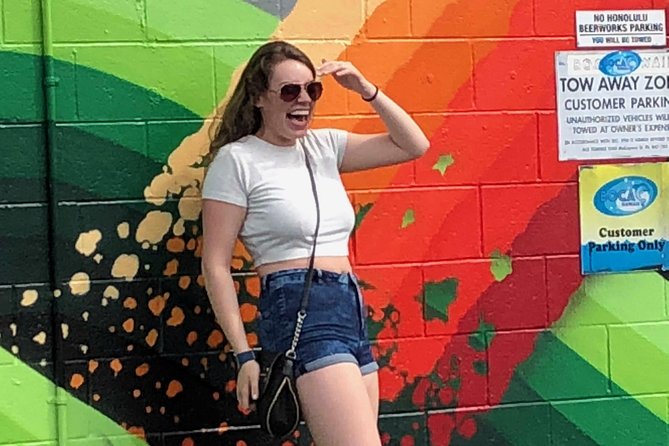
Kaka’ako is one of the most visual parts of the tour. Large mural walls display work by local and visiting artists, and the group stops for photographs. The guide points out details you might miss if you were simply riding through on your own.
The district is also changing quickly. Construction and new development are altering the area, so the ride captures a neighborhood in transition rather than a preserved historic quarter. That can be a plus if you want to see contemporary Honolulu, but it also means the exact streetscape may change over time.
This is one place where Kelly’s photo-taking is especially useful. Solo riders can end up with very few pictures of themselves, and past participants appreciated having photographs taken during the ride and made available afterward. The tour may also include a video collage, adding a personal record of the morning.
Aloha Tower and Honolulu Harbor from above
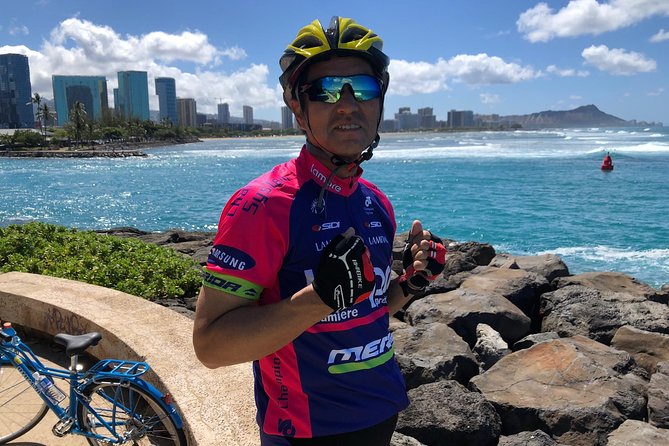
At Aloha Tower Marketplace, you ride to the tower and take the elevator up. The stop lasts about 20 minutes, making it one of the longer pauses on the route.
Aloha Tower once greeted ships and arriving families in Honolulu Harbor. From above, you can look across the harbor and watch the water around the city. The guide explains the surrounding area and points out the harbor’s fish and coral life.
This is a strong value point in the itinerary. You get a broad view without arranging a separate lookout visit, and the elevator makes the stop easy after several miles of riding. The tower also helps you understand Honolulu’s role as a port, not just as a beach destination.
Do not expect a long independent visit. The stop is part of a moving group itinerary, so the time is limited. Still, the combination of harbor views, transportation history, and a short rest makes it a welcome midpoint.
Chinatown and downtown’s edible break

After the harbor, the route continues through Chinatown and downtown. The Chinatown section adds a more everyday feel, with markets, shops, and city streets replacing the open waterfront.
The tour includes a chance to sample some of Hawaii’s exotic fruits. This small food stop is one of the most personable details in the day. It gives you something to taste while connecting the ride to local shopping and food culture. Food and drinks are not generally included beyond the specified snacks, water, and fruit sampling, so do not arrive expecting a full meal.
I would plan lunch after the tour rather than before it. The early start and included snacks should help, but four to five hours on a bicycle is not the same as a short sightseeing loop. Kelly also shares suggestions for places to eat, shop, visit, and find beaches after the ride, which can make the tour useful for planning the rest of your stay.
Royal Honolulu in a compact history lesson
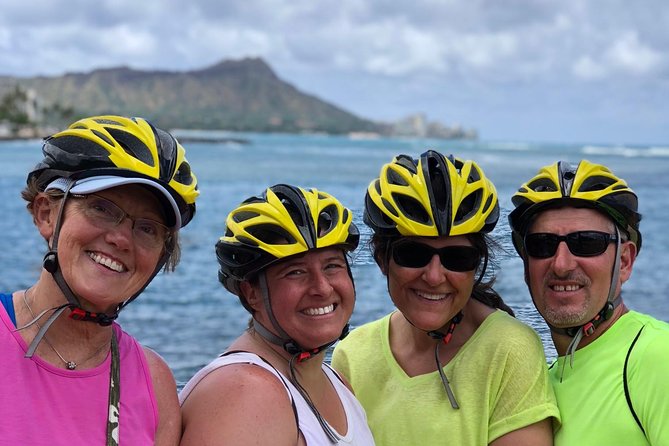
The downtown and civic-center section brings together some of the city’s most important historic sights. Each stop is short, usually around three to seven minutes, so think of this as an overview with photographs and narration rather than a series of museum visits.
The Hawaiian Mission Houses Historic Site and Archives includes Hawaii’s first Western-style home, brought by ship and assembled by the Hall missionary family. The site also contains a printing press used to produce the first Bible printed in the Hawaiian language. The tour does not include a full interior visit, but even a brief stop gives you a useful point of reference for the changes brought by Western contact.
Nearby, Kawaiaha’o Church was built with more than 14,000 coral stones. It remains one of Honolulu’s most important landmarks and holds an 8:30 a.m. Sunday service. The tour schedule begins at 7:00 a.m., so the timing may not allow you to attend that service, but you can still see the church from the outside during the ride.
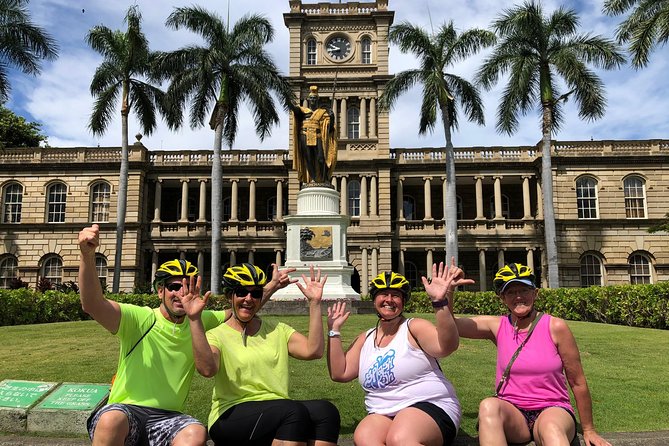
The King Kamehameha Statue is another quick stop. Kamehameha united the Hawaiian Islands, and the statue is recognizable from Hawaii Five-0 opening scenes. Its recent refurbishment with real gold paint adds a bright detail to an otherwise formal civic setting.
Then comes ʻIolani Palace, the former royal residence of Hawaii’s rulers. It is the only royal palace on United States soil and a National Historic Landmark. Seeing it by bicycle gives you a strong exterior view, but it does not replace a dedicated palace tour if you want rooms, furnishings, and a longer look inside.
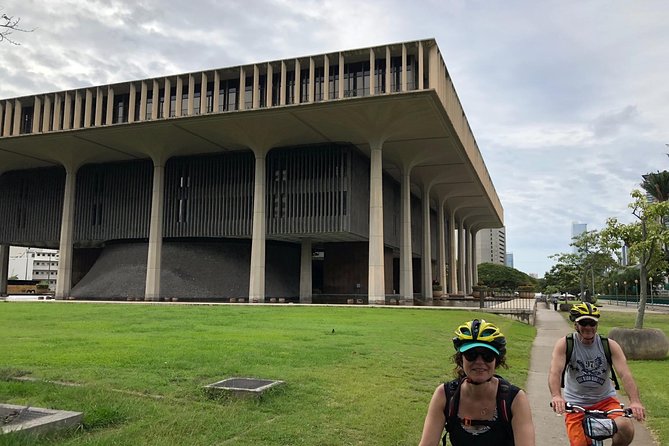
The Hawaii State Capitol completes this section. Built in 1969, it is described as the only open-air capitol in the United States. You roll through the grounds rather than spend a long time inside, so the value comes from the contrast between the modern building and the nearby royal sites.
The Elvis connection at the Blaisdell Center
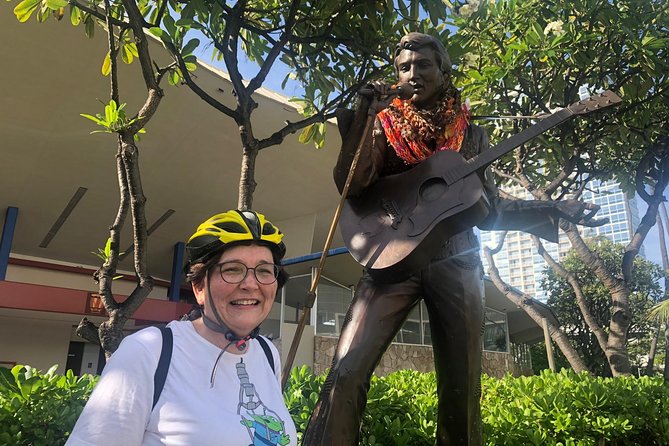
The Neal S. Blaisdell Center provides a pop-culture stop among the historic buildings. A statue honors Elvis Presley, whose famous 1973 Aloha From Hawaii concert took place here. The venue has also hosted performers including Prince, Sting, Jack Johnson, and Janet Jackson.
The stop is short, about five minutes, but it broadens the tour’s story. Honolulu’s past is not only about monarchy, missionaries, and government. It also includes the concerts and performers that shaped the city’s modern identity.
This stop is especially fun if you know the Elvis connection, but it should not be the main reason you book the ride. The real strength is the variety: you get a quick look at the center, then continue into the larger story of Honolulu.
Pace, equipment, and the real physical effort
The ride is described as mostly flat and suitable for people with moderate physical fitness. That makes it accessible to many beginners, but I would not call it effortless. Thirteen and a half miles over four to five hours includes riding, stopping, waiting, photo opportunities, and narration, so the pace is not nonstop. Still, you need to be comfortable on a bicycle for a substantial morning.
Bikes and helmets are included, as are bottled water and snacks. Past outings have also included Gatorade and local fruit, although you should rely on the stated inclusions rather than assume every extra will appear.
Safety has been a praised part of Kelly’s guiding. He keeps the pace controlled, watches the group, and explains the route while riding. One older account described a bicycle chain repeatedly falling off, which is the main practical warning in an otherwise strong set of experiences. Check the brakes, tires, gears, and chain before leaving the beach. A quick inspection can prevent a small mechanical problem from spoiling a long ride.
The tour operates in all weather, so dress for changing conditions. If poor weather causes cancellation, you are offered another date or a full refund. A light drizzle has not necessarily ended the outing, but wet roads and poor conditions can affect comfort and safety.
Is $149 a fair price?
At $149 per person, this is not a budget bicycle rental. You are paying for a guided route, a four-to-five-hour time commitment, equipment, water, snacks, local fruit, historical interpretation, safety support, and a small group.
The value is strongest if you would otherwise book several separate activities. In one morning, you cover Waikiki, the canals, Magic Island, Kaka’ako, Aloha Tower, Chinatown, downtown, the royal center, and the Blaisdell Center. You also receive local suggestions for later in the trip and photographs that can be particularly helpful if you are traveling alone.
The value is weaker if you prefer to stop at every museum, spend an hour at each landmark, or set your own pace. Most stops are short, and admission to places such as the Mission House Museum or ʻIolani Palace is not presented as part of the tour. You are buying breadth and guidance, not lengthy interior visits.
The high rating of 4.9 from 76 ratings and the 99 percent recommendation figure suggest a dependable experience, but no tour is perfect for everyone. The group size, bicycle condition, traffic, weather, and your own fitness will shape the morning.
Who should book this Honolulu bike ride?
I would choose this tour for active first-time visitors who want orientation quickly. It also suits solo riders, couples, and families with older children who can comfortably manage the distance. Children must be accompanied by an adult.
It is a good match if you like hearing stories while moving, want photographs of yourself, and prefer local neighborhoods to a fixed sightseeing bus. Kelly’s friendly style, safety awareness, and willingness to suggest food and activities add real practical value.
I would hesitate if you dislike riding in city traffic, need a fully relaxed pace, or want deep interior visits at the palace and museums. The 7:00 a.m. start also will not suit anyone hoping for a slow Waikiki morning.
FAQ
Where does the Historical Honolulu Bike Tour start?
It starts at the Kuhio Beach Banyan Tree, also called the Kuhio Beach Hula Mound, at 2453 Kalākaua Avenue in Honolulu.
What time does the tour begin?
The tour begins at 7:00 a.m. You should arrange your own transportation to the meeting point before departure.
How far does the bike tour travel?
The riding distance is approximately 13.5 miles. The route is mostly flat, but participants should have a moderate level of physical fitness.
What equipment and refreshments are included?
A bicycle, helmet, bottled water, and snacks are included. Food and drinks beyond the specified inclusions are not included.
How many people can join the tour?
The group is limited to a maximum of 10 participants. Children must be accompanied by an adult.
What happens if bad weather cancels the tour?
If poor weather causes the experience to be canceled, you can choose another date or receive a full refund. You can also cancel for a full refund up to 24 hours before the start time. Cancellations within 24 hours are not refunded.
Should you book it?
Book this ride if you want a broad, active introduction to Honolulu rather than a slow visit to one landmark. The combination of royal sites, harbor views, Kaka’ako murals, Chinatown fruit, and local guidance gives you useful bearings for the rest of your Oahu stay.
I would book it early in the trip, ideally for your first or second morning, and use Kelly’s food and beach suggestions afterward. Just arrive ready for a real 13.5-mile ride, inspect your bicycle before leaving, and remember that the short stops favor variety over long museum visits. For the right rider, $149 buys a full morning of movement, context, and city views that are hard to collect on foot.
More Bike Tours in the USA
- Historic Bike Tour in Tucson
★ 5.0 · 553 reviews - Historical Bike Tour of Savannah and Keep Bikes After Tour
★ 5.0 · 345 reviews - New Orleans History and Sightseeing Small-Group Bike Tour
★ 5.0 · 215 reviews - Nashville’s Historic Electric Bike Tour
★ 5.0 · 189 reviews
Just added around the USA
- Carolina History & Haunts Greensboro Historical Ghost Tour★ 5.0 · 72 reviews
- Newport Walking Food And History Tour★ 5.0 · 377 reviews
- Art Historian’s Gilded Age Newport: A Self-Guided Driving Tour★ 4.0 · 24 reviews
- Historic Newport Harbor Boat Tours★ 5.0 · 29 reviews
- Historic Scenic Tour Through Newport With Elms Admission★ 5.0 · 40 reviews
- Wall Street Inside with a Trader Walking History Tour★ 5.0 · 23 reviews
- The Psychiatric History of New York: Upper East Side Tour★ 5.0 · 31 reviews
- The Original Greenwich Village Food & Cultural Tour Since 1999★ 5.0 · 254 reviews
History Bike, Segway & Tuk-Tuk Tours, compared.
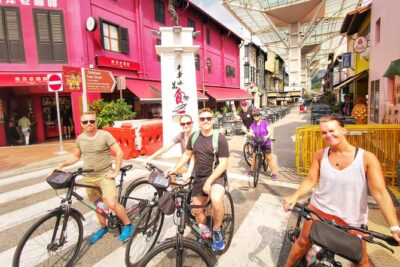
Historical Singapore Bike Tour on Full-Sized Bicycles
Read our review →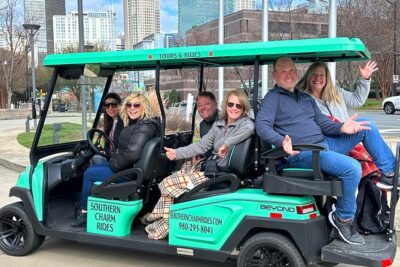
Charlotte’s Ultimate Southern Charm Historical City Cart Tour
Read our review →
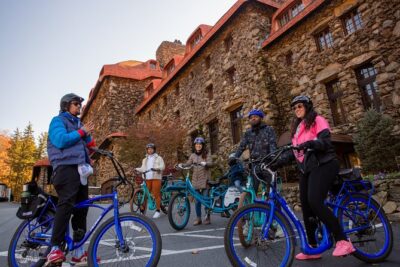
Asheville Historic Downtown Guided Electric Bike Tour with Scenic Views
Read our review →
Private Guided Historic Electric Cart Tour of St. Augustine
Read our review →
60-Minute Guided Segway History Tour of Savannah
Read our review →
Historic Athens: Small Group Electric Bike Tour
Read our review →
90 Minute Historic Uptown Neighborhood Segway Tour of Charlotte
Read our review →Browse the lists this tour appears in