Review · BARCELONA
Barcelona Historical Walking Tour: Gothic Quarter and El Born
Barcelona’s old streets hide plenty of good stories. This two-hour walking tour links the Gothic Quarter with El Born, taking you from an artists’ café and Roman walls to medieval squares, Civil War scars, Jewish heritage, and two major churches. I like the compact route, which covers a lot without turning into an exhausting half-day march. I also like the guides’ mix of history, local traditions, humor, and practical food tips.
The main consideration is that this is an overview, not a deep visit inside every sight. The stops are short, usually about 10 minutes, and admission to Barcelona Cathedral and Santa Maria del Mar is not included. Guide quality can also vary: most praise the clear, warm storytelling, but one guest found a guide too soft-spoken to hear.
Five details worth knowing before you book
- You visit 11 historic stops in about two hours, making this a useful first look at Barcelona’s oldest districts.
- The route begins near Plaça del Vuit de Març and finishes beside Santa Maria del Mar in El Born.
- Els 4 Gats connects you with Picasso and Gaudi, while the Gothic Quarter reveals Roman and medieval Barcelona.
- The group can include up to 20 people, large enough for company but still manageable on narrow lanes.
- Morning is the smart choice when available, since one guest found it cooler and less crowded.
- The price is $30.25 per person, with group discounts available and free cancellation up to 24 hours before the start.
Starting with Picasso, Gaudi, and Catalan identity
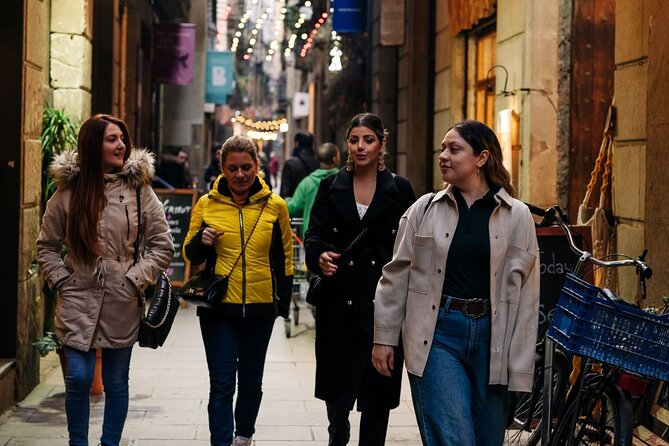
The walk begins at Plaça del Vuit de Març, in the Ciutat Vella, or Old City. This puts you right among the tight streets of the Gothic Quarter, where the city’s Roman, medieval, religious, and political layers sit close together.
The first stop is Els 4 Gats, a historic café and restaurant with an Art Nouveau interior. It became a meeting place for artists, writers, intellectuals, and modernists, including Pablo Picasso and Antoni Gaudi. You do not pay admission for the stop, but the visit is brief, around 10 minutes, so think of it as a chance to understand the place and its cultural role rather than a long café break.
Next comes El Mon Neix En Cada Besada, a large photomosaic created in 2014. Its subject connects to Catalonia’s defeat on September 11, 1714, during the War of Spanish Succession. That date later became La Diada, Catalonia Day. The artwork gives your guide an opening to explain how ideas of freedom and Catalan identity still shape local life.
This is one of the better features of the route. You are not simply ticking off old buildings. You are hearing how politics, art, religion, and local memory have shaped the city. Guides such as Juan have used an iPad to show historical images, while others, including Thami and Petra, have been praised for making the stories lively rather than dry.
More History Walking Tours in Barcelona
- Barcelona: Tapas Walking Tour with Food, Wine, and History
★ 4.8 · 4,261 reviews - Barcelona Tapas Walking Tour: Food, Wine & History
★ 4.5 · 1,928 reviews - Barcelona: Dark History Night Walking Tour
★ 4.8 · 344 reviews
Barcelona Cathedral and the Roman wall
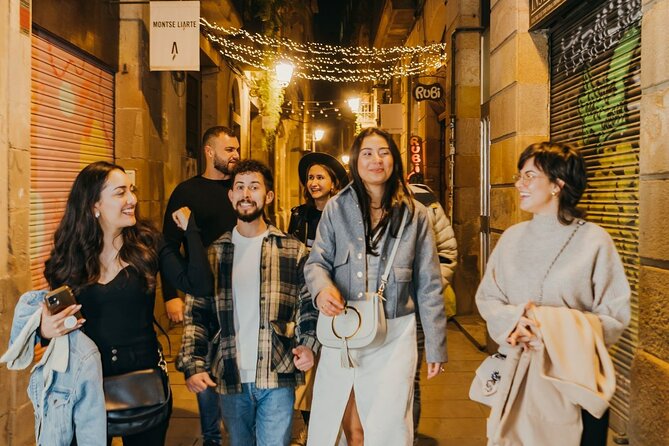
Barcelona Cathedral is the next major stop. This Gothic church honors Saint Eulalia, Barcelona’s patron saint, who was tortured and killed by the Romans. The building sits in the heart of the old city, surrounded by narrow streets and small squares that make it easy to picture the area as an older, more enclosed Barcelona.
You spend about 10 minutes here, and the admission fee is not included. That matters if you want to go inside, examine the church closely, or spend time with its religious art. The walking tour gives you the historical setting, but it is not designed as a full cathedral visit.
Casa de l’Ardiaca offers a more unusual stop. This building combines Gothic and Renaissance elements and incorporates the vertical face of the Roman wall and aqueducts. It is the kind of place you could easily pass without understanding what you are seeing. A guide helps connect the visible masonry with Barcino, the Roman city beneath today’s Barcelona.
The route works well here because the distances between stops are short and the streets themselves become part of the lesson. You are walking through the remains of different eras rather than looking at isolated monuments from a coach window. That is a real advantage in the Gothic Quarter, where buses cannot reach the narrow lanes.
Pont del Bisbe and the Gothic Quarter’s darker corners
Carrer de Bisbe was one of the main routes through Roman-occupied Barcino. Today, its best-known feature is Pont del Bisbe, a Neo-Gothic bridge that crosses the street between historic buildings.
The bridge comes with a superstitious legend. It is exactly the sort of story that makes a short stop memorable, especially when your guide explains the details with a little humor. Jordan has been praised for mixing comedy with solid historical information, while Lidia is known for balancing jokes with useful context.
Plaça de Sant Felip Neri changes the mood. This small square carries painful memories from the Spanish Civil War, and its damaged surfaces still show signs of that past. It is a quiet place, but not a light one. Your guide can help you read the marks on the walls and understand why this corner feels so different from the postcard Barcelona of grand avenues and Gaudi façades.
The tour then reaches MUHBA El Call, the former Jewish quarter. Its narrow medieval streets, synagogue, and local legends provide a look at a part of Barcelona’s past that many first-time visitors miss. The stop is free and brief, so you should not expect a full museum visit. Instead, you get an introduction to the neighborhood and its place in the city’s story.
For me, this section is where the tour earns its price. The route takes you to streets and details that are easy to miss alone, while the guide explains why they matter. You get more than a list of dates, but the short format means you need to listen closely.
Government, royalty, and an angel in the street

Plaça de Sant Jaume is the civic center of the old city. Government buildings surround the square, and the guide explains its role in Barcelona’s public life. It is still an active urban space, so the experience here is less about a preserved monument and more about seeing how history and modern government share the same setting.
Plaça del Rei offers another shift in tone. The square houses the Royal Palace and gives you a look at Barcelona’s regal past. Its attractive appearance hides a darker history, which your guide brings out through stories about the people and events connected with the area.
The stop at Plaça de l’Àngel adds a lighter local legend. Once known as Wheat Square because of its grain trade, it later took the name Angel’s Square because of a heavenly story. These small tales are useful because they give you something to remember after the tour ends. Names on a map become connected to a scene, a superstition, or an old trade.
The walk ends at the Basilica de Santa Maria del Mar in El Born. This Catalan Gothic church is closely linked with Barcelona’s maritime past and is one of the most impressive buildings on the route. Admission is not included, so you will need to pay separately if you want to enter.
Finishing here is practical. El Born has plenty of places to continue your day, and the guide may offer suggestions for food, drinks, attractions, restaurants, and bars. Tammy has been praised for sending detailed recommendations after the tour, while Juan has offered useful ideas for where to eat and what to see next.
More History Walking Tours in Spain
- Barcelona 1.5h Private Old Town, Gothic & Ramblas Walking Tour
★ 5.0 · 318 reviews - Barcelona: The Spanish Civil War Historical Walking Tour
★ 4.9 · 239 reviews - Barcelona in 2 Hours: Guided Walk Through History and Sights
★ 5.0 · 203 reviews - Barcelona Dark History Night Walking Tour With Drinks
★ 5.0 · 153 reviews
What the two-hour format really feels like
The tour allocates about 10 minutes to each of the 11 stops. That creates a brisk but manageable rhythm. You are rarely standing in one place for too long, yet there is enough time to listen, take photographs, and move through the old streets without feeling rushed.
The walking is described as easy and suitable for most people. One guest specifically recommended a morning start because the streets were cooler and quieter. That is good practical advice for Barcelona, especially in warmer months. The tour is offered in English and uses a mobile ticket.
A maximum of 20 people keeps the group from becoming unwieldy, though a group of that size can still make narrow streets and street corners feel crowded. Clear organization matters here. Lidia received praise for detailed meeting instructions and several ways to contact the company, which is reassuring when the starting point is in a maze-like old district.
Most guides appear to bring strong energy and local context. Named guides praised for their work include Juan, David, Thami, Petra, Sonia, Vanesa, Lidia, Jordan, Craig, Justin, Mariah, Sara, Tammy, Darren, Jorge, and others. The repeated strengths are storytelling, humor, answers to questions, and the ability to keep children or teenagers engaged.
Still, you should keep expectations sensible. Guide performance is not perfectly consistent. One poor experience involved a guide who spoke too quietly, and the group found it hard to follow. Another booking was canceled, which is a serious frustration when your plans are fixed. These appear to be exceptions against a very strong overall score, but they are worth remembering before you build an entire day around the activity.
Is $30.25 good value?

At $30.25 per person, this tour offers a reasonably priced introduction to two of Barcelona’s most important old neighborhoods. You receive a local guide, a planned route, historical explanation, stories, and access to places that are free to see from the street.
The value is strongest if you are new to Barcelona or want a quick orientation at the start of your stay. In two hours, you cover Roman remains, medieval streets, a Jewish quarter, royal history, Catalan identity, Civil War memory, and Catalan Gothic architecture. Doing that alone would require research and careful route planning.
The price is less attractive if you want long interior visits. Cathedral admission and Santa Maria del Mar admission are extra, and the short stops do not allow much time for detailed art or architecture study. You are paying mainly for interpretation and route planning, not entrance tickets.
A 4.9 rating from 217 reviews, with 97 percent recommending the experience, suggests that the format works well for most people. I would still judge it by your travel style. If you like stories, orientation, and a moderate walk, the cost is fair. If you prefer to linger quietly inside churches or museums, you may want to add separate visits afterward.
Who should book this Barcelona walk?
I would recommend it to first-time visitors who want to understand the Old City before exploring it alone. It also suits repeat visitors who have seen the main sights but want more context about Roman Barcelona, El Call, local legends, and the relationship between the Gothic Quarter and El Born.
Families can do well here. Vanesa was praised for working especially well with children, and Darren kept a teenager interested. The storytelling style also helps if not everyone in your group is excited by formal history.
This is a good choice for anyone who wants a gentle introduction rather than a strenuous walking day. Morning departures are especially appealing in hot weather. The route ends near Santa Maria del Mar, so you can continue with a church visit, lunch, or more time in El Born.
I would skip it if you dislike group tours, need extended time at each sight, or want guaranteed access inside every church. The guide may vary, and the tour’s success depends heavily on clear delivery. Still, the strong score, manageable route, and wide range of subjects make it an appealing first step into Barcelona’s oldest neighborhoods.
FAQ
How long is the Barcelona Historical Walking Tour?
The tour lasts approximately two hours.
What neighborhoods does the tour cover?
It covers Barcelona’s Gothic Quarter and El Born.
Where does the tour start?
It starts at Plaça del Vuit de Març, Ciutat Vella, 08002 Barcelona, Spain.
Where does the tour finish?
It finishes at Basílica de Santa Maria del Mar, Plaça de Santa Maria, 1, Ciutat Vella, 08003 Barcelona, Spain.
Is the tour offered in English?
Yes, the tour is offered in English.
What is included in the tour price?
The price includes a guided walking tour, a local tour guide, city highlights, and lesser-known places along the route.
Are church admission fees included?
No. Admission to Barcelona Cathedral and Santa Maria del Mar is not included.
How many people can join the tour?
The maximum group size is 20 people.
Is the tour suitable for most people?
Yes. The activity information says most people can participate, and the walk is described in one review as easy and manageable.
Can I cancel for a full refund?
Yes. You can cancel at least 24 hours before the experience start time for a full refund. Changes or cancellations made less than 24 hours before the start are not accepted for a refund.
More Medieval History Tours in Barcelona
- Barcelona: Tipsy Tapas & History Tour in the Gothic Quarter
★ 4.8 · 227 reviews - Barcelona: Gothic Quarter Tour Dark History & Ghosts Tour
★ 4.8 · 64 reviews - Barcelona Ghosts of a Dark Past Gothic Walking Tour
★ 5.0 · 55 reviews - Barcelona: Market, Tasty Tapas/Food and Gothic History Tour
★ 4.7 · 48 reviews
Just added around Barcelona
- Barcelona Jewish & Gothic Tour★ 5.0 · 18 reviews
- Andorra Original History and Sightseeing Tour (Private, Pickup)★ 5.0 · 350 reviews
- History Museum of Catalonia & Rooftop Access Ticket★ 4.5 · 43 reviews
- Sip, Sites & Bites Barcelona Food, Drinks & History Tour★ 4.5 · 95 reviews
- Barcelona Tapas Food Tour, Taverns, History & Local Culture★ 5.0 · 42 reviews
- Taste of Barcelona: Boqueria Market, Tapas & History Tour★ 4.5 · 22 reviews
- Historical Montserrat Half-Day Hiking Tour from Barcelona★ 5.0 · 26 reviews
- Savor Spain: Food, Wine, History & Culture Small Group Tour in Old Barcelona★ 5.0 · 140 reviews
Medieval History Tours, compared.
Oldtown, Medieval Underground & Dungeon History Tour
Read our review →
Prague Old Town, Medieval Underground and Dungeon Historical Tour
Read our review →
Templar Tour Convent of Christ & Almourol Castle from Lisbon
Read our review →

Barcelona 1.5h Private Old Town, Gothic & Ramblas Walking Tour
Read our review →
Day Trip From Addis Ababa See Historical Monastery,Stunning Nature,Animals,Birds
Read our review →
Stockholm Viking History Full Day Tour to Sigtuna + Uppsala
Read our review →