
Review · LONDON
Ancient Hidden Gems in the City of London
London keeps its oldest stories in plain sight. This two-hour walk links Roman walls, bomb-damaged churches, pocket parks, and ancient streets that many tourists pass without a second glance. I like the way it covers a wide slice of London’s past without asking you to plan several separate visits, and I especially like the final stop inside St. Bartholomew the Great, a 900-year-old church with real atmosphere.
The tour also earns points for its accessible pace and route, which can work for wheelchairs and strollers. Guide Vivienne has a gift for storytelling, and one couple with a 10-month-old baby found that she took care to choose accessible paths. The main thing to consider is that this is a walking tour with several brief outdoor stops, so anyone wanting long visits inside major monuments may find the format too quick.
Key points to know before you book
- Roman and medieval London in two hours: See remains of the Roman wall, medieval church ruins, and one of the City’s oldest churches in a compact route.
- Vivienne brings ordinary streets to life: Her storytelling keeps the walk engaging, even if you do not usually seek out history tours.
- The final church visit is the longest stop: St. Bartholomew the Great receives about 20 minutes, while most earlier stops last around five minutes.
- Modern towers meet ancient stone: St. Alban’s surviving tower sits among work associated with Norman Foster, Lord Rogers, and Terry Farrell.
- A useful choice for families and wheelchair users: The tour is wheelchair and stroller accessible, and service animals are allowed.
- A small group keeps the walk manageable: The maximum group size is 25 people, with the tour beginning at 11:00 a.m.
Why this City of London walk is worth your morning

The City of London can feel confusing at first. Modern office towers, narrow lanes, church fragments, public gardens, and Roman remains all sit close together, but the story is not always obvious from the pavement.
That is where this experience earns its price. At $27.46 per person, you are paying for a guide who connects scattered pieces of the city. You do not need to research seven sites, work out the order, or guess which ruins matter. The value is less about admission fees, since the listed stops are free, and more about the explanation that turns a bit of old stone into part of London’s story.
I also like the route’s contrast. You can look at a Roman wall fragment, then see a Wren church tower framed by modern architecture. A few minutes later, you are in a park dedicated to ordinary people who died helping others. This is not a parade of famous landmarks. It is a close look at the layers beneath everyday London.
The tour starts at 101 Moorgate at 11:00 a.m. and ends near St. Bartholomew the Great in Smithfield. The route is about two hours, though the seven listed stops account for only part of that time. The rest is spent walking between them, listening to the guide, and getting the context that links the sites together.
More Ancient History Tours in London:
- Colosseum: Underground and Ancient Rome Tour
★ 4.7 · 12,691 reviews - Colosseum & Ancient Rome with Arena Floor Option I Max 6 People
★ 5.0 · 3,306 reviews - Rome: Colosseum, Ancient Rome Tour or AudioGuided Tour
★ 4.4 · 2,879 reviews
St. Alphage and the Roman wall at London Wall
The first stop sets the tone. At St. Alphage London Wall, you see the remains of a medieval church alongside part of the ancient London wall, first built by the Romans.
This is a good opening because it shows how London was repeatedly rebuilt without fully erasing what came before. The church remains are not a grand interior or a complete monument. They are fragments, and that is precisely why a guide helps. Without context, you could easily walk past them and see only old masonry beside a modern street.
The stop lasts about five minutes, so expect a focused explanation rather than a long visit. I would pay attention to how the church and wall sit together. The pairing gives you an early lesson in reading the City of London as an archaeological record.
For a history-minded visitor, this first stop gives the walk a strong start. For everyone else, it offers a quick reminder that London’s oldest story is often found outside the headline attractions.
St. Alban Wood Street and the city’s sharpest contrast
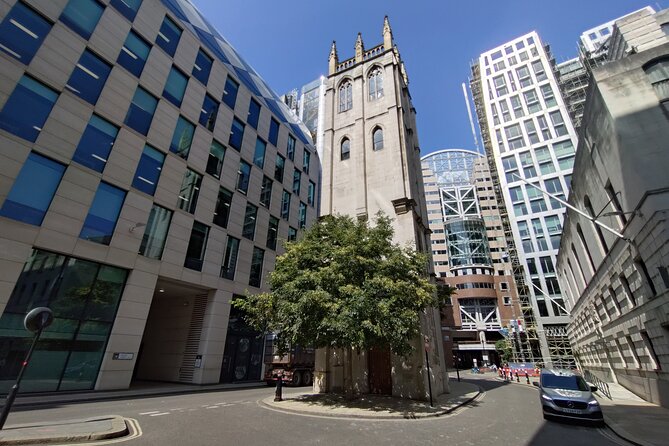
At St. Alban Wood Street, the surviving tower of St. Alban’s provides one of the route’s most striking visual moments. It was built by Sir Christopher Wren and now sits among modern architecture linked with Norman Foster, Lord Rogers, and Terry Farrell.
The point is not simply to admire a church tower. It is to notice how different periods share the same small patch of city. Wren’s work gives you a link to London’s rebuilding after the Great Fire, while the surrounding buildings show the much newer face of the financial district.
This stop also rewards a slow look upward. The tower is only one surviving piece, but it has more impact because it is surrounded by glass, steel, and sharply modern lines. I like this kind of comparison because it does not treat old London as a museum piece. The past is still sitting beside offices and daily city life.
Again, the visit takes around five minutes. That is enough for the main story and the view, but not enough for a detailed architectural study. If you enjoy architecture, bring your own interest and use the guide’s explanation as a starting point.
Noble Street and Roman ruins revealed by bombing
Noble Street offers another brief but memorable stop. Roman ruins were found here after bombing during the Second World War destroyed much of the surrounding area.
The story links two kinds of disruption: the destruction of wartime London and the older remains revealed underneath it. That makes the site more than an isolated Roman feature. It shows how modern disaster sometimes exposes earlier chapters of the city.
You will not spend a long time examining a large archaeological complex. This is a short outdoor visit, so the guide’s account matters more than the size of the ruins. I would treat Noble Street as a lesson in what can survive beneath a city that has been damaged, rebuilt, and altered many times.
It is also one of the places where the walk does something useful for first-time visitors. You do not need to know the City’s street plan in advance. Vivienne explains what you are seeing and why it matters, then keeps the route moving.
A few more history tours around London worth a look
- London Small Group Tour of Historical Pubs
★ 5.0 · 10,422 reviews - Soho Music & Historic Pubs Tour
★ 5.0 · 1,993 reviews - London: Historic Pubs of Central London Walking Tour
★ 4.9 · 1,065 reviews - London: Soho Music and Historic Pubs Walking Tour
★ 4.9 · 836 reviews
Postman’s Park and the Watts memorial
Postman’s Park is one of the more unusual stops. Here, you spend time with the Watts memorial, which honors people who gave their lives while helping others.
The park itself offers a change of mood after the walls, ruins, and architectural comparisons. Its memorial tells personal stories rather than focusing only on kings, generals, churches, or major disasters. That gives the walk a human scale.
I particularly like the inclusion of this park because it shows that London’s history is not only written in grand buildings. A small public space can preserve stories of courage and sacrifice, and the guide discusses both the memorial and the park’s background.
The planned stop lasts about five minutes, though the subject could easily hold your attention longer. If you prefer tours with personal stories and unusual details, this may be one of the most rewarding parts of the route.
Old Bailey and the garden inside a ruined church
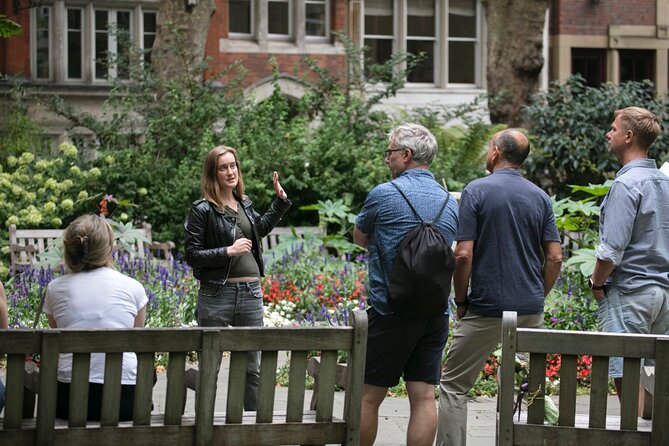
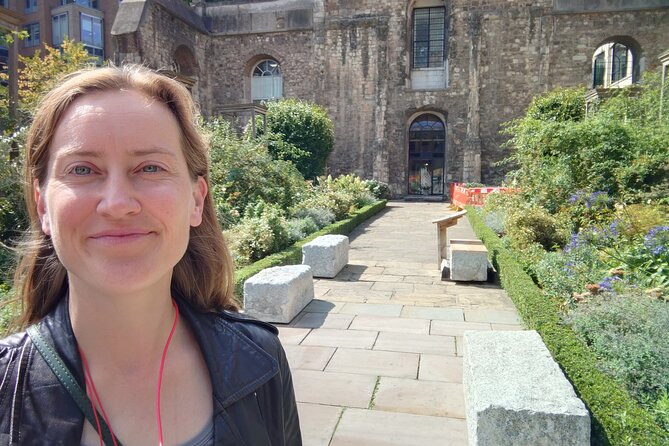
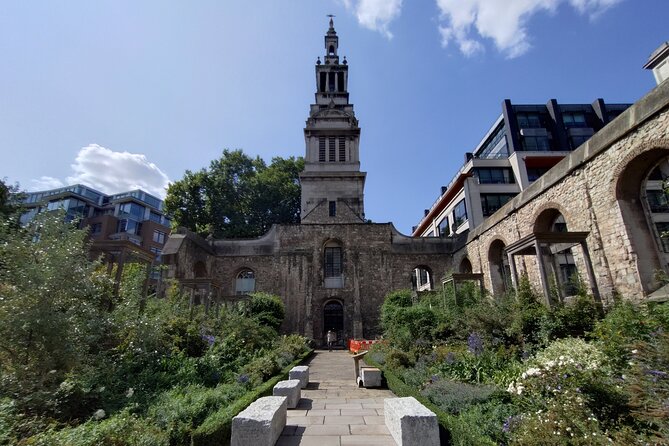
The walk then reaches the Old Bailey area, where you visit a garden within the shell of Christchurch. The church was another victim of Second World War bombing, and the guide discusses the nearby Old Bailey as part of the stop.
This section brings together law, war, religion, and urban change. The Old Bailey is one of Britain’s best-known courts, while the church shell shows the physical cost of wartime destruction. The garden gives the remains a quieter setting than you might expect beside such an important civic building.
The stop is brief, around five minutes, so do not expect to enter a working court or receive a detailed legal history. Instead, you get a concise explanation of how the court and church fit into the story of this part of London.
For me, the value comes from the pairing. You see how civic power and religious buildings once shaped the area, then how war left gaps that were given new uses. It is a compact stop, but it adds depth to the route.
Smithfield Market and a thousand years of London life
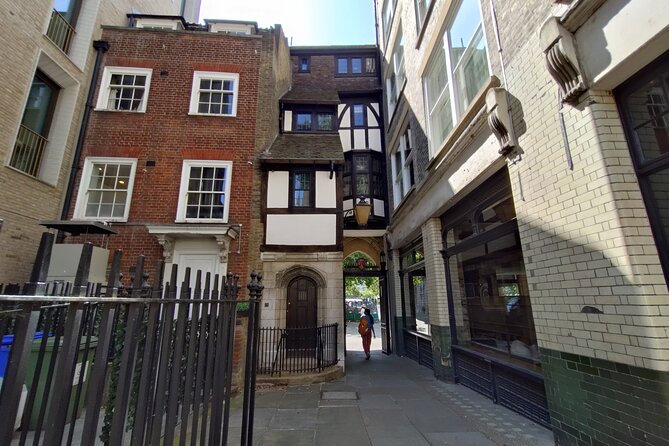
Smithfield Market brings the walk into one of London’s oldest working areas. The meat market has around 1,000 years of history, and the guide discusses the events connected with it that helped shape British history.
This is the point where the tour moves from ruins and memorials into a place linked with trade, food, public life, and major events. Markets reveal a different side of a city. They show where people worked, bought goods, gathered, and sometimes witnessed moments that later became part of national history.
The stop is listed at about five minutes, so the guide must select the key points rather than tell the market’s entire story. That is a fair trade for a two-hour route, though anyone especially interested in Smithfield may want more time in the area afterward.
I would pay attention to the setting as much as the facts. Smithfield helps explain why this part of London mattered for so long. It was not simply a backdrop for famous buildings. It was a place tied to the practical business of feeding and organizing a city.
St. Bartholomew the Great, the fitting finale
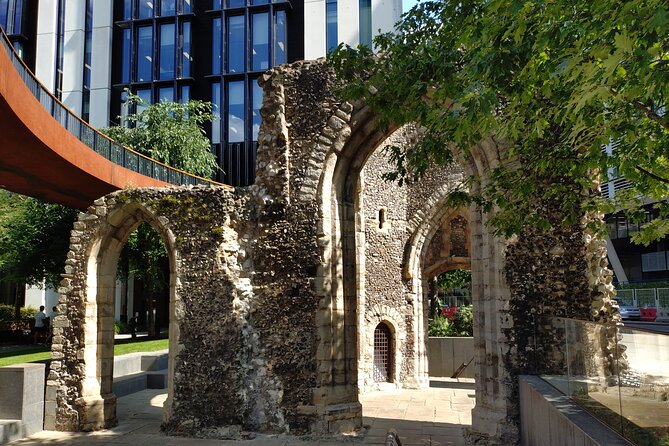
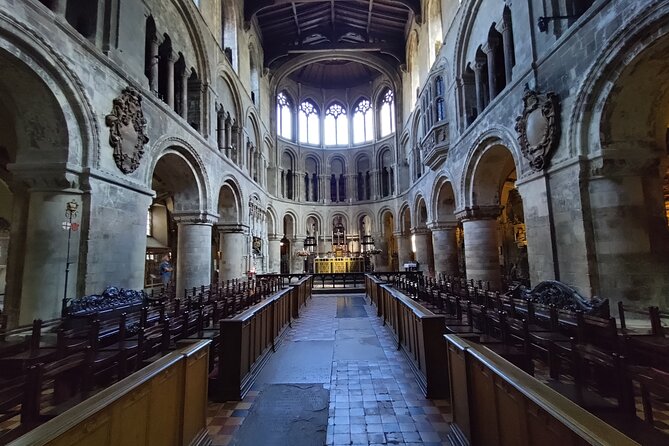
The final stop is St. Bartholomew the Great, and the tour gives it about 20 minutes, much longer than the earlier visits. That extra time makes sense. This is a 900-year-old church, and you hear about its exterior before going inside.
The church provides the strongest finish because it gathers many of the tour’s themes in one place: medieval London, religious life, survival, architecture, and the changes brought by time. After seeing fragments and towers, you get to enter a historic building with a fuller sense of its past.
I would save some attention for the transition from outside to inside. The guide’s explanation helps you understand the building before you walk through its doors, rather than treating the interior as a quick photo stop.
The final visit also gives the walk a satisfying shape. You begin with Roman and medieval remains in the open air, pass through parks and modern streets, and finish in one of the City’s oldest churches. If you want a single memorable interior on this route, this is it.
Vivienne’s storytelling is a major part of the value
The guide can make or break a history walk, and Vivienne appears to be a major strength here. She keeps the story moving, answers questions, and has sometimes added extra stops beyond the planned route.
One couple who had lived in London for seven years found that she showed them places they had already passed without understanding. That is a useful clue about the tour’s appeal. You do not need to be new to London to learn from it.
Another couple, visiting with a 10-month-old baby in a pram, appreciated the care taken with accessible routes. The pace was also described as comfortable. Those details matter because a two-hour city walk can become tiring if the route is rushed or difficult to navigate.
The group limit is 25 people. That is not a private tour, but it is small enough to remain more personal than a large sightseeing procession. You should still expect to share the guide’s attention, especially if the group reaches the maximum.
Who should book it, and who may want something else
I would choose this experience if you enjoy local history, old churches, Roman London, or the small clues that explain why a street looks the way it does. It also suits repeat visitors who have already seen the Tower of London, Westminster, and the major museums but want a less familiar route.
Families may find the accessible route and two-hour length useful, especially with a stroller. Wheelchair users should also find the tour suitable according to the stated accessibility information. Service animals are allowed, and the meeting point is close to public transportation.
The tour is less suitable if you want long visits at every site, extensive museum time, or a quiet private walk. Most stops last about five minutes, and the route covers a lot of ground. You need to be comfortable listening outdoors and moving on before you have examined every detail.
The 11:00 a.m. start is practical for a morning or early afternoon plan. You finish near Smithfield, which makes it easy to continue exploring that part of London, though no onward activities are included in the experience itself.
Price, booking, and cancellation advice
At $27.46 per person, the cost is reasonable for a guided two-hour walk with a maximum group of 25. The stops do not charge admission, so the price is paying for interpretation, route planning, and Vivienne’s storytelling rather than entry tickets.
The experience is usually booked about nine days ahead. That does not mean you must reserve that early, but it is a useful sign to plan ahead if your London dates are fixed.
You receive confirmation at booking, and free cancellation is available up to 24 hours before the start time for a full refund. Changes or cancellations made less than 24 hours before the start are not accepted for a refund. If the minimum group size is not reached and the experience is canceled, you are offered another date or experience, or a full refund.
Should you book Ancient Hidden Gems in the City of London?
Yes, if you want London’s past explained through overlooked streets, fragments, churches, parks, and public spaces. The strongest reasons to book are Vivienne’s storytelling, the accessible pace, the contrast between Roman remains and modern architecture, and the final visit to St. Bartholomew the Great.
I would not book it expecting a grand sightseeing tour with long interior visits. Book it because you want to notice more. After two hours, streets that once looked ordinary may carry a Roman, medieval, wartime, or personal story.
FAQ
How long is the City of London walking tour?
The experience lasts approximately two hours.
What time does the tour begin?
The tour begins at 11:00 a.m.
Where does the tour start?
It starts at 101 Moorgate, London EC2Y 9AA, United Kingdom.
Where does the tour end?
It ends at St. Bartholomew the Great, West Smithfield, Barbican, London EC1A 9DS, United Kingdom.
Is the tour wheelchair and stroller accessible?
Yes. The tour is listed as wheelchair and stroller accessible. Service animals are also allowed.
How many people can join the tour?
The maximum group size is 25 people.
Can I cancel for a full refund?
Yes. You can cancel at least 24 hours before the experience start time for a full refund. Cancellations or changes made less than 24 hours before the start are not accepted for a refund.
Just added around London
- The History of London City Center Tour Semi-Private 12ppl Max★ 5.0 · 30 reviews
- Historic London Pub Tour★ 5.0 · 22 reviews
- Historic London Pubs Private Walking Tour With Free Drinks!★ 5.0 · 41 reviews
- Best of London Tour – Crown Jewels, River Cruise & History Walk★ 4.5 · 110 reviews
- Devour London Historical Pub Tour:Traditional British Food & Ales★ 5.0 · 63 reviews
- City of London Historic Walking Tour (With Rooftop Visit*)★ 5.0 · 26 reviews
- Historical Tour in Death, Debauchery and Doctors in Soho London★ 5.0 · 17 reviews
- Private British Food and History Tour at London’s Borough Market★ 5.0 · 19 reviews
Ancient History Tours, compared.

Colosseum: Underground and Ancient Rome Tour
Read our review →
Colosseum & Ancient Rome with Arena Floor Option I Max 6 People
Read our review →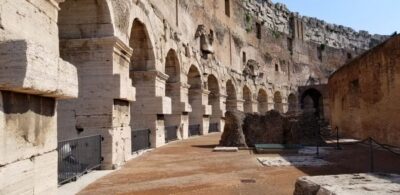
Colosseum, Ancient Rome Tour or AudioGuided Tour
Read our review →
Colosseum Underground & Ancient Rome Guided Tour
Read our review →
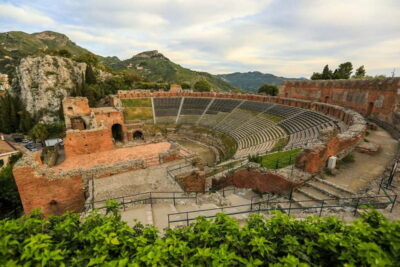
Taormina: Ancient Theater Skip-the-Line Ticket & Audio Guide
Read our review →
Discover the Ancient Ruins of Pompeii: Day Trip from Rome
Read our review →
Discover Matera, the ancient city – English tour
Read our review →Browse the lists this tour appears in