
Review · ROME
Celebrate Ancient Jubilee in Rome in the 4 Papal Basilicas
Four basilicas, one ambitious morning. This five-hour Rome tour links the city’s four papal churches during the 2025 Jubilee, taking you through each Holy Door with an expert Catholic guide and air-conditioned vehicle. I like the focus: you are not simply ticking off famous churches, but following a pilgrimage route tied to St. Peter, St. Paul, Rome’s cathedral, and devotion to Mary.
I also like the small-group design, capped at 12 people, with a private guide and vehicle available. Guides Paul and Daniel receive especially warm praise for their clear explanations and ability to answer questions. The main catch is the pace. Four basilicas in about five hours means plenty of walking, limited free time, and a demanding day for anyone with mobility concerns.
Key things to know before booking
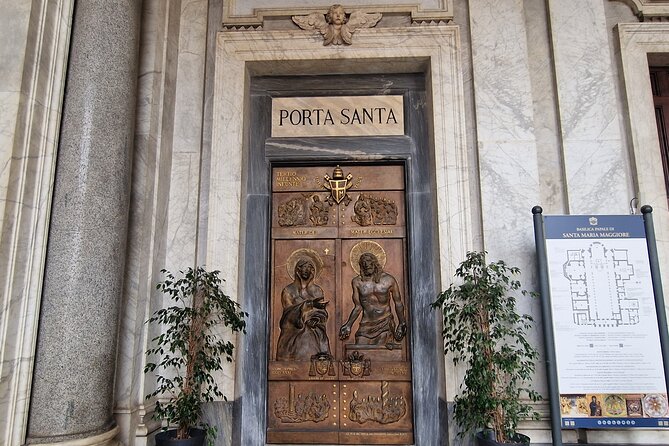
- Four Holy Doors in one outing: Visit St. Peter’s, St. Paul Outside the Walls, St. John Lateran, and St. Mary Major.
- Paul and Daniel are strong guide choices: Paul is praised for linking Catholic teaching with Roman history, while Daniel is known for careful explanations of the Jubilee pilgrimage.
- Small groups matter here: A maximum of 12 people makes it easier to ask questions and adjust the emphasis.
- The route covers major relics: See Michelangelo’s Pietà, St. Paul’s chains, the heads of Saints Peter and Paul, and relics associated with the Nativity.
- Expect a brisk schedule: Each basilica receives about an hour, with driving and walking between stops.
- Plan for mobility limits: The experience is not recommended for people with mobility difficulties, though a wheelchair can be transported if arranged ahead of time.
Why these four basilicas matter during the Jubilee
The appeal of this tour is its clear religious purpose. Rome has many churches, but these four are the papal basilicas, the principal churches connected with the pope and the Catholic Church. During the 2025 Jubilee, each has a Holy Door opened for pilgrims.
That gives the day a stronger shape than a standard church tour. You move from the tomb of St. Peter to the burial place of St. Paul, then to Rome’s cathedral and one of the city’s most important Marian churches. I find that sequence useful because it turns a long list of art and relics into a story.
The experience is also a practical choice if you want to visit all four doors without sorting out the route yourself. The basilicas are spread across Rome. St. Peter’s is in the Vatican area, St. Paul’s is outside the old city center, St. John Lateran is southeast of the historic center, and St. Mary Major is near Termini. Having a vehicle connect the stops saves time and avoids a day of piecing together buses, taxis, and directions.
Still, you should set realistic expectations. The tour lasts about five hours, not a full day. Since each stop is allotted roughly one hour, you will receive an introduction and guided visit rather than an unhurried study of every chapel, tomb, and mosaic.
More Ancient History Tours in Italy
- Colosseum: Underground and Ancient Rome Tour
★ 4.7 · 12,691 reviews - Colosseum & Ancient Rome with Arena Floor Option I Max 6 People
★ 5.0 · 3,306 reviews - Rome: Colosseum, Ancient Rome Tour or AudioGuided Tour
★ 4.4 · 2,879 reviews
St. Peter’s Basilica and Michelangelo’s Pietà
The tour begins at Fontana di Piazza Giovanni XXIII, along Lungotevere Vaticano, near the Vatican. From there, you enter St. Peter’s Basilica, built over the place associated with the burial of St. Peter.
This first stop carries the greatest name recognition, but it is not just a grand opening act. Your guide explains the interior, the major altars, important relics, and the role of the high altar above St. Peter’s burial place. For a Catholic pilgrim, that connection gives the visit its central meaning.
Michelangelo’s Pietà is another major highlight. It is easy to see the sculpture as a famous work of art and move on. A good guide helps place it within the larger setting of the basilica, where art, worship, burial, and church power all meet. The tour description specifically calls out the Pietà, so art lovers should expect it to receive attention.
You are given about an hour here. That is enough for a guided overview, but it can feel short inside such a large basilica. If St. Peter’s is your main priority, you may wish for more time to look around independently. The benefit is that the schedule keeps the whole Jubilee route moving.
St. Paul Outside the Walls and the apostle’s chains
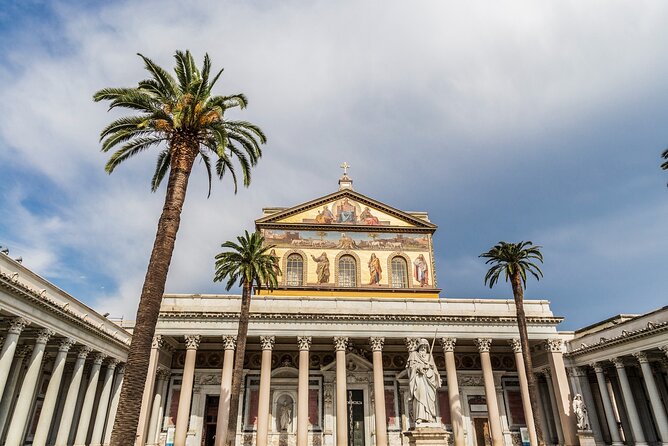
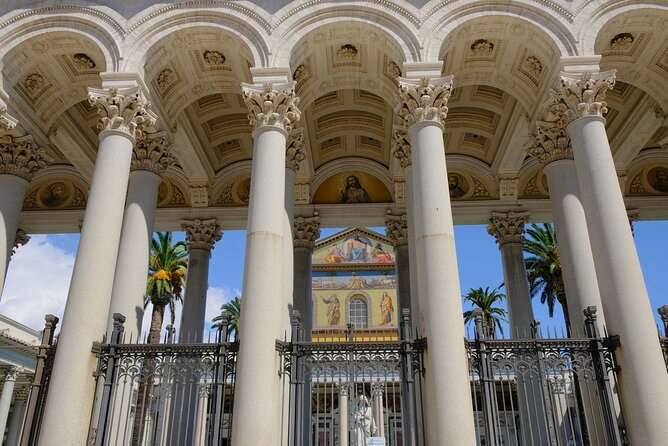
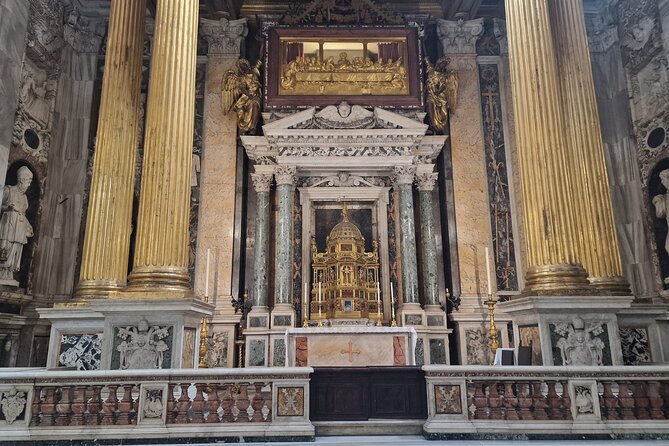
The second stop is Basilica Papale di San Paolo Fuori le Mura, known in English as St. Paul Outside the Walls. It is dedicated to St. Paul, whose remains are associated with the basilica.
This church gives the tour a different mood from St. Peter’s. The focus shifts from the first pope to the Apostle of the Gentiles, and the guide highlights the chains said to have bound Paul during his imprisonment and house arrest in Rome. You will also see his recently excavated sarcophagus.
Those details make this stop especially valuable if you want the pilgrimage to feel personal rather than purely architectural. St. Paul’s chains are a tangible link to the story being told. The sarcophagus adds another layer, connecting the church’s present-day worship with its ancient purpose.
You then receive a guided look at the wider basilica, described as an ancient Theodosian church. As at St. Peter’s, the one-hour schedule gives you a focused visit rather than a slow exploration. I would pay close attention to the guide here, since the meaning of the chains and sarcophagus can be easy to miss if you are only looking at the building.
St. John Lateran, Rome’s actual cathedral
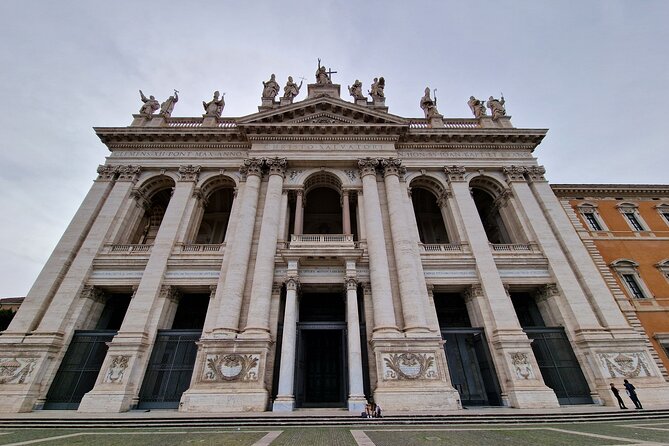
The third stop is the Arch-Basilica of St. John Lateran, or San Giovanni in Laterano. This is Rome’s cathedral, a point that can surprise people who assume St. Peter’s holds that title.
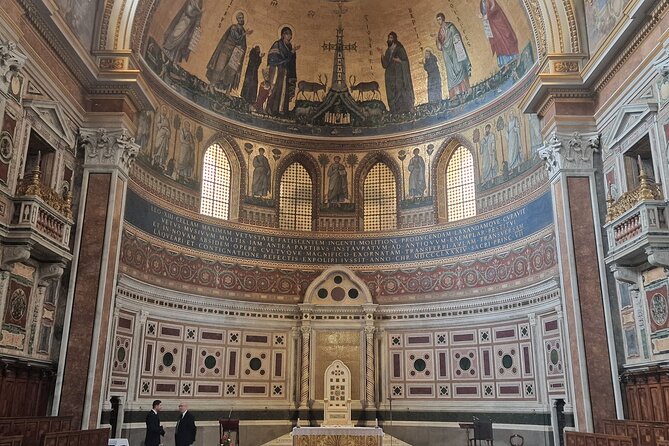
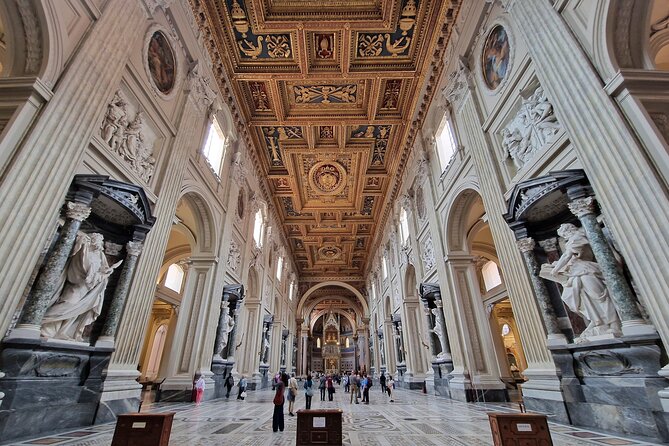
The guide explains the church’s interior and its history, including the ancient mosaics. The visit also includes the heads of Saints Peter and Paul, placed above the altar in the year 1300. That is one of the tour’s most striking connections: the two principal apostles are brought together in Rome’s cathedral.
This stop is a good example of why a guide adds value. Without context, a visitor may see a grand altar and beautiful mosaic work but miss the importance of the basilica’s role as the cathedral of Rome. Paul has been praised for explaining both Catholic teaching and Roman history in plain language, and this church is where those two subjects meet particularly well.
The pace remains brisk. You have about an hour, and the tour still has one more basilica ahead. If your interest leans heavily toward architecture, you may want to spend more time here than the schedule allows. If your goal is to complete the Jubilee pilgrimage, the timed visit keeps the larger plan intact.
More Ancient History Tours in Rome
- Colosseum Underground & Ancient Rome Guided Tour
★ 4.5 · 2,590 reviews - Pantheon Elite Guided Tour – Rome’s Iconic Ancient Temple
★ 5.0 · 1,447 reviews - Ancient Rome: Colosseum Underground Group Tour
★ 4.5 · 1,059 reviews - Colosseum Express Guided Tour and Ancient Rome Admission Included
★ 4.0 · 1,008 reviews
St. Mary Major and the final Holy Door
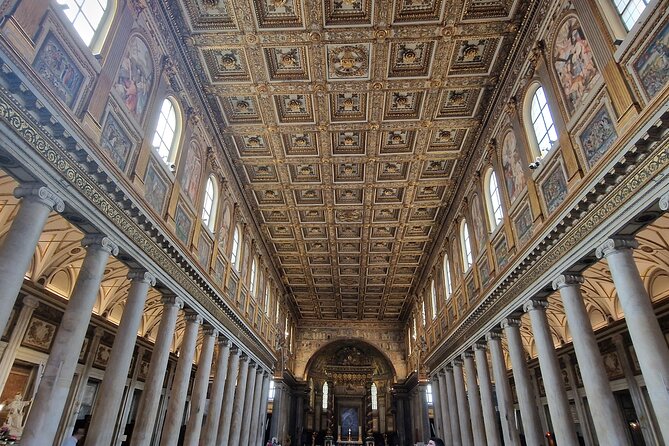
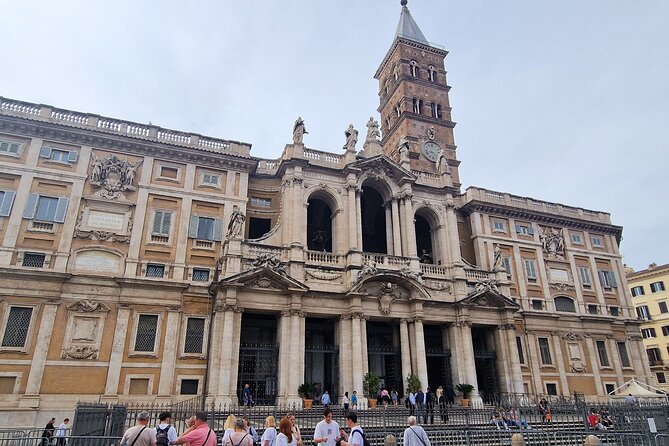
The final stop is the Papal Basilica of Saint Mary Major, one of Rome’s most important churches dedicated to Mary. The tour ends in the piazza in front of the basilica, which makes this a useful final point for continuing your day in Rome.
Inside, the focus turns to the church’s golden interior, the popes buried there, relics associated with the crib of Christ, and the Marian icon Salus Populi Romani. These features give the last stop a distinct character. The day begins with St. Peter and moves through St. Paul and Rome’s cathedral before ending with a major center of Marian devotion.
I like this as the closing church because it brings together art, relics, and living religious practice. The Holy Door is the central Jubilee reason for coming, but the basilica offers more than a doorway to pass through. Your guide helps explain why the church matters and points out details you might otherwise walk past.
Allow yourself a little mental space here. Four churches in one morning can leave you full of names, dates, and sacred objects. The final stop may be the point where the whole route begins to make sense, especially if the guide has kept the pilgrimage theme in view.
What the guide adds to the day
Guide quality matters more on this tour than on a simple sightseeing transfer. The basilicas are large, layered places. Without explanation, you may notice marble, mosaics, paintings, chapels, and tombs without understanding how they fit together.
Paul is repeatedly praised for answering questions with confidence and explaining Catholicism and the Roman Empire in a way that laypeople can follow. He also makes time for photographs and souvenirs, which matters on a tightly scheduled visit. Daniel receives similar praise for his command of the Jubilee process and for tailoring the discussion to the group’s interests.
That last point is important. A small group makes it easier to ask about the Holy Doors, relics, art, or church history instead of listening to a fixed speech from a distance. One person found the emphasis more artistic than expected and wanted more detail about the Jubilee itself. If the spiritual side is your main reason for booking, say so clearly at the start and ask your guide to keep the Holy Door ritual and pilgrimage meaning central.
The group limit is 12 people. That is small enough for conversation but not necessarily intimate in every departure. A private guide and vehicle offer more control, though the supplied price of $300.38 per person may need to be weighed against your group’s size and budget.
Is $300.38 a fair price?
At $300.38 per person, this is not a bargain church walk. You are paying for an expert guide, an air-conditioned vehicle, and the convenience of connecting four distant basilicas in one planned outing. Admission to St. Peter’s is included, and the churches themselves are listed with no separate admission charge.
The value depends on what you would otherwise do. If you are comfortable arranging transport and reading up on the basilicas yourself, you could spend less. You would also need to manage the route, watch the time, and work out how to visit all four Holy Doors in one day.
I see the price as easier to justify for a first-time Rome visitor, a Catholic pilgrim, or anyone with limited time who wants the whole Jubilee route handled by someone else. It is less appealing if you prefer long, quiet visits or want to study the art at your own pace.
Food and drinks are not included, so plan to eat before or after the tour. The experience ends at St. Mary Major rather than returning you to the Vatican, which can be useful if you are continuing toward Termini or central Rome, but you should plan your next move accordingly.
Timing, meeting point, and walking demands
The meeting point is at Fontana di Piazza Giovanni XXIII, Lungotevere Vaticano, 00193 Rome. The guide is supposed to be identifiable by an orange flag. One group had trouble finding the guide and needed to call the operator, so I would arrive early, keep the operator’s contact details available, and look carefully for that flag.
The vehicle is air-conditioned, a welcome feature when Rome is warm. It also helps with the long jumps between basilicas. But this is not a seated sightseeing tour. You will get in and out of the vehicle, walk through large churches, and spend much of the five hours on your feet.
The experience is not recommended for people with mobility difficulties. If someone in your party uses a wheelchair, contact the operator before the tour. The vehicle can accommodate one when arranged in advance, but the amount of walking inside and around the basilicas still needs careful thought.
The average booking window is 61 days ahead, which suggests that planning early is sensible during the Jubilee year. Confirmation is provided at booking, and cancellation is free up to 24 hours before the start time. Changes or cancellations inside that 24-hour window are not accepted for a refund.
Who will enjoy this pilgrimage most?
I would choose this tour if you:
- Want to visit all four papal basilicas during the 2025 Jubilee
- Care about the religious meaning of the Holy Doors
- Prefer a guide who can explain relics, Catholic tradition, and Roman history
- Value air-conditioned transport between widely separated churches
- Like the idea of a group capped at 12 people
- Have only one morning or afternoon available for the route
I would hesitate if you want a slow art tour, have trouble walking, or prefer to spend several hours in one basilica. The schedule is efficient, but efficiency comes with limits.
Should you book it?
Book this experience if completing the four Holy Doors is the heart of your Rome visit. The route is ambitious, the transport removes much of the logistical work, and guides such as Paul and Daniel can give the churches meaning beyond their impressive interiors.
Before booking, confirm your mobility needs and decide how much Jubilee information you want from the guide. If you are seeking a focused Catholic pilgrimage with strong historical context, the price can make sense. If you want leisurely photography and long stretches of quiet exploration, visit fewer churches on your own instead.
FAQ
How long does the tour last?
The tour lasts approximately five hours.
Which basilicas are included?
The tour visits St. Peter’s Basilica, St. Paul Outside the Walls, St. John Lateran, and St. Mary Major.
Does the tour include all four Holy Doors?
Yes. The experience is designed around visiting the four Holy Doors opened for the 2025 Rome Jubilee.
What is the group size?
The group has a maximum of 12 people. A private guide and vehicle option is also available.
Is transportation included?
Yes. An air-conditioned vehicle is included.
Is food included?
No. Food and drinks are not included.
Where does the tour begin?
It begins at Fontana di Piazza Giovanni XXIII, Lungotevere Vaticano, 00193 Rome.
Where does the tour end?
It ends in the piazza in front of St. Mary Major at Piazza di Santa Maria Maggiore.
Is the tour suitable for people with mobility difficulties?
The tour is not recommended for people with mobility difficulties because it involves walking between and inside the basilicas. A wheelchair can be transported in the vehicle if you arrange it in advance.
Just added around Rome
- Colosseum & Ancient Rome Access with a Host★ 4.0 · 68 reviews
- Colosseum & Ancient Rome for Kids Private Family Tour★ 5.0 · 190 reviews
- Colosseum Gladiator’s Arena and Ancient Rome VIP Guided Tour★ 4.0 · 214 reviews
- Colosseum Underground All Access Tour with Ancient Rome★ 4.0 · 40 reviews
- Colosseum and Ancient Rome Guided Tour★ 4.0 · 20 reviews
- ROME:Colosseum & Ancient Rome – private/small group TOUR★ 5.0 · 24 reviews
- Colosseum Exclusive Semi-Private Tour & Ancient Rome Exploration★ 4.5 · 19 reviews
- Colosseum Guided Tour and Ancient Rome★ 4.5 · 32 reviews
Ancient History Tours, compared.
Colosseum: Underground and Ancient Rome Tour
Read our review →
Colosseum & Ancient Rome with Arena Floor Option I Max 6 People
Read our review →
Colosseum, Ancient Rome Tour or AudioGuided Tour
Read our review →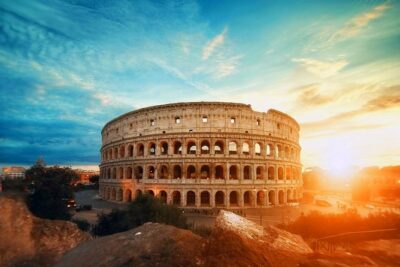
Colosseum Underground & Ancient Rome Guided Tour
Read our review →
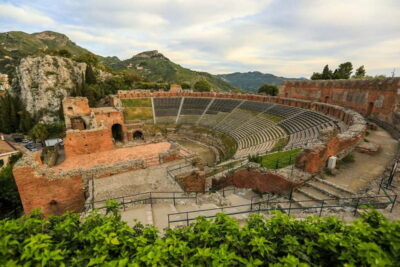
Taormina: Ancient Theater Skip-the-Line Ticket & Audio Guide
Read our review →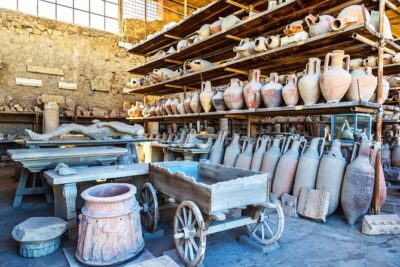
Discover the Ancient Ruins of Pompeii: Day Trip from Rome
Read our review →
Discover Matera, the ancient city – English tour
Read our review →Browse the lists this tour appears in