
Review · DETROIT
Self Guided Detroit’s Spirit and History Solo Walking Tour
Detroit rewards a closer look. This self-guided audio walk links public art, grand skyscrapers, and the city’s long comeback story in about an hour. I like the freedom to pause for pizza, coffee, drinks, or a closer look, and I like that the WalknTours app lets you move through downtown without keeping up with a group. The main drawback is simple: you must use your own phone, download the app, and create an account before you begin.
At $9.75 per person, this is an easy way to get your bearings without spending much. You’ll hear about Detroit’s highs and lows while walking from Buddy’s Pizza near the Madison Building to Hart Plaza, but the tour works best for visitors who enjoy exploring independently and do not need a live guide beside them.
Key points at a glance

- Seven downtown stops in about 45 minutes to one hour: The route covers Parker’s Alley, The Belt, Campus Martius Park, the Penobscot Building, the Guardian Building, the Spirit of Detroit, and the Joe Louis Monument.
- Pause and restart whenever you like: You can stop for food, drinks, shopping, photos, or a longer look at a building, then continue from the same point.
- Detroit’s comeback is part of the story: Campus Martius shows how a neglected area became a popular public square.
- Art Deco architecture gets proper attention: The Guardian Building and Penobscot Building give the walk plenty of visual weight.
- A strong price for a private experience: There is no group to follow, and only one tour is needed per group according to the tour details.
- Plan for app setup: The tour is not led in person, and the WalknTours app is separate from the booking platform.
Starting near Buddy’s Pizza and the Madison Building

The tour begins at Buddy’s Pizza, at the Madison Building on Broadway Street. That is a useful starting point because you can eat before setting off, or save pizza for the end if your appetite needs a little encouragement.
The route is designed for downtown orientation rather than a long city trek. The advertised time is 45 minutes to one hour, though you may spend longer if you stop for photos, go inside buildings, browse nearby shops, or pause for a meal. One of the best features is the ability to stop the narration without losing your place.
You’ll follow directions and listen through the WalknTours app. The route is private in the practical sense that only your group participates. You will not be waiting for late arrivals, trying to hear a guide over street noise, or wondering if the group has already moved to the next stop.
The tradeoff is that the app matters. You need a smartphone and enough comfort with downloading and opening an app. The WalknTours app requires its own registration, and it is not connected automatically to the account used for booking. Set it up before you reach the starting point. That small bit of preparation can prevent a frustrating first few minutes.
More History Walking Tours in the USA
- History and Hauntings of Salem Guided Walking Tour
★ 5.0 · 14,564 reviews - Boston: Freedom Trail History Small Group Walking Tour
★ 5.0 · 6,450 reviews - Historic Charleston Guided Sightseeing Walking Tour
★ 5.0 · 6,216 reviews
Parker’s Alley and the story of Thomas Parker
The first stop is Parker Street, better known here as Parker’s Alley. It is a short stop, listed at about three minutes, but it gives the tour an important human scale.
The alley is named for Thomas Parker, a free Black man who was one of Detroit’s first Black landowners. That detail helps move the city’s story beyond buildings and corporate names. You begin with a person who claimed a place in Detroit’s early history, not just with a date or architectural label.
The brick paving gives the alley a distinct feel, and the small setting is a nice contrast with the tall buildings that come later. You may want to pause the narration here and look carefully rather than treating it as a quick checkpoint.
This is also a good example of the tour’s approach. It does not attempt to tell every chapter of Detroit’s past. Instead, it uses several compact stops to show how race, industry, public space, art, and civic identity connect across downtown.
The Belt, public art in a former garment district
Next comes The Belt, an alley named for its location in the former garment district, whose shape suggested a belt. The space is part of an effort by the Library Street Collective to rethink underused parts of the city.
The stop lasts about three minutes, but you should give yourself extra time if you enjoy public art. The Belt is the sort of place you might miss while walking from one major attraction to another. That makes it useful on a self-guided route, since the app points you toward a smaller space you may not have selected on your own.
The value here is not only the art. The setting shows how an old service alley can be given a new public purpose. Detroit’s story is often told through factories, abandoned buildings, and financial setbacks. The Belt offers a more current chapter, one focused on creative reuse.
You can take photos, pause the audio, and look around without blocking a group. If public art is one of your main reasons for taking the walk, plan to spend more than the listed three minutes.
Campus Martius Park and Detroit’s public comeback
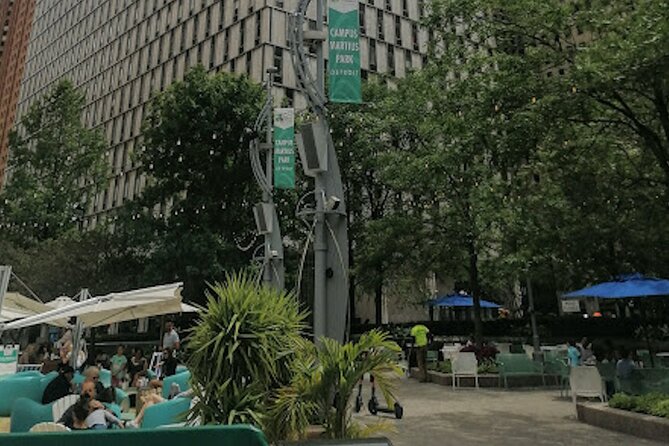
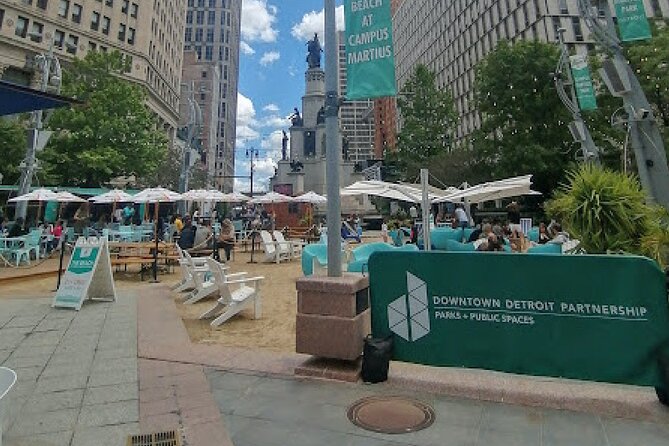
Campus Martius Park is the route’s clearest example of change in downtown Detroit. Created in 2004, it became a central gathering place and was named one of the top 10 public squares in the United States by USA Today.
The tour connects the park’s current role with its recent past. Two decades earlier, few people felt comfortable walking into this part of the city. Now it functions as a major hangout and a setting for seasonal activity, shops, and stops along the route.
This is where the audio format works particularly well. You can listen while taking in the park, then stop the narration if you want to sit for a while. Some people have used the pause function to visit Christmas shops, find food, or simply linger before continuing.
Campus Martius is also a natural place to judge your own walking pace. If you have limited time, keep moving after the narration. If you are using the tour as an easy introduction to Detroit, give the park a little breathing room. Its importance is not just visual. It shows how public space can influence how a city feels and functions.
One caution: a public square can be noisy or uncomfortable at certain times. The audio may be clear through your phone, but surrounding activity can affect how relaxing the stop feels.
More Self-Guided History Audio Tours in the USA:
- Salida History Audio Tour l A Self-Guided Wild West Experience
★ 5.0 · 41 reviews - Historic Bar Harbor Self-Guided Walking Audio Tour Guide
★ 4.5 · 38 reviews - Historic Dallas Downtown Solo Self Guided Walking Tour
★ 4.5 · 32 reviews - Baltimore Walking & Driving Self-Guided Audio Tour
★ 3.5 · 30 reviews
The Penobscot Building and Detroit’s high-rise era
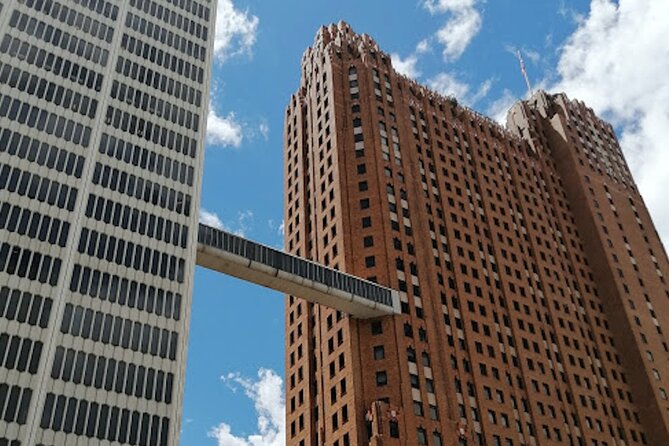
The Penobscot Building brings you into Detroit’s skyscraper story. Completed in 1928, it was the fourth-highest building in the United States and the eighth-highest in the world at the time.
Look upward. The building rises with a series of setbacks, giving it the appearance of a cliff edge above the street. That shape is easier to appreciate from below than from a photograph, so this is a stop where you should take a moment before pressing ahead.
The tour uses the building to explain Detroit during an era of confidence and rapid growth. You are not simply looking at an old office tower. You are seeing evidence of a city that once had the money, industry, and ambition to compete on a global architectural scale.
The stop is scheduled for about three minutes. That is enough for the basic explanation, but not necessarily enough if you want to study the details. The route does not require you to rush, so keep the audio paused while you examine the upper floors.
The Guardian Building and the Cathedral of Finance
The Guardian Building is one of the most rewarding stops on the walk. Finished in 1929, it was first called the Union Trust Building and earned the nickname Cathedral of Finance.
The name is fitting. The building is celebrated as one of the finest Art Deco skyscrapers in the United States, and its interior is a favorite part of the experience for many people who take this route. If the doors are open, make time to look inside rather than treating the building as an exterior photo stop.
This is one of the places where the tour can change your plans. You may arrive expecting a short audio stop and end up lingering over the decoration. I would not schedule a tight appointment immediately after the walk, especially if architecture interests you.
A small inconsistency appears in the available comments about the route: one person wished the Guardian Building had been included, while the stated stop list does include it. The practical lesson is to check the current route in the app before setting out. In any case, the Guardian Building is clearly an important sight to look for.
The Spirit of Detroit and a citywide symbol
The Spirit of Detroit is one of the city’s best-known public symbols. The sculpture shows a seated figure holding a sphere in one hand and human figures in the other.
The audio explains the symbolism: the sun-like sphere represents rays coming from God, while the figures represent human relationships. The Spirit’s image appears throughout Detroit, so seeing the sculpture in person gives context to a symbol you may encounter again on signs, souvenirs, and public displays.
The stop takes about five minutes, giving you time to listen and examine the statue. I like this kind of pause because it connects a physical object with the wider identity of the city. It is not just a monument to a person or event. It is meant to represent Detroit itself.
You’ll also notice how the route shifts from architecture and urban renewal to civic imagery. That variety keeps the walk from becoming a parade of building facts.
The Joe Louis Monument and the meaning behind the boxer
The Joe Louis Monument offers one of the tour’s strongest historical moments. Joe Louis was famous for boxing, but the narration focuses on his fight against segregation and Jim Crow laws as well.
He encouraged young African American men to join the United States Army during World War II, even though the army remained racially segregated. His response when asked why he supported the effort is remembered for its blunt clarity: America had many problems, but Hitler would not solve them.
The monument therefore represents more than athletic fame. It opens a conversation about race, patriotism, military service, and the limits of American equality during the war years.
The stop lasts about three minutes, but you may want to pause and read the sculpture in your own way. This is a compact conclusion to the historical portion of the walk, linking one person’s public reputation with larger national struggles.
Ending at Hart Plaza by the Detroit River
The route ends at Hart Plaza, at 1 Hart Plaza. The plaza opened in 1975 and has hosted festivals and special events ever since.
A large ring called Transcending honors the working men and women who built the city. It gives the walk a fitting endpoint because many of the earlier stops point back to labor, industry, construction, and civic effort.
Hart Plaza is open from midnight to 11:30 p.m. daily during the stated operating period, so you have flexibility about when to finish. The late listed closing time also makes it possible to take the walk at a relaxed pace, though you should still account for weather and your own comfort.
The ending does not return you to Buddy’s Pizza. You finish at Hart Plaza, so consider where you want to go next. This is helpful if you plan to continue exploring downtown, but you should know the route is point-to-point rather than a loop.
Why the audio format works well
The strongest feature is control. You can pause at every stop, replay material you missed, or take a break for lunch and continue later. That freedom is especially useful for families, couples, solo visitors, and anyone who dislikes keeping up with a scheduled group.
The directions are designed to be easy to follow, and the route moves in a logical order. That matters more than it may sound. A self-guided walk becomes tiring when you are constantly checking a map, guessing which turn is correct, or doubling back.
The app also offers a virtual walk you can take after the in-person route. That gives you a way to revisit the material later, although the most useful part of the experience is still being downtown and seeing the buildings and monuments directly.
The limits are just as clear. There is no person to answer follow-up questions, adjust the route, or explain something beyond the recorded material. If you want local conversation and spontaneous stories, choose a live tour instead.
Price, timing, and who gets the most value
At $9.75 per person, this is a low-cost introduction to central Detroit. The value improves if you use the pause function well and treat the route as a flexible framework rather than a timed race.
The tour details say only one tour is needed per group, so check the booking terms when purchasing if you are going with family or friends. A private route at this price is unusual in the best sense, though the lack of a live guide is part of why it remains affordable.
The advertised duration is 45 minutes to one hour. In practice, allow extra time for photos, food, drinks, building interiors, or a break at Campus Martius. Several people have completed it in about an hour, while others have stretched the experience into a longer downtown outing.
The tour suits you best if you:
- Want a quick introduction before exploring Detroit on your own
- Prefer a private outing instead of a group schedule
- Enjoy architecture, public art, and city history
- Need the freedom to pause because of mobility or energy limits
- Are comfortable using a smartphone app
- Want a low-cost activity near downtown hotels and public spaces
It may not suit you if you need a live narrator, dislike app-based tours, or want a broad look at neighborhoods outside the central route.
Practical tips before you start
Download and register with WalknTours before arriving. The app is separate from the booking account, and one person had trouble accessing the tour because that distinction was not clear.
Bring enough phone battery for audio, directions, and photos. The supplied information does not specify whether headphones are required, so you should decide what listening method is most comfortable for your group.
Wear shoes suitable for a city walk. One person with a recent injury found the route manageable, but comfort can vary. The tour is outdoors and weather can interfere, as rain caused one person to stop after the first location.
You may want to begin with food at Buddy’s Pizza, pause for a drink along the way, or plan lunch near Campus Martius. The ability to stop and resume is one of the best reasons to choose this format.
Should you book this Detroit walk?
I would book it if you want an inexpensive, flexible introduction to downtown Detroit. The route gives you public art, a major park, landmark skyscrapers, two powerful monuments, and a clear explanation of how the city has changed.
I would skip it only if you strongly prefer a human guide or do not want to manage an app. For everyone else, the price is modest, the route is easy to adapt, and the pause function lets you turn a one-hour walk into a relaxed half-day downtown outing.
FAQ
How much does the Detroit Spirit and History Solo Walking Tour cost?
The tour costs $9.75 per person. The tour details also state that only one tour is needed per group.
How long does the walking tour take?
The advertised duration is approximately 45 minutes to one hour. You can take longer by pausing for photos, food, drinks, or extra time at the stops.
Is there an in-person guide?
No. This is a smartphone-guided tour using the WalknTours app, with no in-person guide accompanying you.
What language is the tour offered in?
The tour is offered in English.
Where does the tour begin?
It begins at Buddy’s Pizza at the Madison Building, 1565 Broadway Street, Detroit, Michigan 48226.
Where does the tour end?
It ends at Hart Plaza, 1 Hart Plaza, Detroit, Michigan 48226.
What locations are included?
The route includes Parker’s Alley, The Belt, Campus Martius Park, the Penobscot Building, the Guardian Building, the Spirit of Detroit, and the Joe Louis Monument.
Can I pause the tour?
Yes. You can pause the audio and continue later, making stops for food, drinks, photos, or additional sightseeing.
Do I need an app to take the tour?
Yes. The tour uses the WalknTours app on your smartphone. You need to register an account in that app because it is separate from the booking platform.
Can I cancel for a refund?
You can cancel up to 24 hours before the experience start time for a full refund. Cancellations or changes made less than 24 hours before the start time are not refunded or accepted.
Just added around the USA
- 700 Year Tour – Half Day Mesa Verde Cultural Tour★ 4.5 · 109 reviews
- Best Downtown Detroit Historical Walking Tour★ 5.0 · 56 reviews
- Detroit’s Hidden History Guided Walking Tour★ 5.0 · 48 reviews
- Private Nightlife Tour in Denver: Culture, History, and Cocktails★ 5.0 · 48 reviews
- Historical Walking Tour Of Denver With A Haunting Twist★ 5.0 · 19 reviews
- Denver – Capitol Hill Guided Walking Ghost / History Tour★ 4.5 · 75 reviews
- Tip Based: Capitol Hill History & Ghost Tour★ 5.0 · 34 reviews
- Downtown Dallas Sightseeing & History 2 Hour E-Scooter tour★ 5.0 · 155 reviews
Self-Guided History Audio Tours, compared.

Taormina: Ancient Theater Skip-the-Line Ticket & Audio Guide
Read our review →
Katakolo Port: Transfer to Ancient Olympia and VR Audio Tour
Read our review →
Budapest Paddle Steamer Danube Cruise with Tokaj & Audio Guide
Read our review →
Matera: Sassi di Matera Historical Self-Guided Audio Tour
Read our review →
Self-Guided Ngilgi Cave Ancient Lands Experience
Read our review →
Hagia Sophia History Museum Entry with Audio Guide
Read our review →
Browse the lists this tour appears in