Review · BARCELONA
Tarragona and Sitges Small Group Tour – Roman History & Culture
Roman ruins, a coastal swim, and one long day.
This 10.5-hour tour from Barcelona gives you a useful change of pace from Gaudí and city streets. You travel by air-conditioned minivan to Tarragona, walk through one of Spain’s finest Roman sites, pause at the unusual coastal village of Roc de Sant Gaieta, then spend the afternoon in beachy Sitges. I especially like the walk across the nearly 2,000-year-old aqueduct and the mix of guided history with free time. The main drawback is the schedule: Tarragona deserves more time, and Sitges can become very busy, especially on a Sunday.
I also like the small-group format and the quality of the guides, including Sergio, Rod, Xavier, Enrique, Jordi, Stephen, and Steve, who have been praised for making the history clear and entertaining. Lunch, drinks, museum admissions, and hotel transfers are not included, so the $119.48 price is fair rather than a bargain. You are paying for transport, a full day out, and strong guiding, not an all-inclusive package.
At a glance: what makes this day trip worthwhile
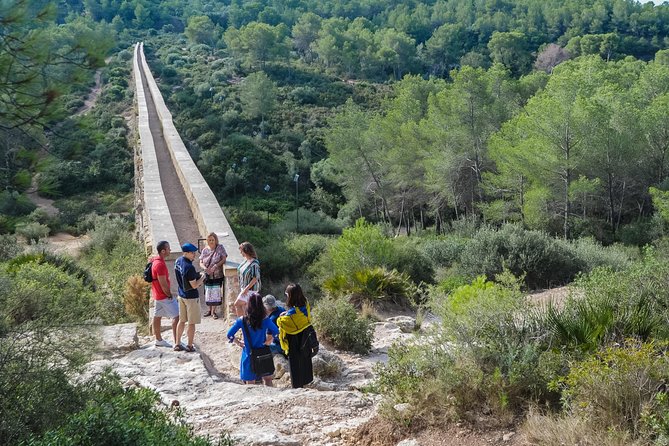
- Walk across the Pont del Diable: Cross the top of a Roman aqueduct built in the first century BC, a rare chance to touch Tarragona’s ancient water system in a very direct way.
- See Tarragona’s Roman and medieval layers: The old quarter combines city walls, a cathedral, underground Circus passages, a forum, and an amphitheater beside the Mediterranean.
- Break up the history with the sea: Roc de Sant Gaieta offers a short, photogenic stop before the longer afternoon in Sitges.
- Choose your own afternoon in Sitges: Spend your three hours eating, shopping, wandering whitewashed lanes, visiting a beach, or taking a quick swim.
- Benefit from a smaller vehicle: The minivan is more practical than a large coach on narrow streets and keeps the group closer to the guide.
- Plan for a walking day: Comfortable shoes, sun protection, swimwear, and a towel will make a real difference.
Starting beside Palau de la Música at 8:15am
The meeting point is on C/ Palau de la Música, right beside Barcelona’s famous concert hall. You arrive at 8:15am for an 8:30am departure, with time to use the restroom and perhaps buy a quick coffee.
There is no hotel pickup, so allow extra time to reach the office. The tour finishes around Plaça de Catalunya, although the vehicle may return to the office or stop near Arc de Triomf depending on group size and traffic. That is useful at the end of a long day because both areas have easy onward transport by metro or taxi.
The first drive takes about 90 minutes. As you leave through the Eixample, your guide gives a short introduction to Barcelona before letting you settle into the minivan. This is not dead time. It gives you a quick sense of how Barcelona fits into Catalonia before you begin looking at Roman Tarragona.
The transport is air-conditioned and described as comfortable, though space is naturally more limited than on a coach. The supplied information gives two different maximum group sizes, 15 in one place and 8 in another. If the size of the group matters to you, confirm it before booking. Either way, this is designed to feel more personal than a standard large-group excursion.
More Local Culture and Traditions Tours in Spain
- Barcelona & Chocolate Amatller History and Culture + Activity and Tasting
★ 4.9 · 173 reviews - Savor Spain: Food, Wine, History & Culture Small Group Tour in Old Barcelona
★ 5.0 · 140 reviews - Barcelona Tapas Food Tour, Taverns, History & Local Culture
★ 5.0 · 42 reviews
Pont del Diable: the most memorable forty minutes
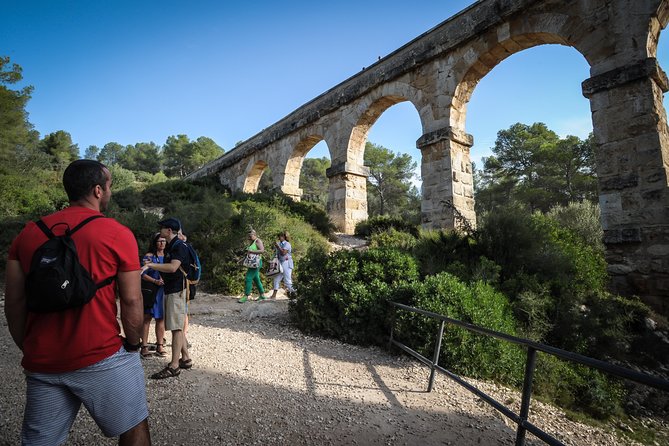
The first stop is the Les Ferreres Aqueduct, commonly called Pont del Diable, or Devil’s Bridge. It sits just beyond Tarragona and once carried water to the Roman city.
The aqueduct is the sort of site that works better in person than in a photograph. You can walk across the top from one side to the other, looking down at the stone arches and the surrounding ground. Being able to use the same elevated route that formed part of an ancient water network gives the stop a physical quality that a museum display cannot match.
You have about 40 minutes here. That is enough to walk across, take photographs, and hear the basic story, but it is not a long archaeological visit. One person specifically wished for more time at the aqueduct, and I understand why. If ancient engineering is your main interest, this may feel brief.
Wear shoes with a good grip and bring water. The tour deliberately gets you out of the vehicle, and the aqueduct stop is one of the places where the right footwear matters. Admission is listed as free, but you should still treat the stop as an outdoor walking visit rather than a full museum presentation.
Tarragona’s old quarter and its Roman bones
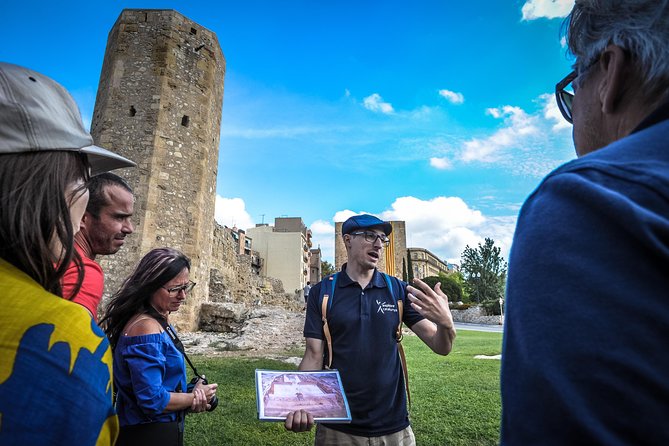
Around 11am, you enter Tarragona through a narrow gateway in the ancient walls. The modern city has grown around the old Roman center, so this is not a preserved ruin isolated from daily life. Roman stones, medieval buildings, traffic, cafes, and ordinary city routines all occupy the same space.
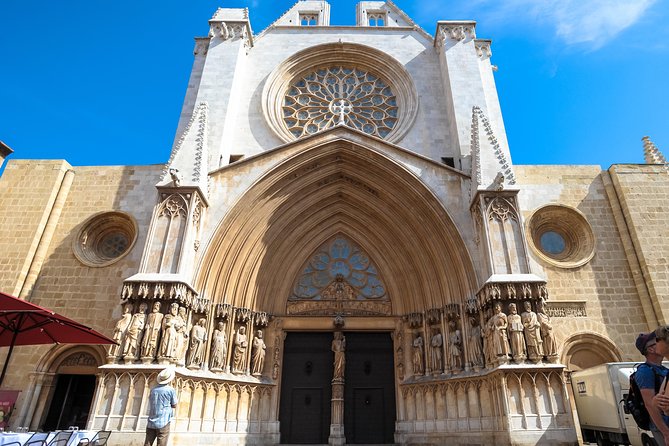
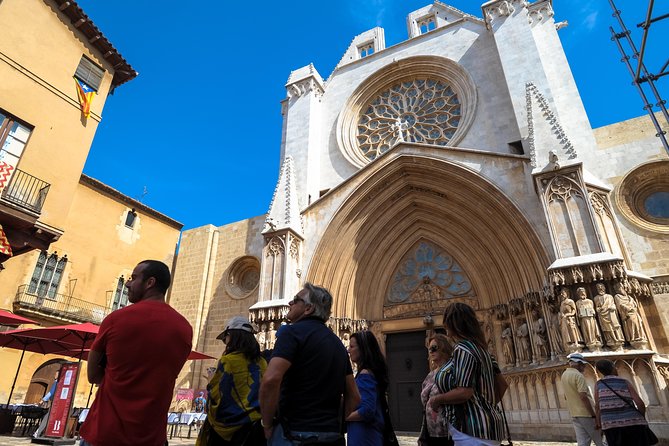
The walking route begins along the Archaeological Walkway, where you see surviving sections of the old walls. From there, the route passes the medieval hospital and continues toward the cathedral. Depending on the day, a Sunday antique market may be set up near the cathedral, adding a local touch to the morning.
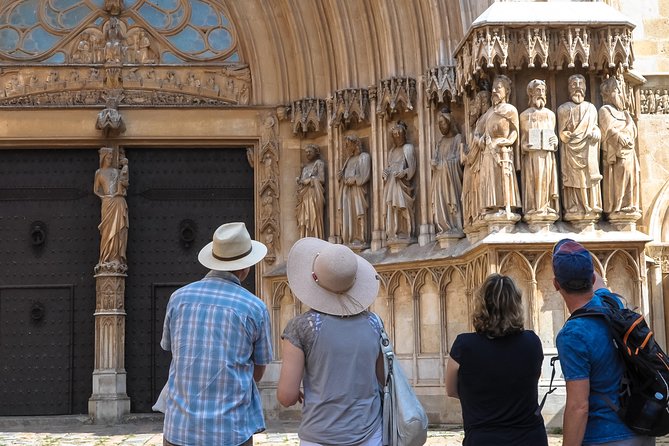
The cathedral is important not only for its architecture but also for the way it shows Tarragona’s changing role. Roman power gave way to medieval religious authority, while the city continued to grow on the same hill. Your guide helps connect those layers rather than treating each monument as a separate photo stop.
You then move down through the old quarter toward the Roman Forum and Circus. The remains are partly woven into the modern town, which can make them harder to read at first. A good guide is especially valuable here. Sergio, Rod, Xavier, Enrique, Jordi, Stephen, and Steve have each been singled out for clear explanations, useful suggestions, and an easy manner with questions. Guides such as Sergio and Rod are also praised for keeping the history lively instead of turning it into a list of dates.
The Roman Circus and amphitheater
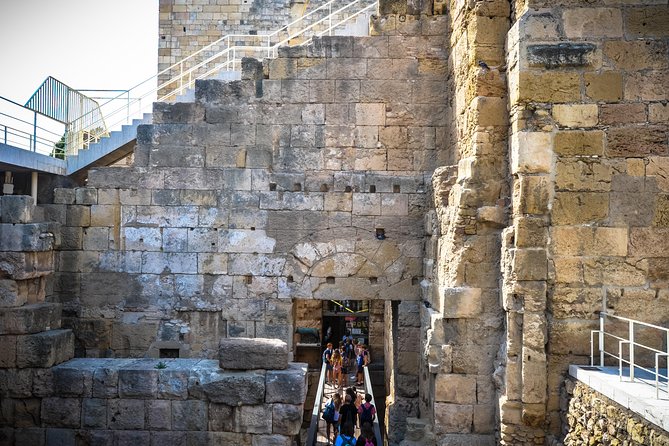
The Roman Circus is one of Tarragona’s most intriguing sites because parts of it remain below the present-day streets. The route includes underground passageways that once supported the Circus stands and leads to Plaça de la Font, a busy square occupying part of the ancient complex.
This is a place where you need to use your imagination. The Circus once hosted chariot races, but what you see now is broken into rooms, walls, tunnels, and fragments integrated into the town. That contrast between modern cafes above and Roman foundations below is part of Tarragona’s appeal.
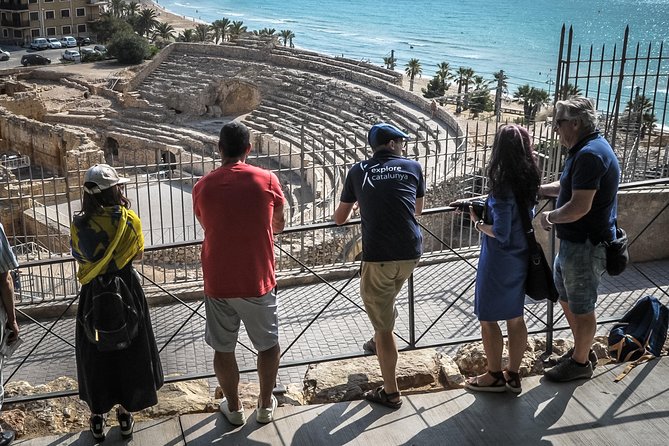
The route then reaches the Roman amphitheater, positioned beside the sea. From the viewpoint, you can look over the surviving structure and imagine the public spectacles once held there. One especially striking feature is the Christian church built in the middle of the former arena, using blocks from the amphitheater itself. It is a concise lesson in how later generations reused ancient buildings for new purposes.
You spend about two hours in Tarragona, including the old quarter, walls, cathedral area, forum, Circus, and amphitheater. That gives you a solid introduction, but not enough time for every museum or paid monument. Entrance fees for museums and monuments are not included, and you should not expect a long independent archaeological study. If you want to enter every site and read every panel, a separate Tarragona visit would serve you better.
For most people, though, the balance works. You receive a guided route through the key areas, then enough freedom to look around without spending the entire day underground or behind museum glass.
More Small-Group History Tours in Spain
- Madrid Tapas & Taverns Small Group Food & History Tour
★ 5.0 · 2,664 reviews - Ultimate Seville Tapas, Wine & History Small Group Tour
★ 5.0 · 1,766 reviews - Alicante Historic Small Group Tour with Tapas Tasting
★ 5.0 · 559 reviews - Bilbao Historical Small Group Tour
★ 4.5 · 159 reviews
Roc de Sant Gaieta: a short coastal pause
After Tarragona, the minivan stops at Roc de Sant Gaieta for about 20 minutes. This is a small settlement built along a rocky shoreline, with tiny white houses and a style influenced by Mediterranean, Roman, and Greek references.
The stop is brief, so think of it as a visual interlude rather than a full visit. You can stroll between the houses, take in the sea views, and stretch your legs before continuing to Sitges. It also breaks up the day nicely. After two hours of Roman walls and urban archaeology, the coast gives you a different sense of Catalonia.
Twenty minutes will not allow much more than a walk and a few photographs. If you prefer a deep visit at each location, the stop may feel rushed. I see its value as a palate cleanser, especially because the tour later gives you much more time in Sitges.
Three hours in Sitges, with room for your own choices
You reach Sitges around 2:30pm and leave at about 5:30pm. This is the most flexible section of the day.
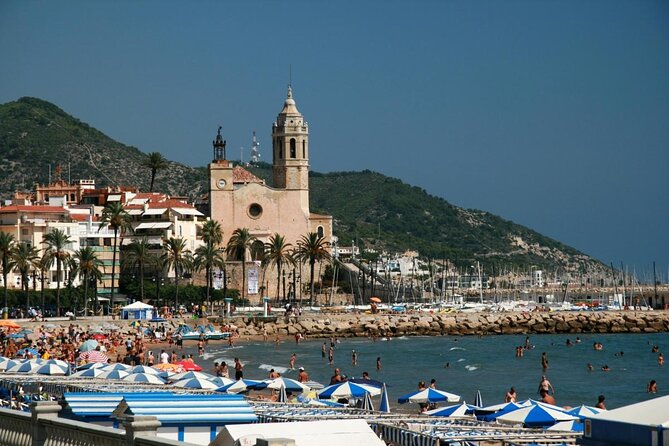
Sitges began as a fishing village and developed into a fashionable seaside town in the late 19th century. Its old lanes, whitewashed fisher houses, cafes, boutiques, and long beaches create a strong contrast with Tarragona. Here, the guide gives you the setting and suggestions, but you largely decide how to spend the afternoon.
You might begin with lunch at a cafe or restaurant by the water. The town has options for different budgets, but food and drinks are your responsibility. Because you have three hours, you can take a proper break rather than grabbing something hurriedly between monuments.
You can also wander the side streets, browse the shops, or head to one of the town’s 17 beaches. Swimming is possible, so bring a swimsuit and beach towel if that appeals to you. Several people enjoyed fitting in a quick swim, although the water can be cold and the time available for changing and drying will be limited.
Sitges is not always tranquil. Sunday crowds can make the restaurants and waterfront very busy, and one practical complaint was that lunch took nearly two hours. I would avoid choosing a slow formal meal if you want both beach time and shopping. Ask your guide for a restaurant that can serve you within your schedule, or keep lunch simple.
The best approach is to choose one priority. If you want a swim, head to the beach first. If lunch matters most, accept that you may have less time for the lanes and shops. Trying to do everything can make the afternoon feel hurried.
Is $119.48 good value?
At $119.48 per person, this is a reasonable price for a full day that includes a professional guide and air-conditioned minivan transport. You cover a lot of ground: Barcelona to Tarragona, the aqueduct, several Roman sites, Roc de Sant Gaieta, Sitges, and the return to central Barcelona.
The value is strongest if you would otherwise need to organize regional trains, local transport, taxis, and site visits yourself. The small vehicle also saves you from dealing with the practical challenge of reaching the aqueduct and moving between Tarragona’s scattered Roman remains.
The price looks less attractive if you want an all-inclusive day. You pay separately for lunch, drinks, and any museum or monument admissions. The Tarragona portion is primarily a guided outdoor walking route, so history fans who want extensive interior visits may prefer to spend the money on a dedicated Tarragona day.
This tour’s real product is convenience plus interpretation. The guides have received repeated praise for being friendly, patient, entertaining, and able to answer questions. Enrique was remembered for his lively commentary, Xavier for being attentive and cheerful, and Rod for offering especially strong historical explanations. Those personal qualities matter on a long day with several stops.
Who should book this tour?
I would recommend it to you if you want three different experiences in one day: Roman archaeology, a small coastal village, and a relaxed beach town. It suits couples, families with older children, and anyone who likes a guide-led morning followed by independent time.
It is also a good choice if Barcelona is your base and you do not want to plan regional transport. You get a useful look at Catalonia beyond the capital without changing hotels.
I would be more cautious if you have limited mobility or dislike uneven walking. The day includes ancient walls, old streets, underground passages, outdoor paths, and time in the sun. It is not recommended for children aged four and under, and the long duration may be tiring for very young children.
History specialists should consider the tradeoff carefully. Tarragona is the stronger historical stop, and at least one person wished to skip Sitges in favor of more time among the Roman remains. If that sounds like you, choose a Tarragona-focused tour instead. If you want history without giving up the coast, this combination is the point.
The tour operates in English only. Bring comfortable shoes, sun protection, water, and a swimsuit and towel if you plan to use the beach. Free cancellation is available up to 24 hours before the start time, subject to the stated conditions, and the tour may be canceled if its minimum number is not reached.
My verdict: a smart day beyond Barcelona
Book this tour if you want a well-paced introduction to Roman Tarragona and a pleasant seaside finish. The aqueduct and amphitheater are the highlights, while Sitges gives the day a lighter, more relaxed ending.
Skip it if you want long, detailed museum visits or several unhurried hours at one archaeological site. The schedule covers a lot, and Tarragona’s Roman remains could easily fill a day on their own.
For most visitors with only a few days in Barcelona, I like the balance. You get memorable ancient engineering, a guide who can make the past readable, Mediterranean views, and enough free time to choose your own lunch or swim. Just keep your expectations clear: this is a broad regional outing, not an exhaustive study of Tarragona.
FAQ
Where does the tour start?
It starts at C/ Palau de la Música, 1, in Barcelona’s Ciutat Vella, beside Palau de la Música.
What time does the tour begin?
You should arrive around 8:15am. The scheduled departure is 8:30am.
Where does the tour end?
The tour ends around Plaça de Catalunya between 7pm and 7:15pm. Depending on traffic and group size, it may instead return to the tour office or stop near Arc de Triomf.
How long is the full tour?
The experience lasts approximately 10 hours and 30 minutes.
Is hotel pickup included?
No. You must make your own way to the central Barcelona meeting point, and hotel drop-off is not included.
Is food included?
No. Lunch, drinks, and other food are not included in the price.
Are museum and monument admissions included?
No. Entrance fees for museums and monuments in Tarragona are not included.
Can I swim in Sitges?
Yes. You have free time in Sitges and may swim if you wish. Bring swimwear and a beach towel.
Is the tour offered in languages besides English?
No. This tour operates in English only.
What happens if I need to cancel?
You can cancel up to 24 hours before the experience start time for a full refund. Cancellations or changes made less than 24 hours before departure are not accepted for a refund.
More Small-Group History Tours in Barcelona
- London Small Group Tour of Historical Pubs
★ 5.0 · 10,422 reviews - Boston: Freedom Trail History Small Group Walking Tour
★ 5.0 · 6,450 reviews - Hidden Alleyways and Historic Sites Small-Group Walking Tour
★ 5.0 · 2,335 reviews - New Orleans Small-Group Haunted History Carriage Tour
★ 4.5 · 2,289 reviews
More Local Culture and Traditions Tours in Barcelona
- Bike Tour in Barcelona: History, Architecture and Culture
★ 3.5 · 29 reviews - Barcelona Tapas Tour, Taverns, History & Local Culture
★ 5.0 · 25 reviews - Amsterdam Food and Cultural Tour with Tastings
★ 5.0 · 4,315 reviews - Sevilla Food Tour: Tapas, Wine, History & Traditions
★ 5.0 · 3,468 reviews
Just added around Barcelona
- Barcelona Jewish & Gothic Tour★ 5.0 · 18 reviews
- Andorra Original History and Sightseeing Tour (Private, Pickup)★ 5.0 · 350 reviews
- Sip, Sites & Bites Barcelona Food, Drinks & History Tour★ 4.5 · 95 reviews
- Barcelona Tapas Food Tour, Taverns, History & Local Culture★ 5.0 · 42 reviews
- History Museum of Catalonia & Rooftop Access Ticket★ 4.5 · 43 reviews
- Taste of Barcelona: Boqueria Market, Tapas & History Tour★ 4.5 · 22 reviews
- Historical Montserrat Half-Day Hiking Tour from Barcelona★ 5.0 · 26 reviews
- Savor Spain: Food, Wine, History & Culture Small Group Tour in Old Barcelona★ 5.0 · 140 reviews
Local Culture & Traditions Tours, compared.

Amsterdam Food and Cultural Tour with Tastings
Read our review →
Sevilla Food Tour: Tapas, Wine, History & Traditions
Read our review →
Tromsø: Reindeer Camp and Sami Cultural Tour with Lunch
Read our review →
Half Day Dominican Republic Cultural Tour : Small Group
Read our review →
Ultimate Melbourne Walking Tour: History, Laneways & Culture
Read our review →
Tromsø: Sámi Reindeer Sledding and Sami Cultural Tour
Read our review →
Kyoto Gion: 2-Hour Geisha Culture & History Walking Tour
Read our review →