
Review · BAVARIA
Nuremberg: Historical Rock Passages Tour
Beneath Nuremberg, another city waits. This one-hour tour takes you below the old town into sandstone corridors first documented in 1380, where beer was stored, matured, and protected over many centuries. I like the way the visit connects Nuremberg’s red beer tradition with the city’s wartime past, rather than treating the cellars as a simple underground walk.
I also like the small-group format, limited to four participants, and the guides’ lively approach. Charlie is praised for turning historical facts into an entertaining time journey, while another guide, described as humorous and clear, kept visitors involved with questions. The main drawback is practical: this is a confined underground setting, and the tour is not suitable for people with mobility impairments, wheelchair users, or claustrophobia.
Key points before you book
- Seven centuries beneath the city: The rock passages were first mentioned in 1380 and were dug into Nuremberg’s light-colored sandstone over many generations.
- Beer is the main story: The cellars were used for storing and maturing beer, especially the original Nuremberg red beer.
- A working brewery connection: Part of the cellar system is still used by the Altstadthof brewery for special beers and beer spirits.
- History takes a darker turn: The route includes an air raid shelter used during World War II.
- Whiskey appears underground too: You visit the home brewery, distillery, and whiskey storage areas.
- German is the live tour language: An audio guide is not included, so check language arrangements if you do not understand German.
Why Nuremberg’s underground cellars matter
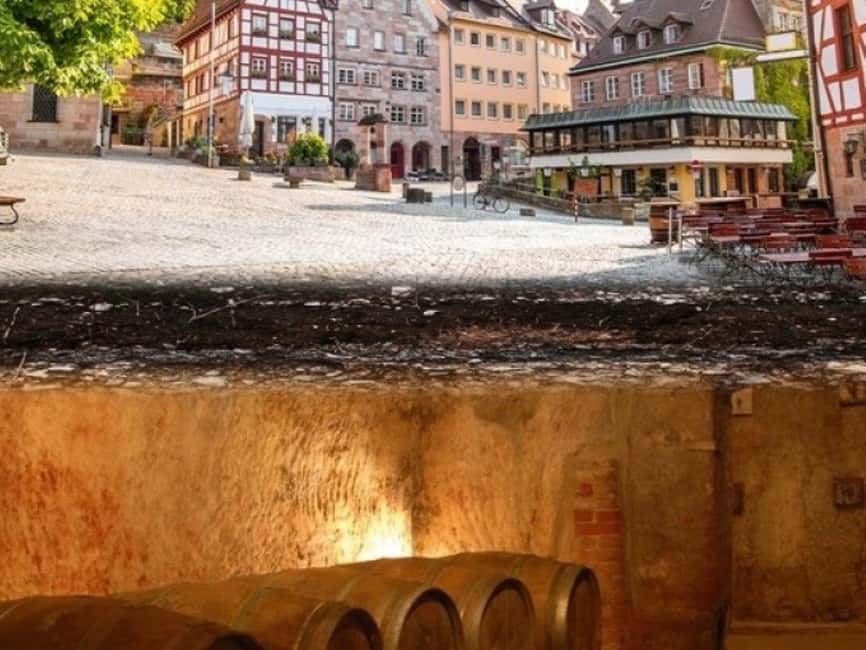
Nuremberg is often associated with its castle, churches, and World War II history. The rock passages add another layer, one that is easy to miss because the important rooms are hidden below street level.
Citizens cut vaults and corridors into the soft, light-colored sandstone beneath the city. The system grew over many centuries, creating a network of rooms and passageways rather than one single cellar. The first written mention dates to 1380, which gives you a clear sense of its age.
The original purpose was practical. Beer needed a cool place to mature and remain stable, long before modern refrigeration. Nuremberg’s brewers used the cellars to store their beer, with the city’s red beer holding a special place in local tradition.
That detail gives the tour a useful focus. You are not simply walking through old stone rooms and hearing dates. You are seeing how an everyday product shaped the city’s underground architecture. The cellars were part of working urban life, built for storage, trade, and brewing.
I find this sort of history more rewarding than a collection of disconnected facts. The passages show how people solved a basic problem with local materials and patient labor. They also explain why beer remains central to the experience today.
A few more history tours around Germany worth a look
- Leipzig: City History Canal Sightseeing Tour on a Motorboat
★ 4.7 · 7,671 reviews - Leipzig: 1.5-Hour Historical Walking Tour in German
★ 4.7 · 2,217 reviews - Berlin: 3-Hour World Heritage Cruise to Potsdam
★ 4.5 · 1,569 reviews
Entering at Bergstraße 19
The tour begins at Bergstraße 19, in front of the brewery shop. That meeting point matters because you are not searching for a hidden entrance somewhere in the old town. Look for the brewery shop and gather there before the guided visit begins.
The full tour lasts about one hour and returns to the same address. That makes it easy to fit into a day of sightseeing around central Nuremberg. You can place it between visits to other old-town sights without giving up half a day.
A one-hour format has advantages. You get a focused look at the passages without committing to a long underground program. It also means the guide needs to use the time well. The strongest feedback points to guides who do exactly that, keeping the hour moving with humor, questions, and clear explanations.
The small group limit of four participants should help the tour feel personal. You are not joining a large crowd that gets spread through the tunnels. A small group also gives you a better chance to ask questions, although the experience still depends on the guide and the German language.
Following the beer cellars through 700 years
The central part of the tour explains how the rock passages were created and used over roughly 700 years. You will hear about their early development, their storage function, and their role in Nuremberg’s brewing culture.
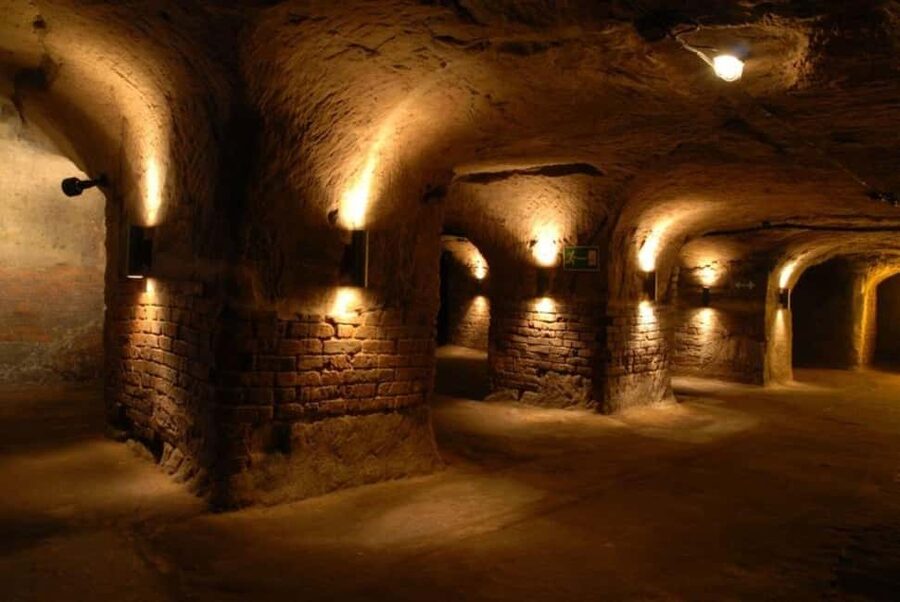
The sandstone setting is the star here. Instead of a polished museum, you are moving through an old underground system shaped by excavation and repeated use. The corridors and vaults form a labyrinthine network, although the tour gives you a guided route through it rather than asking you to find your own way.
Beer storage is not just a side note. The cellars were mainly used for the maturation and storage of beer, particularly the red Nuremberg city beer. That makes the underground spaces part of the city’s food and drink history, not only its architectural past.
The Altstadthof brewery now uses a small portion of this old system again. Special beers and beer spirits are matured and stored underground, linking the current brewery to the original purpose of the cellars.
I like that connection between past and present. You are not looking at a place that has been frozen and labeled. At least part of the cellar system still has a brewing role, giving the visit a working character.
Do not expect a full brewing lesson, however. The supplied details promise a visit to the brewery and whiskey distillery, along with storage areas, but they do not describe brewing equipment demonstrations or a complete production tour. The emphasis is on the underground rooms, their history, and their present connection to beer and spirits.
The brewery and whiskey storage areas
The route includes the home brewery and distillery, followed by whiskey storage. This adds variety to the tour and gives you a reason to look closely at how the spaces are used today.
The brewery is especially important because it brings the red beer story into the present. The Altstadthof brewery uses part of the underground system to mature and store special beers and beer spirits. You are seeing an old storage method continue in a modern business.
Whiskey storage offers a different angle. Beer is the historic reason these cellars matter, while whiskey shows how the cool underground conditions are also useful for spirits. The tour does not promise a whiskey tasting as part of the ticket, so treat the storage visit as part of the guided history rather than a tasting event.
You can sample specialties separately in the tasting boutique, brewery, restaurant, or brewery cellar tavern. Beer is not included in the tour price, so budget extra if you want to try the original Nuremberg red beer or other products afterward.
That separation is worth understanding. At about $16 per person, the ticket pays for the guided cellar experience. It does not include drinks. For me, that is still a fair price if you care about local history and want a compact activity, but it is less attractive if you mainly want a beer tasting.
Same place, a different slice of the past:
- Heidelberg: Night Watchman Historic Adventure Tour
★ 4.7 · 1,186 reviews - The Local Tour of Hamburg Historic Centre
★ 5.0 · 1,058 reviews - Elbfloren: Historical city tour
★ 4.8 · 929 reviews - Berlin: History of the Third Reich Guided Walking Tour
★ 4.7 · 791 reviews
A World War II shelter beneath the city
The tour also includes an air raid shelter from World War II. This changes the mood and broadens the historical scope of the visit.
The same underground environment that once protected beer was later used to protect people. That practical shift says a great deal about life in Nuremberg during wartime. The cellars were not only storage rooms. Underground space became a place of safety when the city faced air raids.
The shelter section gives the tour a serious counterpoint to the brewery and whiskey material. You move from beer maturation and distillery use to the human cost of war. That contrast is one of the strongest reasons to choose this experience over a standard brewery visit.
The available information does not give details about the shelter’s layout, capacity, or specific wartime stories. Your guide’s explanation will shape this part of the visit. Recent comments praise guides such as Charlie for presenting historical facts in a lively way, so you can expect the tour to avoid a dry recital of dates.
Still, the setting may feel confined. If underground rooms make you uneasy, the air raid shelter and narrow passages may be the least comfortable parts of the experience. This is a place to avoid if you already know that enclosed spaces cause serious distress.
The guide can make or break the hour
The tour is led live in German. That is the main language issue to consider before booking. Some information describes audio guides in different languages, but the activity details specify German as the live tour language and say the audio guide is not included.
If you understand German, the personal guide is a real advantage. The best feedback highlights humor, clear explanations, questions that involve the whole group, and a well-paced hour. Charlie is singled out for making the history entertaining enough that the time passed quickly. Another guide was praised for combining good humor with solid information.
Those comments point to the experience’s strongest feature: presentation. The rock passages themselves are historic, but an underground corridor can feel repetitive without a guide who explains why each space matters. A good guide turns the cellar into a connected story about excavation, beer, war, brewing, and whiskey.
If you do not speak German, confirm the available language support before paying. The supplied information mentions audio guides in various languages, but also lists audio guides as not included. That means you should not assume a translated device comes with the standard booking.
The small group limit of four is another plus. It should make it easier to hear the guide and follow questions. It also keeps the visit from feeling like a large commercial group, though the experience remains dependent on the scheduled guide.
What the $16 price really buys you
At $16 per person, this is a reasonably priced historical activity in central Nuremberg. You receive a one-hour guided visit to a very specific local site, including the beer cellar, the World War II shelter, the home brewery and distillery, and whiskey storage.
The price works best for you if you value context. You are paying for access and explanation, not a large quantity of food or drink. Since beer is not included, add a separate purchase if sampling the red beer is part of your plan.
The tour also has practical value because it is short. You can see the underground passages without giving up a whole afternoon. The return to Bergstraße 19 makes it simple to continue with your own sightseeing or stop at the brewery’s tasting boutique, restaurant, or cellar tavern afterward.
I would compare it with the cost of a drink-led brewery visit. If you want several samples, this may not be the best value on its own. If you want a compact look at Nuremberg’s underground history, the price is easier to justify.
Free cancellation up to 24 hours before the start and reserve-now, pay-later booking add flexibility. Those terms help if your Nuremberg schedule is still changing, but they do not change the tour’s main limitation: space is small, and language and mobility requirements matter.
Who should take this underground tour?
I would recommend it to you if you enjoy local history, old working spaces, and the link between food traditions and city development. It is especially useful for people who want more than the usual above-ground sights and have an interest in Nuremberg’s beer culture.
It also suits a short city break. One hour is enough to add a focused historical stop without exhausting your day. The brewery connection gives you an easy follow-up option if you want to sample beer afterward.
The tour may suit families with older children, but unaccompanied minors are not allowed. Baby carriages are also not permitted, and several mobility aids are excluded. People using wheelchairs, electric wheelchairs, walking frames, crutches, or scooters should not book this experience.
You should also leave large luggage, oversize bags, bikes, handcarts, food, and drinks behind. Smoking and vaping are not allowed. These rules make sense underground, where narrow passages and sensitive historic spaces leave little room for extra belongings.
People with claustrophobia should think carefully before booking. The passages and shelter are underground, and the experience is specifically built around enclosed historic spaces. If that sounds stressful rather than interesting, choose an above-ground Nuremberg activity instead.
Should you book the Historical Rock Passages Tour?
Book it if you want a compact, atmospheric look at Nuremberg’s beer cellars, wartime shelter, brewery, distillery, and whiskey storage. The best reason to go is the combination of place and guide: the passages provide the setting, while a strong German-speaking guide connects the details into an entertaining story.
The $16 price is fair for a one-hour guided visit, but remember that beer costs extra and the tour is not designed as a tasting package. Check language support before booking if you do not speak German, and avoid it if you need wheelchair access or dislike confined underground spaces.
For the right visitor, this is a smart addition to a Nuremberg day. It shows you the city from below, where beer, war, and local working life share the same sandstone rooms.
FAQ
Where does the tour begin?
It begins at Bergstraße 19, in front of the brewery shop.
How long does the tour last?
The guided tour lasts one hour and returns to Bergstraße 19.
What language is the live tour conducted in?
The live tour guide speaks German.
Is an audio guide included?
No. The activity information lists the audio guide as not included. Other details mention audio guides in various languages, so confirm available language support before booking.
Is beer included in the ticket?
No. Beer is not included. You can purchase specialties separately in the tasting boutique, brewery, restaurant, or brewery cellar tavern.
What places are included in the tour?
The experience includes the historic beer cellar, a World War II air raid shelter, the home brewery and distillery, and whiskey storage.
Is the tour suitable for wheelchair users?
No. The tour is not suitable for wheelchair users or people with mobility impairments.
Can I cancel for a full refund?
Yes. You can cancel up to 24 hours in advance for a full refund.
Just added around Germany
- Nuremberg:Complete Tour! Castle/Old Town/World War history★ 5.0 · 45 reviews
- Nürnberg: Mörder, Fälscher, Messerstecher★ 4.8 · 53 reviews
- Nuremberg: 1.5-Hour Private Tour through Historical Old Town★ 4.8 · 283 reviews
- Munich: Nazi History 2-Hour Small Group Walking Tour★ 5.0 · 30 reviews
- Munich: Guided Tour of the historic Town Hall on Marienplatz★ 4.8 · 63 reviews
- Munich and Nazi History Combination Day Tour Small Group★ 5.0 · 32 reviews
- Münster: Old Town Historical Walking Tour by “Geo Epoche”★ 4.7 · 51 reviews
- Lübeck: Hanseatic League History Walking Tour★ 4.9 · 57 reviews
Germany History Tours, compared.
Leipzig: City History Canal Sightseeing Tour on a Motorboat
Read our review →
Leipzig: 1.5-Hour Historical Walking Tour in German
Read our review →


Bamberg: Guided Beer History Tour with Optional Tasting
Read our review →Browse the lists this tour appears in