
Review · POMERANIA PROVINCE
Historic City Center Tour Gdansk in German
Gdansk reveals itself one brick at a time. This 2.5-hour German walking tour links the city’s grand gates, medieval waterfront, churches, and wartime history in a compact route through the old center. I like the focus on major sights with real historical context, and I like that the guide can point you toward a café or restaurant afterward.
The German-language guiding is the main reason to book this version. Recent praise for Sandra highlights her clear, engaging storytelling, even in cold weather. The one caution is that the tour can pack in many dates and religious details, so you may need to choose what to remember rather than expect every fact to stick.
Key points to know before you book
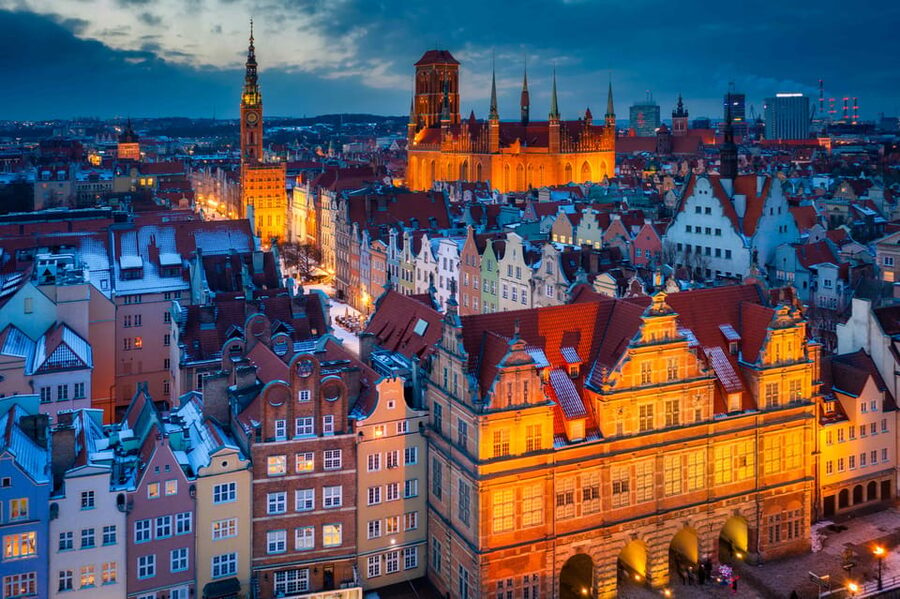
- A 150-minute walk begins at the Golden Gate, where yellow umbrellas make the meeting point easy to spot.
- The route covers Gdansk’s essential old-town sights, including the High Gate, St. Mary’s Church, Arthur’s Court, the Right City Town Hall, the Crane, and the Polish Post Office.
- German is the only listed tour language, making this a useful choice for German-speaking visitors.
- The Crane is more than a pretty waterfront landmark: it once operated through human muscle power and is presented as Europe’s largest medieval crane.
- The tour runs rain or shine, so winter visitors should dress warmly and prepare for wet weather.
- The $26 price is mainly for the guide and reservation, with no hotel transfer and no private group included by default.
Starting at the Golden Gate in Gdansk
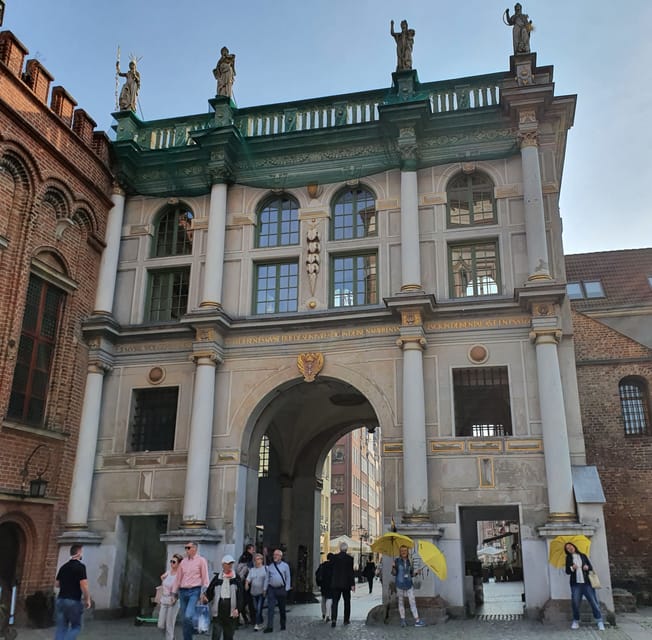
The tour begins at the Golden Gate, or Złota Brama, one of the most recognizable entrances to the old center. Look for the yellow umbrellas. That detail matters in a busy historic area, especially if several groups gather nearby.
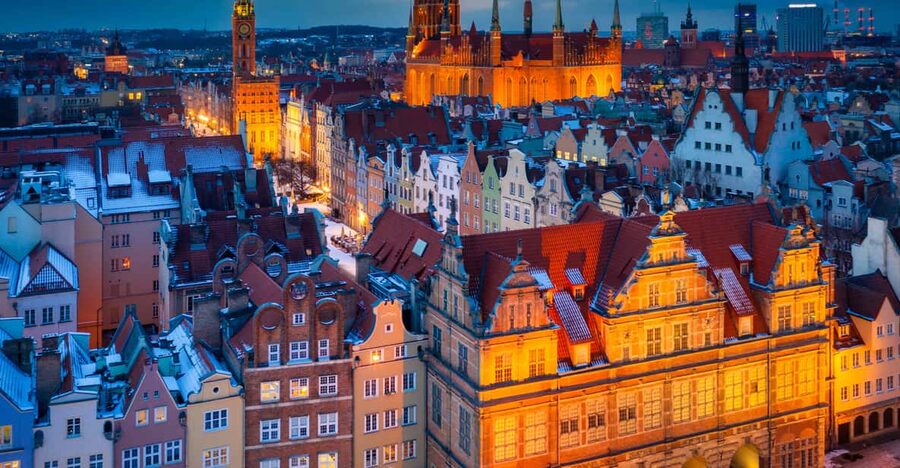
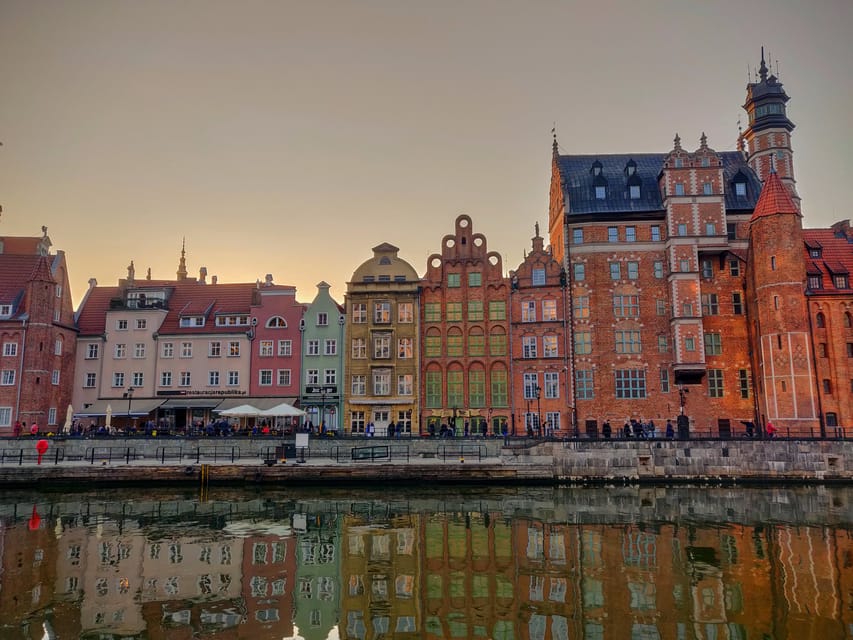
From here, you enter the old legal town, often called the Main Town in English descriptions of Gdansk. The setting is made for walking: cobbled streets, tall narrow façades, ornamental details, and terraces that frame the route. The buildings give you an immediate sense of Gdansk’s trading wealth, civic pride, and mixed cultural past.
You will also encounter the High Gate during the walk. Together, the gates help explain how the old city was organized and protected. They are not just decorative photo stops. They mark the transition from ordinary streets into the formal heart of Gdansk.
I like beginning here because the route starts with the city’s public face. You get architecture first, then the guide adds the political and historical background. That order makes the information easier to follow than beginning with a long lecture about dates.
A few more history tours around Poland worth a look
- Gdansk: City Cruise on Historical Polish Boat
★ 4.8 · 2,913 reviews - Warsaw: POLIN Museum of the History of Polish Jews Ticket
★ 4.7 · 1,142 reviews - Gdańsk: Sunset Cruise on a Historic Polish Boat
★ 4.9 · 977 reviews
St. Mary’s Church and the challenge of so much history
St. Mary’s Church is the visual heavyweight of the tour. It is described as the largest brick church in the world, and its huge scale gives the stop real impact even if you are not especially interested in church architecture.
The church also brings a large amount of religious history into the tour. That can be useful if you want to understand how faith shaped Gdansk’s public life and buildings. It can also be the point where the pace feels slower. One recent assessment found that the guide spent a little too long on church history, while another noted that the number of historical facts could be hard to remember.
That is a fair warning. A good walking tour should give you a framework, not make you sit an exam later. If the guide spends extra time here, listen for the broad ideas: why the church mattered, what its size says about the city, and how religious life fit into Gdansk’s development. You do not need to retain every date.
The German delivery seems to be a strong part of the experience. Sandra, one praised guide, is described as making the material interesting and absorbing, even when the weather was cold. For German-speaking visitors, that can make a big difference at a site where architectural details and historical terms may otherwise become tiring.
The Right City Town Hall and civic Gdansk
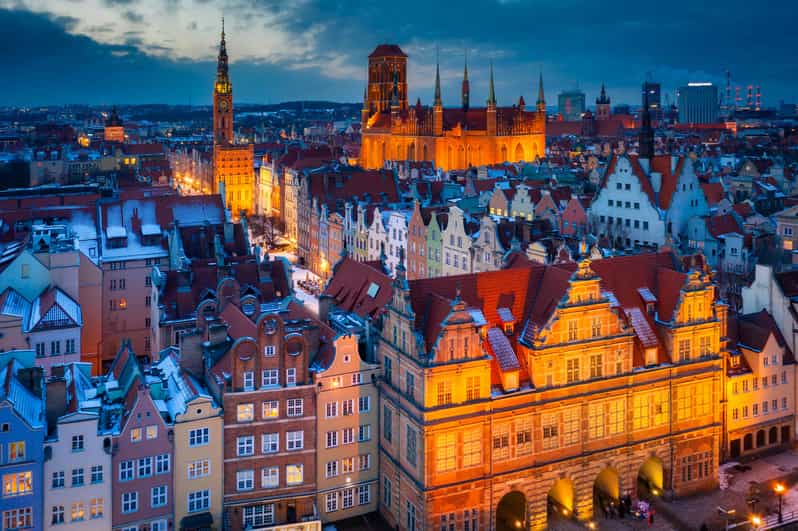
The Right City Town Hall, also called the Main Town Hall in many English references, shifts the focus from religion to government. This is where the tour helps you read the old center as a working civic district rather than a collection of attractive façades.
The building represents local power, administration, and the city’s long tradition of public decision-making. Your guide can connect it with the streets and institutions around it, giving more meaning to the formal architecture.
This is one of the tour’s useful habits: it places individual buildings into a larger sequence. The Golden Gate introduces the old city, St. Mary’s shows religious scale, and the town hall explains civic authority. You are not simply collecting photographs. You are building a rough map of how the city functioned.
The amount of information may feel dense at times. If you prefer a light stroll with only a few facts, this tour may be more detailed than you need. If you want a strong introduction before exploring alone, the historical commentary is part of the value.
Arthur’s Court and the city’s grand public life
Arthur’s Court adds another layer to the old center. The name points to the world of merchants, public gatherings, and civic display associated with Gdansk’s historic center. It belongs to the same grand urban setting as the town hall and the elegant street façades.
This stop is especially useful for understanding that Gdansk’s old center was built for more than daily errands. It was a place where status, trade, government, and ceremony were displayed in public. The slender buildings and decorated terraces make more sense once you hear what kind of city life took place around them.
I would pay attention to the guide’s links between Arthur’s Court and the surrounding streets. The value here is not only the building itself. It is the way the stop helps you see the old center as a connected civic stage.
Same place, a different slice of the past:
- Gdańsk City Sights & History Guided Walking Tour in English
★ 4.8 · 876 reviews - Warsaw: Chopin Concert at Historical Venue in Old Town
★ 4.7 · 445 reviews - Krakow: Tipsy Polish Food Tour With History, Pierogi & Shots
★ 4.9 · 439 reviews - Krakow: Vistula River Cruise with Historical Views
★ 3.5 · 357 reviews
The Crane and the medieval waterfront
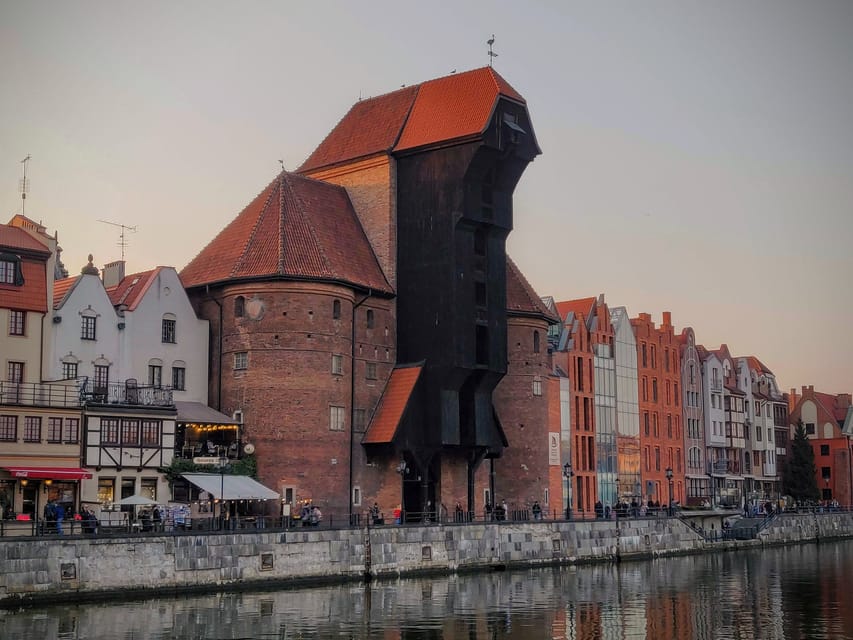
The Crane is one of Gdansk’s defining landmarks and probably the most unusual stop on the route. It was once operated by human muscle power, a detail that turns an impressive wooden structure into a lesson in medieval engineering and labor.
The Crane is also described as the largest medieval crane in Europe. Its size reflects Gdansk’s role as a port and trading center, while its mechanism points to the physical effort behind historic commerce. Goods did not move through the harbor by magic. People powered the systems that lifted and loaded them.
This is the kind of stop I value on a walking tour because it connects a building to ordinary work. You can look at the waterfront and imagine the practical problem the Crane solved. It gives the city’s trading past a human scale.
The tour does not include hotel pickup or transport. That is no real problem for a central walking route, but it means you should plan to reach the Golden Gate on your own. The meeting point is fixed, and the experience is built around walking from one central sight to the next.
The Polish Post Office and the Free City of Danzig
The Polish Post Office introduces a much more modern and politically charged part of Gdansk’s story. The stop concerns the post office in the former Free City of Danzig, a period when the city had a special political status and complicated relations with Poland and Germany.
This part of the route helps prevent the tour from becoming a pleasant parade of medieval buildings. Gdansk’s identity cannot be understood through architecture alone. Its twentieth-century history, changing borders, and Polish and German connections are essential to the city’s story.
For a German-speaking audience, this subject may be especially valuable. The guide can explain the historical terms in German and place the Free City period into a wider timeline. You may find this stop more demanding than the decorative old-town sights, but it gives the tour emotional and political weight.
The advertised route includes more than the named stops, so the exact balance may depend on the guide and the group. The core promise is a broad historical walk through the central area, not an interior-focused museum visit.
What the $26 price really buys you
At $26 per person, the cost is reasonable if you want orientation, context, and a German-speaking guide in one outing. You are paying for a 150-minute walking experience that connects several major landmarks instead of visiting only one building.
The price also covers the reservation fee and the guide’s payment. It does not cover hotel pickup and drop-off. The standard outing joins a general walking tour, so this is not the same as booking a private guide for your own party.
That distinction matters. A shared group usually offers good value because the guide’s time and local explanation cost less per person. A private tour may suit you better if you want to stop often, move at your own pace, or ask very specific questions. The provider can help arrange a smaller private tour after booking.
I would call the price good value for a first visit, especially if you have only a short time in Gdansk. The guide gives you a base for later exploring. You can return to the Crane, the church, or the town hall with a clearer idea of what you are seeing.
Weather, walking pace, and what to bring
The tour runs rain or shine. That is worth taking seriously because the experience is entirely outdoors in the sense that you move between city sights, and the route includes cobbled streets.
Wear comfortable shoes with secure soles. Bring a waterproof layer if rain is possible, and dress warmly in winter. Cold weather already tested the experience for one recent group, and the advice was simple: add warm clothing.
The 150-minute duration is long enough to cover a lot without taking up a full day. Still, you should expect a steady city walk rather than a brief photo tour. Anyone who finds cobblestones or extended standing difficult should consider the pace before booking, although the activity is listed as wheelchair accessible.
Because the tour is live and guide-led, the tone may vary. Sandra has been praised for making the history engaging, while other feedback suggests that the amount of information can sometimes be heavy. Your best approach is to listen for the main story and ask questions when a detail interests you.
Who will get the most from this German tour?
I would recommend this experience to German-speaking visitors who want a clear first look at Gdansk’s old center. It suits you if you enjoy architecture, political history, church history, and the practical stories behind historic buildings.
It is also a sensible choice if you want recommendations for the rest of your stay. One recent participant specifically valued the guide’s suggestions for a café and restaurant after asking for advice. That small service can save you time when you are hungry and still getting your bearings.
The tour may be less suitable if you want a quiet, slow stroll or a short list of photo stops. The route covers many subjects, and the historical material can be dense. It is also not the best choice if you want a fully private experience unless you contact the supplier about arranging one.
Free cancellation up to 24 hours before the start gives you some flexibility, and you can reserve now and pay later. Those terms help if your schedule is still changing, but the central question remains whether you want a shared, information-heavy walk.
Should you book the Historic City Center Tour Gdansk in German?
Book it if you want the essential old-center sights explained in German, with enough time to connect Gdansk’s medieval trade, civic life, religious architecture, and twentieth-century politics. The Golden Gate, St. Mary’s Church, Arthur’s Court, the Right City Town Hall, the Crane, and the Polish Post Office make a strong route for a first visit.
I would skip it only if you dislike group walks or prefer to explore at your own pace with very little commentary. For most German-speaking visitors, the $26 fee is a fair exchange for a well-filled 2.5 hours, especially when you arrive prepared for cold weather, cobblestones, and a generous helping of dates.
FAQ
How long does the Historic City Center Tour Gdansk in German last?
The tour lasts 150 minutes, or 2.5 hours.
What language is the tour conducted in?
The live tour guide speaks German.
Where does the tour meet?
The meeting point is the Golden Gate, also called Złota Brama. Look for the yellow umbrellas.
Which major sights are included?
The route includes the High Gate, Golden Gate, St. Mary’s Church, the Right City Town Hall, Arthur’s Court, the Crane, the Polish Post Office in the Free City of Danzig, and additional central sights.
Is the Crane included in the tour?
Yes. The tour visits Gdansk’s medieval Crane, which is described as the largest medieval crane in Europe.
Does the tour visit St. Mary’s Church?
Yes. St. Mary’s Church is one of the principal stops and is described as the largest brick church in the world.
Is hotel pickup included?
No. Hotel pickup and drop-off are not included.
Is the tour wheelchair accessible?
Yes, the activity is listed as wheelchair accessible.
Does the tour operate in bad weather?
Yes. The tour takes place rain or shine.
Can I cancel for a full refund?
Yes. You can cancel up to 24 hours in advance for a full refund.
Just added around Poland
- Best of Wroclaw 3-Hour History and Culture Walking Tour★ 4.9 · 49 reviews
- Schindler’s List Movie Tour: Historic Sites & Film Location★ 5.0 · 23 reviews
- Krakow: Vistula River Cruise with Historical Views★ 3.5 · 357 reviews
- Krakow: Kościuszko Mound Ticket – History & Views!★ 4.4 · 303 reviews
- Krakow Old Town Segway Tour — 2H of History, Fun & Discovery★ 4.8 · 91 reviews
- Warsaw: Historic Private Tour in Retro Fiat★ 4.9 · 41 reviews
- Small-Group Historical Guided Tour of Warsaw with pick up/drop off. Public Tour.★ 4.5 · 343 reviews
- Warsaw: Jewish History Guided Walking Tour in English★ 4.7 · 324 reviews
Poland History Tours, compared.

Gdansk: City Cruise on Historical Polish Boat
Read our review →
POLIN Museum of the History of Polish Jews Ticket
Read our review →
Gdańsk: Sunset Cruise on a Historic Polish Boat
Read our review →
Gdańsk City Sights & History Guided Walking Tour in English
Read our review →

Krakow: Tipsy Polish Food Tour With History, Pierogi & Shots
Read our review →
Krakow: Vistula River Cruise with Historical Views
Read our review →
Small-Group Historical Guided Tour of Warsaw with pick up/drop off. Public Tour.
Read our review →Browse the lists this tour appears in