
Review · MANCHESTER
Angel Meadow Manchester History Tour with Author Dean Kirby
Hell upon Earth has a story worth hearing. This 90-minute walk through Manchester’s Angel Meadow brings the city’s industrial past into focus through the work of author and historian Dean Kirby. I like the small group of up to 15 people, which leaves room for questions, and I like the way Kirby uses streets, parks, and the River Irk to rebuild a district that redevelopment has largely erased. The main drawback is that little of the original neighborhood survives, so much of the tour depends on spoken history and imagination.
The tour costs $27.62 per person and begins at 2:00 pm near Sadler’s Cat on Hanover Street. I see it as a good-value history walk for anyone who wants more than Manchester’s usual cotton-mill story. Still, you should be comfortable with steps and moderate walking, and poor weather can lead to a cancellation or a new date.
Key points to know before you book
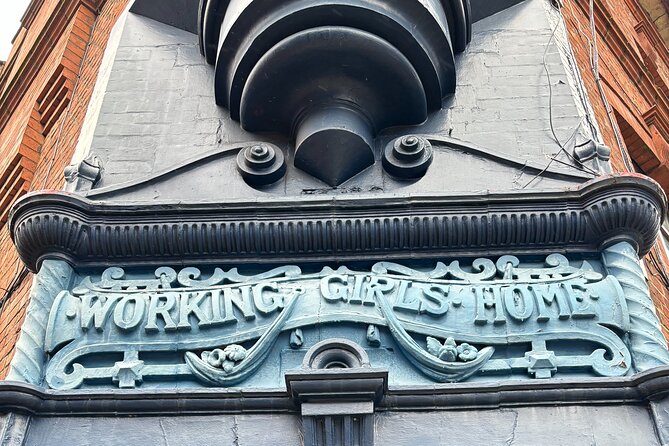
- Angel Meadow was once called Hell upon Earth: The walk explores one of Victorian Manchester’s most desperate districts.
- Dean Kirby leads the tour: Kirby wrote Angel Meadow: Victorian Britain’s Most Savage Slum and brings the subject to life with clear storytelling.
- The tour stays small: A maximum of 15 people makes it easier to ask questions and keep up with the guide.
- The River Irk is part of the story: Its banks connect poverty, overcrowded housing, industry, and the growth of Manchester.
- The final stop is Angel Meadow Park: You can continue exploring after the tour, or walk back with Kirby to the starting point.
- The walk suits history lovers more than casual sightseers: Much of what you see today is modern, so the past comes through explanation rather than preserved buildings.
Why Angel Meadow matters to Manchester
Manchester’s industrial story is often told through mills, warehouses, canals, and grand commercial buildings. Angel Meadow offers the harder side of that story. Here, industrial growth rested on the labor of families living in cramped and unhealthy conditions.
The district was once home to roughly 30,000 people. Many lived in overcrowded lodging houses and deep cellars near the River Irk. Poverty was not a brief inconvenience for these families. It shaped where they slept, what they ate, how they worked, and how they raised children.
That context gives the walk its purpose. You are not simply looking at an old park or walking a modern street. You are trying to understand how ordinary Mancunians experienced the Industrial Revolution while cotton mills and industrial wealth transformed the city around them.
Friedrich Engels described Angel Meadow as Hell upon Earth, a phrase that tells you how severe conditions were. The tour does not treat that line as a dramatic slogan. It uses it as a starting point for examining overcrowding, poor sanitation, child poverty, and the social pressures created by rapid industrial growth.
I find this kind of history useful because it keeps Manchester’s famous industrial success in human terms. The city’s rise was not only about machines and trade. It was also about families forced to survive close to factories, polluted waterways, and unstable work.
A few more history tours around the UK worth a look
- London Small Group Tour of Historical Pubs
★ 5.0 · 10,422 reviews - Edinburgh: Edinburgh Castle Guided History Tour with Tickets
★ 4.8 · 9,933 reviews - A History of Terror – Belfast City Centre Walking Tour
★ 5.0 · 2,883 reviews
Meeting at Hanover Street and setting the scene
The tour starts at Sadler’s Cat on Hanover Street, Manchester, at 2:00 pm. The meeting point is in a central part of the city, and the experience is offered in English with a mobile ticket.
The opening location matters less as a sight than as a practical place to gather before heading toward Angel Meadow. Give yourself time to find Hanover Street and get settled before the start. Because the walk lasts about an hour and a half, arriving on time helps the group move without delay.
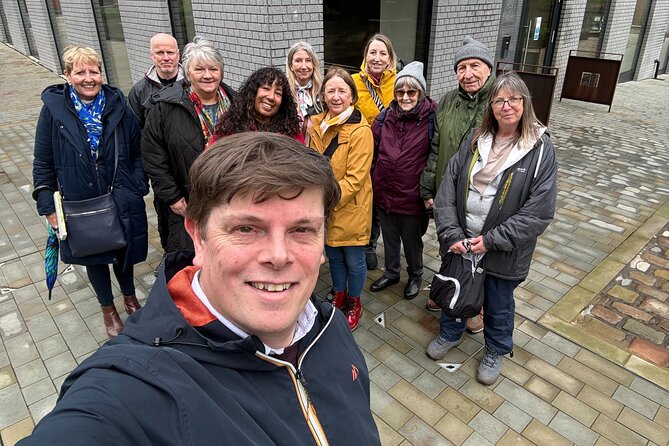
The small-group format is one of the strongest features here. With no more than 15 people, you have a better chance to hear Kirby clearly and ask about details that catch your attention. A large group can turn a history walk into a one-way lecture. This format should feel more like a guided conversation, especially since the tour is designed for people who enjoy the subject.
Kirby’s background adds real value. He is the author of Angel Meadow: Victorian Britain’s Most Savage Slum, so the walk is tied closely to serious research and a sustained interest in this particular neighborhood. You are not getting a guide who simply memorized a few dates before leading a route.
The available feedback gives Kirby high marks for explaining the subject clearly, creating a relaxed mood, and leaving room for questions. That combination matters. Angel Meadow can be a bleak subject, but a calm guide helps the story remain engaging rather than grim for its own sake.
St. Michael’s Flags and the first view of Angel Meadow
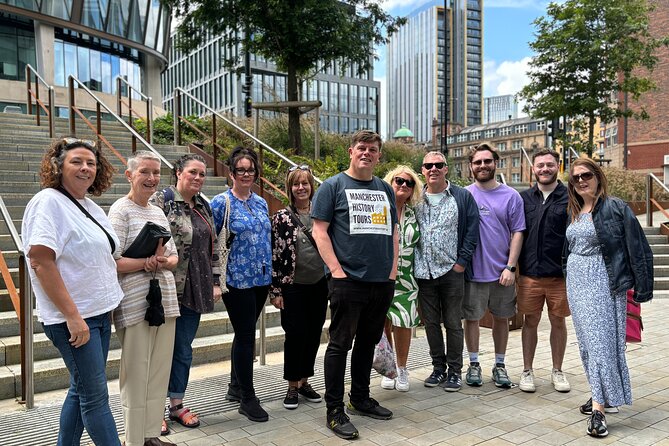
The route includes St. Michael’s Flags and Angel Meadow Park, areas that help introduce the district’s former size and social importance. The park is now tree-lined, but the tour asks you to picture a far more crowded setting.
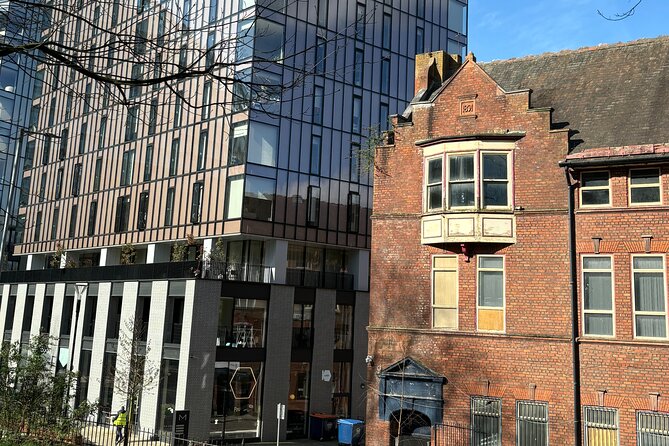
This is where the contrast between present and past becomes central. You may see modern apartments alongside places connected to the old neighborhood, including former ragged schools. The modern buildings are not a distraction from the history. They show how completely the area has changed.
Kirby’s role is to connect those visible fragments with the lives that once filled the district. He describes the streets, lodging houses, cellars, schools, and working families that made Angel Meadow a dense urban community. You should expect more explanation than surviving architecture. The pleasure comes from learning to read the present-day streets as evidence of what has disappeared.
The route also offers photo opportunities, and the guide points out useful spots along the way. Those pictures will not be a collection of grand Victorian facades. Instead, they can record the relationship between today’s streets, the park, the River Irk, and the new buildings that replaced much of the old district.
If you prefer tours built around intact monuments, this walk may feel less visually rewarding. If you enjoy historical reconstruction, the lack of preserved buildings makes the guide’s storytelling even more important.
Walking beside the River Irk
The River Irk is one of the key settings on the route. The walk follows its banks and uses the waterway to explain why this part of Manchester developed as it did.
The river connects the physical setting with the social story. Angel Meadow’s residents lived near industry and worked within a city shaped by mills, transport, and manufacturing. The river was part of the working environment, but it was also tied to the poor living conditions that made the district notorious.
You will hear about families trying to keep body and soul together while the Industrial Revolution expanded around them. That phrase captures the focus of the tour: not only what Manchester produced, but who paid the human cost.
The river section should appeal to anyone who likes history with a clear sense of place. You can stand in the same broad area where the district’s workers lived and imagine the pressure of crowded housing and hard work. At the same time, you should keep your expectations practical. The modern river corridor cannot reproduce the Victorian scene, and the tour does not pretend otherwise.
The value comes from the link between geography and history. A book can explain poverty, industry, and urban growth. A walk lets you connect those ideas to streets, water, slopes, and distances. Even when the original buildings are gone, the route helps you understand why the neighborhood mattered.
Same place, a different slice of the past:
- Edinburgh: Whisky Tasting with History and Storytelling
★ 4.9 · 2,451 reviews - Edinburgh: Old Town History and Tales Walking Tour
★ 4.8 · 2,361 reviews - Old Town Walking Tour History and Tales in Edinburgh
★ 5.0 · 2,168 reviews - Soho Music & Historic Pubs Tour
★ 5.0 · 1,993 reviews
Ragged schools, lodging houses, and vanished streets
One of the most affecting parts of the experience is the attention given to ordinary institutions and homes. The route passes streets where newer apartments now sit close to former ragged schools, creating a sharp contrast between past and present.
Ragged schools served poor children in industrial cities. Their presence points to the scale of hardship in Angel Meadow and to the limited support available to families. The tour uses places like this to show that the neighborhood was not only a collection of slums. It was a community with children, schools, working households, and local identities.
The discussion of lodging houses and deep cellars adds another layer. Overcrowding was not simply a matter of unpleasant surroundings. It affected privacy, health, family life, and the ability to escape poverty. Kirby’s account helps you see how daily survival worked in a district where large numbers of people were packed into limited space.
You may also hear about gangs of scuttlers, who were part of the street life associated with Victorian Manchester. This detail adds tension to the story, but the main focus remains the wider social conditions that produced such an environment.
This is a good section for asking questions. The group size makes it realistic to pause for clarification, and Kirby’s subject gives him a strong base for answering questions about the neighborhood and its people.
What redevelopment leaves behind
The tour’s biggest limitation is also part of its value. Much of Angel Meadow has been redeveloped, and many of the original streets and buildings are gone. You will not spend 90 minutes moving through a perfectly preserved Victorian slum.
Instead, the walk uses fragments. A park, a river, a former school, a street line, and the position of modern apartments all become clues. Kirby supplies the missing connections, helping you imagine the crowded district that once occupied the area.
Some people may find this approach more rewarding than a conventional heritage visit. It asks you to think rather than simply look. Other people may prefer visible structures with plaques and restored interiors. If you need a constant stream of intact historic sights, choose your expectations carefully.
I like the honest nature of this format. The guide does not need to claim that Angel Meadow remains untouched. The story is partly about disappearance, redevelopment, and how cities decide which parts of their past remain visible.
The modern setting also makes the tour relevant. Manchester continues to change, and Angel Meadow shows that urban change is not new. Buildings rise, streets change use, and communities can be forgotten unless someone records their stories.
Cost, timing, and the shape of the experience
At $27.62 per person, this is reasonably priced for a focused 90-minute guided walk led by an author with a strong connection to the subject. You are paying for interpretation, not admission to a museum or a collection of preserved rooms.
That distinction helps explain the value. A museum can give you objects, labels, and displays. This tour gives you a route through the actual neighborhood and a guide who can explain how its parts fit together. If Angel Meadow is new to you, the context may be worth more than a longer but less focused city walk.
The tour begins in the afternoon and ends beside the entrance to Angel Meadow Park on Old Mount Street. The listed postcode for the park entrance is M4 4GU. From there, Shudehill bus station is about a six-minute walk, which makes it easy to continue into central Manchester by public transport.
Kirby also walks back with anyone who wants to return to the starting point. That is useful if you left something nearby or prefer not to work out the route alone. If you want to continue exploring Angel Meadow, you can stay near the park after the formal walk ends.
The duration is short enough to fit into a larger Manchester day. You could pair it with other city sightseeing before or after, but do not crowd the schedule too tightly. The tour depends on a steady walk and stops for explanation, so give yourself breathing room.
Who will enjoy this Manchester history walk
I would recommend this experience most strongly to:
- People who want the social history behind Manchester’s industrial success
- Readers interested in Victorian cities, urban poverty, or Friedrich Engels
- Visitors who prefer small groups and questions over a large sightseeing crowd
- Anyone who enjoys tours where a guide helps reconstruct places that have changed
- People looking for an unusual Manchester activity away from the city’s better-known attractions
It is less suitable for anyone who wants a fully preserved historic district or a short route with no steps. You need a moderate level of fitness, and the tour is not recommended if you cannot manage steps. Service animals are allowed, and the route is near public transport.
The experience is offered in English, so you should be comfortable following a detailed spoken explanation. Since the subject is serious, it also suits people ready to think about hardship rather than only admire architecture.
The tour has received a five-star rating from 65 ratings, with 100 percent recommending it. The most praised qualities are Kirby’s clear command of the subject, his relaxed manner, and the chance to ask questions. Those points match the tour’s real strength: it turns a difficult, partly vanished neighborhood into a story you can follow.
Weather, cancellations, and practical planning
This outdoor experience requires good weather. If conditions are poor, you may be offered another date or a full refund. That policy is worth keeping in mind when planning a tight Manchester schedule.
You can cancel for a full refund up to 24 hours before the 2:00 pm start time. Changes or cancellations made inside that 24-hour period are not accepted for a refund, and the cut-off uses local time.
The tour also requires a minimum number of people. If it cannot operate because that minimum is not reached, you will be offered another date or experience, or a full refund.
For comfort, wear shoes suited to a city walk and check the forecast before setting out. The supplied details do not promise a specific surface or step count, so anyone concerned about mobility should consider the moderate fitness requirement carefully before booking.
Should you book Angel Meadow with Dean Kirby?
Book it if you want Manchester history told from the viewpoint of working families, crowded housing, and the people left out of the usual industrial success story. Dean Kirby’s authorship, relaxed style, and willingness to take questions give the walk a strong personal focus.
Skip it if you need grand buildings, museum displays, or a neighborhood that looks much as it did in the Victorian period. Angel Meadow has changed heavily, and the tour asks you to picture much of the past through words.
For most history-minded visitors, $27.62 is a fair price for a small, focused walk with a clear subject. The best reason to go is not the number of sights. It is the chance to understand how poverty and survival helped shape Manchester, right beside the modern city that grew from them.
FAQ
How long does the Angel Meadow History Tour last?
The tour lasts approximately 1 hour and 30 minutes.
What time does the tour start?
The tour starts at 2:00 pm.
Where does the tour begin?
The meeting point is Sadler’s Cat on Hanover Street, Manchester, M60 0AB, United Kingdom.
Where does the tour finish?
The tour finishes beside the entrance to Angel Meadow Park on Old Mount Street. The postcode provided for the park entrance is M4 4GU.
Can I return to the starting point after the tour?
Yes. Dean Kirby will walk back with anyone who wants to return to the starting point.
How many people can join the tour?
The tour has a maximum of 15 people.
Is the tour suitable for people with limited mobility?
The tour requires a moderate level of physical fitness and is not recommended for people unable to negotiate steps.
What happens if the weather is poor?
The experience requires good weather. If it is canceled because of poor weather, you will be offered a different date or a full refund.
Just added around the UK
- Oxford: 90 minute Architectural & Historical Highlights Tour★ 5.0 · 23 reviews
- Historical Tour and Seafood Experience★ 4.5 · 27 reviews
- Historic Walking Tour of Colchester★ 5.0 · 35 reviews
- Cruise Wells Next The Sea on Historic RNLI and Dunkirk Veteran Lifeboat★ 5.0 · 199 reviews
- The Padstow History Walk – Tales, Tales and Traditions★ 5.0 · 25 reviews
- Lightfoot Tours: Historical Tour★ 5.0 · 38 reviews
- Newcastle: History and Highlights Private Guided Walking Tour★ 5.0 · 29 reviews
- Walkabout Durham History Tour★ 5.0 · 89 reviews
UK History Tours, compared.
Edinburgh Castle Guided History Tour with Tickets
Read our review →
A History of Terror – Belfast City Centre Walking Tour
Read our review →
Old Town Walking Tour History and Tales in Edinburgh
Read our review →

Browse the lists this tour appears in