Review · MEXICO CITY
Walking Tour in Historic Center CDMX
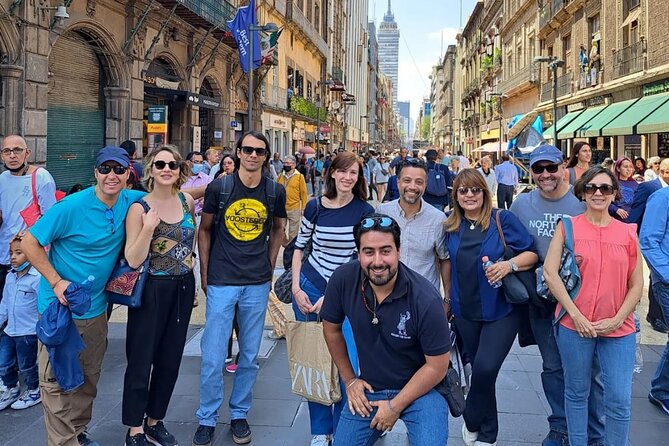
Mexico City tells its story in layers. This walking tour connects Diego Rivera’s political mural, grand Porfirian buildings, theater scandals, colonial power, and the Aztec capital of Tenochtitlan in one well-paced route. I like the wide range of subjects and the way the tour moves from modern Mexican history backward to the Aztecs. I also like that guides such as Delta, Diego, Jorge, and Jaime have earned praise for clear English, patience, and thoughtful answers.
The main compromise is time. You visit many places in roughly three hours, but several stops last only 10 to 20 minutes. That makes this a strong introduction, not a series of full museum visits. Book early in the day if you want smaller crowds, and expect to keep moving.
Key points at a glance
- Nine major stops in about three hours: The route covers murals, parks, palaces, theaters, archaeological remains, and the Templo Mayor area.
- A useful reverse-history structure: You begin with Mexico’s more recent political and cultural story, then finish with Tenochtitlan and the Spanish conquest.
- Several admission tickets are included: The listed visits include the Diego Rivera Mural Museum, Palacio de Bellas Artes, Palacio Postal, Palacio de Minería, and Museo Nacional de Arte.
- The tour ends outside Templo Mayor Museum: You receive an explanation of the temple, models, and the construction of Tenochtitlan, but the experience does not promise a full museum visit.
- Guide quality matters here: Delta, Diego, Jorge, and Jaime have all been praised for strong English, kindness, flexibility, and detailed explanations.
- The group can reach 25 people: That is manageable for a city walk, though a smaller group will make it easier to hear and ask questions.
Why this route works for Mexico City’s historic center
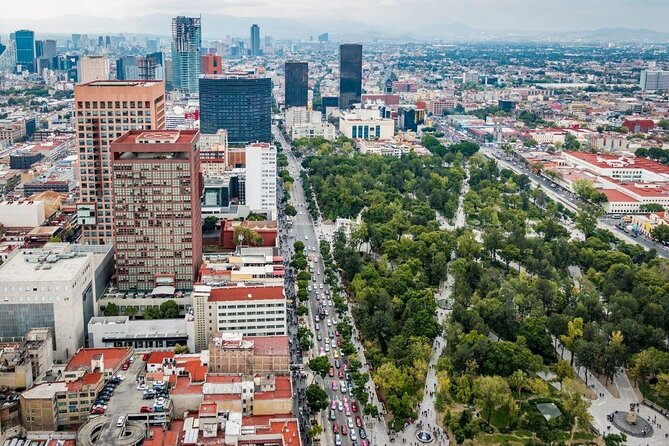
Mexico City’s center can feel like several cities placed on top of one another. Aztec foundations sit below Spanish colonial buildings. Nineteenth-century ambitions appear in ornate public buildings. Modern Mexican politics and art are displayed in murals and museums.
This tour gives you a framework for making sense of those layers. Rather than spending the entire morning inside one institution, you move between different sites and see how power, religion, money, art, and public life shaped the center.
I especially like the order. The tour begins with Diego Rivera and the political struggles of modern Mexico, then moves through the city’s grand public spaces and finishes with the Aztec capital. By the end, you have followed the story backward to the foundations of the city.
That structure is useful if you are new to Mexico City. It also helps if you have only one day in the historic center and want a guided overview before choosing which places deserve a longer visit.
The walking itself is not the whole point. The guide explains why each building matters, how the city changed, and how ordinary life was shaped by large political and cultural forces. The route also includes less polished subjects, including censorship, institutional power, the treatment of women, human sacrifice, and the violence of the conquest.
More History Walking Tours in Mexico
- Historic Downtown Walking Tour
★ 5.0 · 1,289 reviews - Mexico City: Historic Downtown Walking Tour
★ 4.8 · 1,039 reviews - Walking Tour of the Historic Center of Mexico City
★ 5.0 · 870 reviews
Diego Rivera’s mural sets the tone
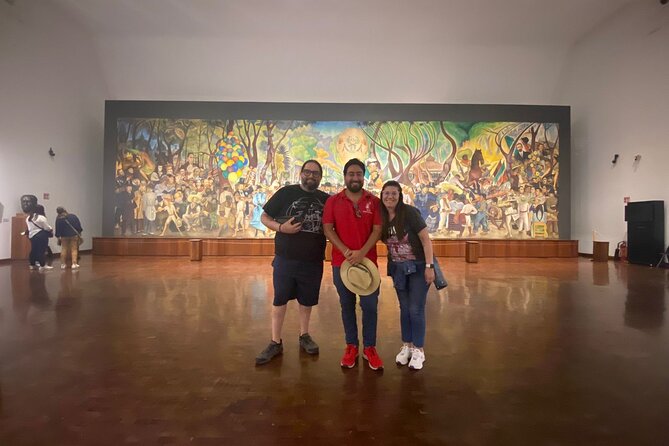
The first stop is the Museo Mural Diego Rivera, where you spend about 25 minutes with Rivera’s famous mural depicting Mexican history. The key detail here is the censorship connected with Rivera’s phrase God does not exist. That controversy gives the guide a natural way to explain the tension between religion, politics, and public art in Mexico.
The mural is not treated as a pretty picture alone. You learn about the figures who changed Mexico’s political, cultural, and ideological life. That opening is valuable because it gives you a broad timeline before you begin examining the city’s buildings.
Twenty-five minutes is enough for an informed introduction, but not enough for every figure and detail in the mural. If you are a serious art student, you will want to return later and spend more time with the work. For most people, however, this is an effective starting point.
The meeting point is at the Diego Rivera Mural Museum on Calle Colón Balderas. Check the exact location carefully before setting out, since a clear start helps the group keep to a tight schedule.
Alameda Central shows the city at leisure
After the mural, the tour moves to Alameda Central for about 10 minutes. It is described as the first public park in the Americas, and the guide discusses its classical sculptures and the way city residents use the space.
This is a short stop, but it adds something that a building-by-building tour can miss. You see the center as a place for public life, not just a collection of monuments. The park helps connect formal city planning with daily routines.
Do not expect a long stroll through every path or a detailed explanation of each sculpture. Ten minutes is enough to understand why the park matters and how people relate to it. It is also a useful pause between the museum and the grand architecture ahead.
Palacio de Bellas Artes gives you the visual centerpiece
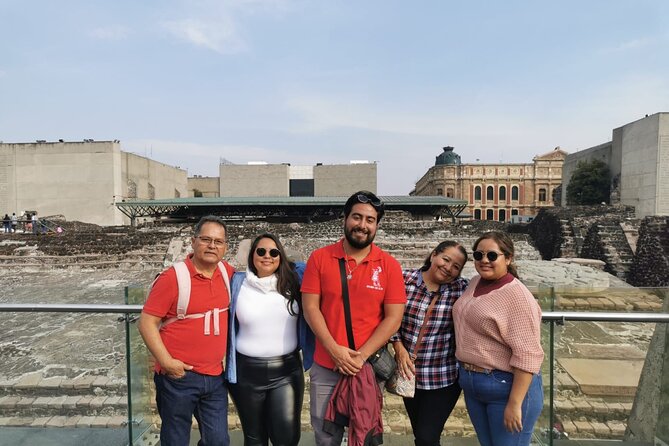
The Palacio de Bellas Artes receives about 20 minutes, and it is the visual centerpiece of the route. The guide explains its history and why it became one of Mexico City’s best-known buildings.
The short visit should help you understand the building’s place in the city, but it is not a substitute for a full visit to the interior galleries or performances. The tour is designed to show you the building and explain its importance within the city’s development.
I like the way this stop fits the broader theme of contrasts. Mexico City presents grand civic architecture beside busy streets and older structures. The tour does not reduce the center to a postcard view. It asks you to notice how the city was organized and how it grew.
If Bellas Artes is high on your list, treat this as an introduction. You may want to return with extra time after the walking tour.
More Old Town and Historic Centre Walks in Mexico
- Historic Center Food Tour in Mexico City
★ 5.0 · 1,263 reviews - Mexico City Historical Centre Food Tour with 7 Authentic Tastings
★ 5.0 · 723 reviews - Walking Tour – Impressive murals in Historical Center of Mexico City
★ 5.0 · 224 reviews - Walking Tour Across the Historic Center in Merida
★ 5.0 · 177 reviews
Porfirian ambition at Palacio Postal and Palacio de Minería
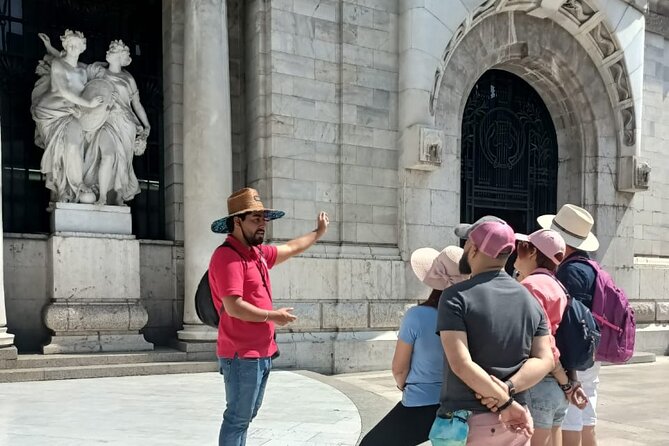
The Palacio Postal stop lasts about 15 minutes. Its story is tied to Porfirio Díaz’s project to beautify and modernize Mexico City. That context is important because it explains why certain public buildings feel so formal and ambitious.
This is not only an architecture stop. It shows how governments use buildings to project order, progress, and national confidence. The guide can help you read the building as part of a larger political project rather than as an isolated decoration.
At Palacio de Minería, you spend about 10 minutes learning about Mexico’s continuing importance as a silver exporter. The stop links the city’s architecture to natural resources, trade, and national wealth.
Ten minutes goes quickly, so the value depends heavily on the guide’s explanation. A good guide can make the connection between a handsome building and Mexico’s economic story clear without turning the visit into a lecture.
Museo Nacional de Arte adds architecture and sculpture
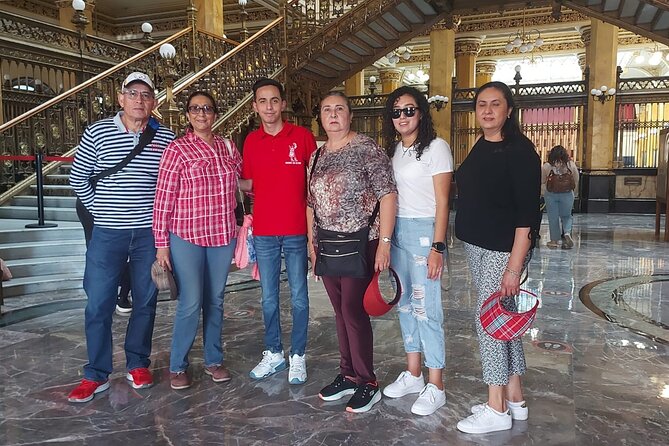
The Museo Nacional de Arte, known as MUNAL, is another brief stop of about 10 minutes. The tour includes a look at a sculpture made by an artist with one hand, along with architectural details.
That unusual fact gives the visit a human focus. Instead of seeing the museum only as an impressive façade, you get a small story about artistic ability and persistence. The architectural explanation also helps you notice details that are easy to miss when passing through the center on your own.
Again, keep your expectations realistic. Ten minutes does not allow time to tour the museum’s collection. Think of this as a guided preview, especially useful if you want to decide where to return later.
Teatro de la Ciudad reveals a darker side of city life
The Teatro de la Ciudad stop takes about 15 minutes and covers the history of theater in Mexico. The guide also tells the tragic story of Esperanza Iris, a major figure connected with the theater.
Across from the theater, you learn about an eighteenth-century asylum for women described at the time as insane. This creates one of the tour’s sharper contrasts: public entertainment and glamour on one side, institutional confinement and suffering on the other.
I appreciate this part of the route because it does not present the historic center as a polished collection of grand façades. The city’s past includes ambition and beauty, but also difficult social attitudes and painful personal stories.
The stop is short, so the guide’s storytelling makes a real difference. Jaime, Delta, Diego, and Jorge have each been praised for answering questions and explaining sites clearly. A guide who can handle sensitive subjects with care will make this portion far more useful.
Underground remains at Centro Cultural España
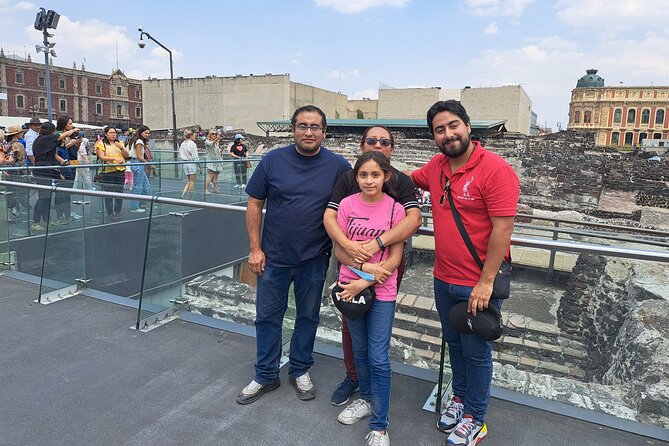
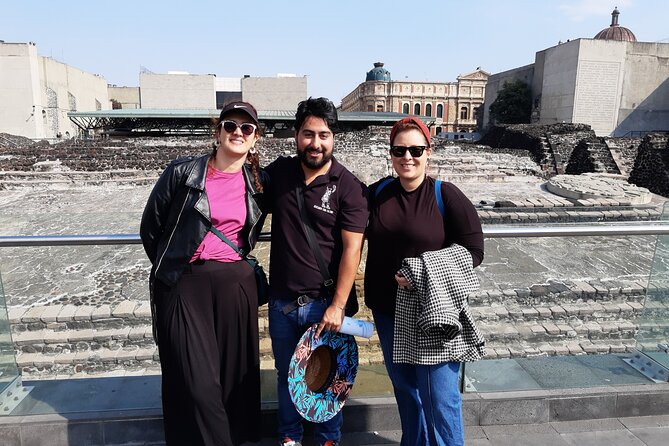
At Centro Cultural España en México, the tour goes below ground to see remains of what was once a school for the sons of Aztec nobles. The visit lasts about 20 minutes.
This is where the route begins to connect modern Mexico City directly with Tenochtitlan. You are not simply looking at old stones. You are seeing how the later city was built over, around, and alongside the earlier Aztec capital.
The stop is listed as free, which makes it a helpful addition to the route. The archaeological remains also add variety after several grand civic buildings. You shift from public architecture above ground to a more compact and hidden archaeological setting below it.
Because the schedule is tight, listen for the guide’s explanation of what the school was and why the remains matter. The setting alone may not tell you how the site fits into the larger story.
Templo Mayor finishes with Tenochtitlan
The final site is the Museo del Templo Mayor area. The tour ends by explaining the main temple from outside, using models to show how the Aztecs built Tenochtitlan, how they understood the world, and how sacrifice and the conquest fit into that story.
This ending works well because it brings the whole route into focus. You have just seen the city’s later buildings, then you return to the civilization that existed before Spanish rule. The models help explain the scale and organization of Tenochtitlan, especially if you have trouble imagining the ancient city beneath modern Mexico City.
Pay attention to the wording of the experience. The end point is Templo Mayor Museum, but the description says the tour explains the site from outside. Do not assume the price includes a full museum entry or a long archaeological visit.
The route ends at Seminario 8 in the historic center. That is practical if you want to continue exploring the area afterward, but the tour does not include lunch, drinks, or a return transfer.
Is $83.64 good value?
At $83.64 per person, this is not the cheapest way to see the center. The price makes more sense if you value a certified English-speaking guide and want a connected explanation rather than a self-guided walk between buildings.
You receive roughly two and a half to just over three hours of guided sightseeing, with several listed admission tickets included. The guide’s ability to answer questions can add real value, particularly at sites where a building or mural means little without context.
The value drops if you prefer long museum visits. The route covers nine stops, and several are limited to 10 minutes. You are paying for range, interpretation, and a carefully ordered route, not exhaustive time at every attraction.
A private-feeling experience is not guaranteed, since the group can include up to 25 people. Still, the maximum is not enormous for an urban walking tour. If you have mobility concerns, most participants can take part, and service animals are allowed, but you should be ready for a continuous city walk between stops.
Timing, guides, and practical planning
The tour is offered in English and uses a mobile ticket. Confirmation is provided when you book, and the start is near public transportation.
I would choose an earlier departure when possible. The route includes famous buildings and central public spaces, so an early start can make it easier to hear the guide and move with the group. One family specifically found that booking earlier helped avoid crowds.
Guide quality appears to be one of the strongest parts of this experience. Delta has been praised for warmth, clear explanations, and good time management. Diego has been described as especially easy to understand and helpful with lunch suggestions and advice on where to catch an Uber afterward. Jorge is praised for answering questions, while Jaime is noted for kindness and adapting to individual needs.
Those details matter because this tour covers difficult subjects and many stops in a short period. A guide who keeps the timing under control while still answering odd questions can make the difference between a rushed checklist and a useful introduction.
Tips are not included. Food and drinks are also not included, so plan to eat before or after the walk. Free cancellation is available up to 24 hours before the start time. Changes or cancellations inside that window are not accepted for a refund.
Who should book this walking tour?
I would recommend it to first-time visitors who want a fast orientation to Mexico City’s historic center. It also suits families, solo visitors, and older adults who prefer having a guide explain the route instead of sorting out the connections alone.
Art lovers should book it if they want a preview of Rivera, Bellas Artes, and MUNAL, then plan separate return visits. History-minded visitors will appreciate the movement from modern Mexico to the Aztec past.
I would be cautious if you dislike short stops, want extended museum time, or prefer a slow architectural walk. You may feel hurried at Bellas Artes, Palacio Postal, and MUNAL. The tour is broad by design.
Should you book the Historic Center CDMX walking tour?
Book it if you want a guided story of Mexico City rather than a simple building tour. The strongest feature is the route’s range: Rivera’s mural, public parks, Porfirian architecture, theater history, archaeological remains, and Tenochtitlan all fit into one morning or afternoon.
Skip it if your priority is detailed time inside museums. In that case, use the route as a map of places to visit independently. For everyone else, the certified guide, English service, included admissions at several stops, and strong reports about Delta, Diego, Jorge, and Jaime make the $83.64 worthwhile, provided you accept the brisk pace.
FAQ
How long does the walking tour last?
The experience lasts approximately 2 hours 30 minutes to 3 hours 10 minutes.
What language is the tour offered in?
The tour is offered in English.
Where does the tour begin?
It begins at the Diego Rivera Mural Museum on Calle Colón Balderas in Mexico City’s Centro area.
Where does the tour end?
It ends at the Templo Mayor Museum area on Seminario 8 in the historic center.
Is admission included?
Admission is listed as included for the Diego Rivera Mural Museum, Palacio de Bellas Artes, Palacio Postal, Palacio de Minería, and Museo Nacional de Arte. The stops at Teatro de la Ciudad, Centro Cultural España en México, and the Templo Mayor Museum are listed as free, with the Templo Mayor portion explained from outside.
Is food included?
No. Lunch, food, and drinks are not included.
How many people can join the tour?
The tour has a maximum group size of 25 people.
Can I cancel for a full refund?
Yes. You can cancel at least 24 hours before the local start time for a full refund. Cancellations or changes made less than 24 hours before the start are not accepted for a refund.
Just added around Mexico
- Culture, History and Food in Oaxaca City★ 5.0 · 43 reviews
- Bicycle Tour through Oaxaca learning about its Urban Art and History★ 5.0 · 78 reviews
- Oaxaca city bike ride – History & traditions★ 5.0 · 25 reviews
- Walking Tour – Impressive murals in Historical Center of Mexico City★ 5.0 · 224 reviews
- Food and Historic Walking Tour: Private Tortilla Crawl in Mexico City Downtown★ 5.0 · 35 reviews
- Best PRIVATE TOUR of Legends and Events in the Historic Center★ 5.0 · 33 reviews
- The real “Dia de muertos” tour in Mixquic + secret cemetery★ 4.0 · 27 reviews
- 10 wonders of the Historic Center of Mexico City food and music★ 5.0 · 67 reviews
Old Town & Historic Centre Walks, compared.

Live Fado Show with Port Wine in Historic Center
Read our review →
Valencia Old Town Tour with Wine & Tapas in 11th Century Historic Monument
Read our review →
Prague Old Town, Medieval Underground and Dungeon Historical Tour
Read our review →
Historic Center and Getsemaní Shared Walking Tour
Read our review →
Old Town Walking Tour History and Tales in Edinburgh
Read our review →
Philadelphia Old City Historic Walking Tour with 10+ Top Sites
Read our review →