
Review · GLASGOW
The Magnificent and Mysterious History of Glasgow
Glasgow wears its past on every corner. This walking tour links grand civic buildings, medieval streets, music halls, statues, murals, and Glasgow Cathedral into a lively introduction to the city. I like the wide range of sights and the way the walk explains Glasgow’s social character, not just its dates and names. I also like the local stories, from Robert Burns crowdfunding to the traffic cone on the Duke of Wellington. The main drawback is the pace: you cover a lot, and some early George Square stops may be affected by construction.
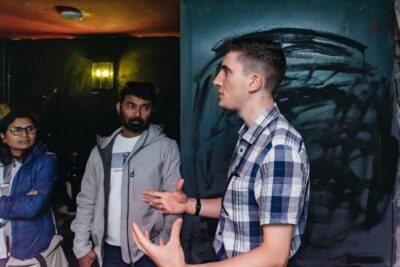
Bruce receives especially warm praise for his humor, local knowledge, and ability to make buildings talk. Henry Bell is also singled out for clear, entertaining explanations. Plan for a serious amount of walking, bring weatherproof clothing, and allow closer to two and a half hours than two hours if the group pauses or walking time runs long.
Key points before you book
- George Square sets the tone: The tour begins with Glasgow’s civic pride, war memorials, writers, merchants, and grand architecture.
- The route gets wonderfully odd: You may hear about a pizza restaurant’s unusual job opening, a traffic cone on a duke, and the world’s oldest surviving music hall.
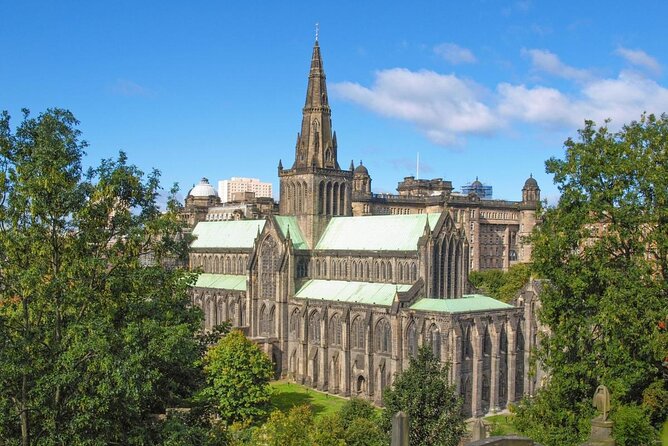
- Glasgow Cathedral is the grand finish: You spend about 20 minutes looking inside the city’s oldest building.
- Expect 40 to 45 minutes of walking: The tour is not a string of nearby stops. You move through Merchant City and the old center.
- The guide makes the difference: Bruce and Henry Bell receive strong praise for humor, clear speaking, stories, and local insight.
- The value is strong at $17.91: With more than 20 sights and no separate admission fees listed, this is an inexpensive way to get oriented.
Starting with Glasgow’s proudest address, George Square
The tour starts at George House, at 50 George Square. That puts you beside the city’s grand civic heart, where the first lesson is about how Glasgow wanted the world to see it in the 19th century.
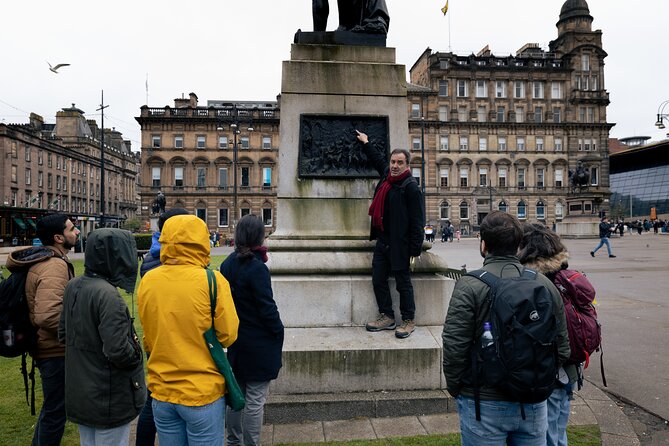
The City Chambers is the visual heavyweight. It houses Glasgow City Council and is described as one of the city’s most spectacular buildings. Look closely at the sculpture. The decoration says plenty about civic ambition, trade, empire, and the self-image of Glasgow’s citizens during the city’s great period of growth. You do not simply hear that Glasgow became prosperous. You get an architectural clue to how that prosperity was displayed.
The Glasgow War Memorial follows, a small stop with serious weight. It honors citizens killed in the First World War and marks a change in the city’s story. This is a good example of how the walk moves between proud public display and the human cost behind it.
George Square also gives you the statues of Sir Walter Scott, Robert Burns, and David Livingstone. Scott’s monument links Scotland’s national identity with the way modern ideas about the country were shaped. Burns brings a more popular story. His statue was funded by small donations, including contributions of only five pence, and about 30,000 people attended its unveiling. That is a useful reminder that public monuments were not only paid for by wealthy patrons.
The Robert Burns stop may be one of the tour’s best short moments, especially if your guide recites one of his poems. One review specifically praised the enthusiastic delivery in front of the statue. It is the sort of detail that turns a stone figure into a person with a public following.
A few more history tours around the UK worth a look
- London Small Group Tour of Historical Pubs
★ 5.0 · 10,422 reviews - Edinburgh: Edinburgh Castle Guided History Tour with Tickets
★ 4.8 · 9,933 reviews - A History of Terror – Belfast City Centre Walking Tour
★ 5.0 · 2,883 reviews
Merchants, mansions, and the city’s money
From George Square, the route moves toward Merchant City. This part of Glasgow explains who paid for the grand buildings and how trade shaped the city.
Merchant’s House gives you a look at the importance of Glasgow’s merchants and the way they viewed their role. The building is not just a handsome stop. It helps connect wealth, status, civic leadership, and the growth of the modern city.
The Gallery of Modern Art adds an architectural twist. Before becoming a gallery, the building was a private mansion and served several other purposes. That changing use is typical of central Glasgow, where old structures have been adapted again and again. You get a quick lesson in the city’s past and present without being locked into a museum visit.
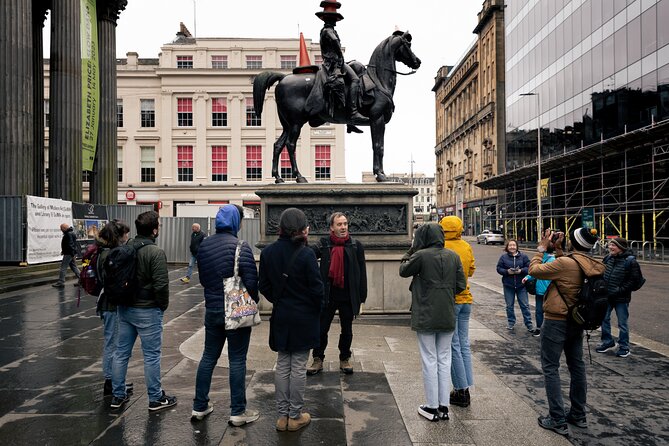
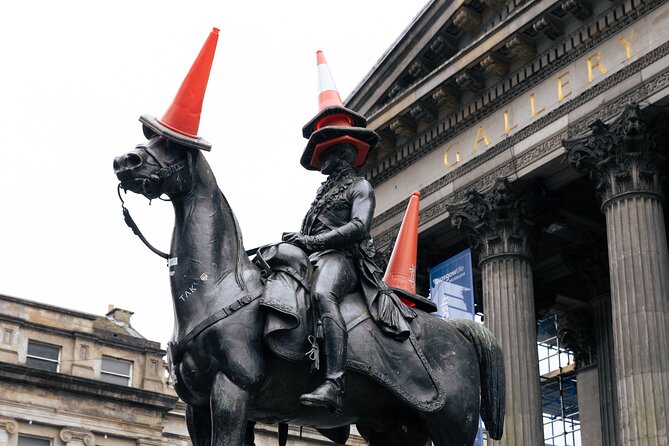
The Duke of Wellington Statue supplies the comic relief. Wellington was a decorated military leader and former prime minister, but the statue is now famous for a different reason. A traffic cone is regularly placed on his head. The joke has become part of Glasgow’s public identity, with a slightly rebellious edge that fits the city well.
Then comes Paesano Pizza, one of the city’s popular pizza spots. The stop is only about a minute, but it carries a curious story about a very unusual job opportunity. This is not a major monument, and that is precisely why it works. The tour is interested in modern Glasgow as well as grand old Glasgow.
An 18th-century Georgian townhouse appears next. The original family had an interesting story, and the house gives you another reminder that modern streets often preserve older layers. The stop is brief, so do not expect a full interior visit or a long architectural lecture. Think of it as a useful piece in the city’s larger story.
Trades, markets, and Glasgow’s working institutions
The Trades Hall of Glasgow represents a different side of civic life. The Trades House spoke for groups such as carpenters, tanners, and dyers, while also helping members who had become too old to work. This is an important counterweight to the merchant story. Glasgow was shaped by powerful traders, but it also depended on skilled workers and systems of mutual support.
The route then reaches a medieval street associated with candle makers. They worked apart from the old town because of the risk of fire. Later, the same area became a place for markets and warehouses, and it now forms part of Glasgow’s cultural district. This is a fine example of the tour’s method: a short street can reveal changes in work, safety, commerce, and culture over several centuries.
The Corinthian Club occupies buildings that once served as a bank, courthouse, and county building. Today it is a high-profile club and wedding venue. You may not spend long here, but the stop makes a practical point about Glasgow’s old buildings. Their uses change, but their grand public face often remains.
The Saints of Ingram section links several charitable institutions. Along with the original Merchants House and Trades House, Hutcheson’s Hospital was once described as one of Glasgow’s three graces. Together, these institutions cared for citizens for many years. The story helps you see charity not as a side note, but as part of the way the city was organized.
The Old Fruitmarket and Glasgow’s entertainment side
The Old Fruitmarket was once a busy commercial center. The building has been converted to retail use, but you can still walk through it and picture the earlier market. This is the kind of stop I appreciate because it does not require much imagination from the guide or the audience. The building itself helps you make the connection.
At Trongate 103, the tour introduces Glasgow’s arts scene. The arts center includes the Sharmanka Kinetic Gallery, among other attractions. You do not need to enter for the walking tour, but the stop points you toward an area worth exploring later if you have time.
The Britannia Panopticon Music Hall is one of the route’s most distinctive sights. It is described as the world’s oldest surviving music hall, and a young Stan Laurel performed there before becoming one half of a famous comedy partnership. The building connects working-class entertainment, popular performance, and the city’s long relationship with humor.
This section gives the tour a welcome change of mood. The route is not only about council halls, statues, and religious buildings. It also asks where ordinary people went for entertainment and how Glasgow’s cultural life developed.
Same place, a different slice of the past:
- Edinburgh: Whisky Tasting with History and Storytelling
★ 4.9 · 2,451 reviews - Edinburgh: Old Town History and Tales Walking Tour
★ 4.8 · 2,361 reviews - Old Town Walking Tour History and Tales in Edinburgh
★ 5.0 · 2,168 reviews - Soho Music & Historic Pubs Tour
★ 5.0 · 1,993 reviews
High Street, medieval Glasgow, and St. Mungo
Mercat Cross is a recreation of a medieval market cross, the kind of place where proclamations were made. It helps you picture a city where public announcements happened in the street, close to markets and daily trade.
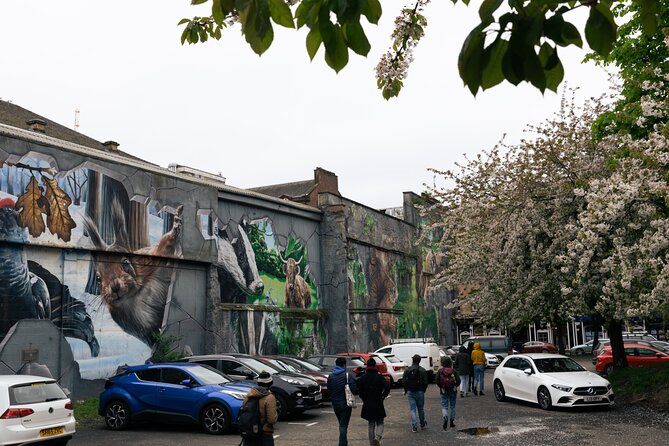
High Street receives the longest outdoor stop, about 15 minutes. It was the heart of medieval Glasgow, and several attractions are tied together here. You hear about the site of the old University, described as the fourth oldest in Britain, along with two murals connected to Glasgow’s patron saint, St. Mungo.
This is also where the tour’s religious and civic themes begin to meet. St. Mungo is central to Glasgow’s identity, and guides such as Bruce have been praised for explaining his miracles and importance in a clear, memorable way. If you know little about him before the walk, this section gives you a useful foundation for understanding the city’s symbols.
The High Street portion may be the most rewarding part for anyone interested in architecture, murals, or the old city plan. One point to keep in mind is that the tour covers many subjects quickly. If you want detailed architectural analysis of each building, you may need to return on your own.
Ramshorn, medicine, and the city’s long memory
The Ramshorn Theatre opened in 1824, replacing an earlier church. Many prominent people from Glasgow were buried there. In later years, the building became a theatre and now serves as a language studies center owned by the University of Strathclyde.
This stop shows how one building can carry several different identities. Church, burial place, theatre, and university center are not separate stories here. They are chapters in the same urban building.
The Friends of Glasgow Royal Infirmary Museum introduces Glasgow’s medical past. The hospital is the oldest in the city, and many medical innovations were developed there. The stop is short, but it gives you another way to understand Glasgow’s contribution to public life. The city’s story is not only commerce and architecture. It includes hospitals, care, and practical advances.
Glasgow Cathedral, Provand’s Lordship, and the best finish
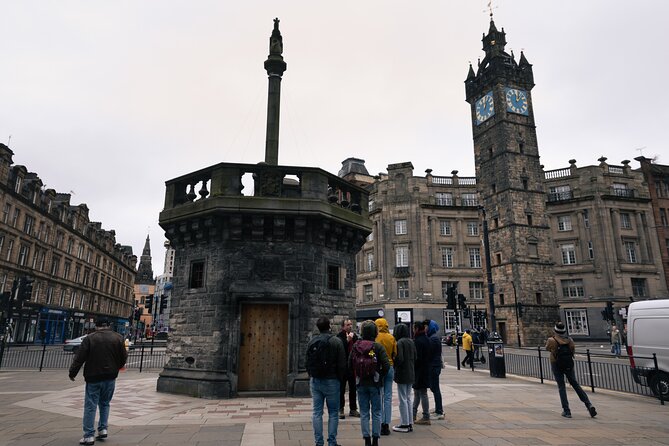
The tour finishes around Glasgow Cathedral, the oldest building in the city, dating from the 13th century. A church has occupied the site since the 6th century. You spend about 20 minutes looking inside, making this the most substantial single stop at the end of the walk.
The cathedral is the place to slow down. After the quick statue stops and street explanations, the interior gives you time to consider the age of the city and the role of religion in its development. One group could not enter because of a private service, and construction has also affected some parts of the route at times. Access can therefore change, even though the cathedral is a key part of the planned experience.
Nearby Provand’s Lordship dates from the 14th century and is, apart from the cathedral, one of Glasgow’s oldest buildings. The St. Mungo Museum of Religious Life and Art was built to look older than it is and presents different religions practiced around the world today. Together, these final stops create a useful contrast: medieval religious buildings, a modern museum, and the continuing place of faith in public life.
The published end point is 98 Ingram Street, outside Ramshorn Church, not far from George Square. Allow a little flexibility, since the route descriptions also connect the finish with the cathedral area. Either way, you are not finishing at the exact place where you began. Plan your next activity around Ingram Street rather than assuming you will walk straight back to George Square.
How the pace and group size affect the experience
The listed duration varies from about 2 hours 4 minutes to 2 hours 14 minutes, while the practical guidance says the walk may last about 2 hours 45 minutes. That difference matters. The route includes about 40 to 45 minutes of walking between major sights, plus time for questions, group movement, and pauses.
You should be comfortable walking on city streets for several hours. This is not a hop-on, hop-off experience, and it is not a short George Square talk. One person found the full route longer than needed and would have preferred to finish in the square. Another appreciated the quick but comfortable pace because it allowed the group to see much more.
The group can have up to 15 people. That is reasonably small for a public tour, but it is not private. One review noted that it was sometimes hard to hear, and suggested paying a little more for a smaller group. If you have hearing concerns, try to stay close to the guide and avoid drifting behind during street crossings.
The tour is offered in English, uses a mobile ticket, and is near public transportation. Service animals are allowed, and most people can take part. Wear shoes suited to city walking and bring rain protection. The experience requires good weather, so poor conditions can lead to a new date or a refund.
Is $17.91 a fair price?
Yes, the price is strong for the amount of ground covered. At $17.91 per person, you receive roughly two to two and three-quarter hours of guiding, a route through central Glasgow, and explanations of more than 20 locations. The appeal is not admission savings, since the stops are described as free. The value comes from context and orientation.
You can walk through George Square or High Street on your own. The challenge is understanding why the buildings matter, how the merchant and trades groups differed, and how the medieval city relates to the modern arts district. A good guide turns separate sights into a connected city story.
The value depends on your expectations. If you want an in-depth lecture on architecture, the short stops may feel too brisk. If you want a lively first look, plenty of local facts, and a list of places to revisit, the price is easy to justify.
Who will enjoy this Glasgow history walk?
I would recommend it for a first visit, especially if you want to get your bearings in Merchant City and the old center. It suits people who enjoy city stories, civic buildings, statues, religious history, street art, and odd local facts.
It also works well for repeat visitors who think they already know central Glasgow. One local participant still learned new things, particularly from the historical explanations. The tour can reveal details you might walk past every day.
You may want another option if you dislike group walking, prefer a slow architectural study, or have only a short time before another fixed booking. The route covers a lot, and the guide’s pace can be brisk. It is also wise to check current construction and access conditions around George Square and Glasgow Cathedral.
Should you book it?
Book this tour if you want a lively, affordable introduction to Glasgow that mixes major sights with unusual stories. The strongest parts are the guide-led connections between civic pride, trade, religion, entertainment, and the city’s slightly mischievous humor.
I would book it early, since it is commonly reserved about 35 days ahead. Choose it near the start of your stay, then use the route to decide where to return. Just allow extra time, expect some walking, and accept that a few stops may change because of construction or private services.
FAQ
Where does the tour start?
It starts at George House, 50 George Square, Glasgow G2 1EH, UK.
Where does the tour finish?
It ends at 98 Ingram Street, outside Ramshorn Church, not far from George Square.
How long does the tour last?
The stated duration is about 2 hours 4 minutes to 2 hours 14 minutes, but practical guidance says to allow about 2 hours 45 minutes, including walking between sights.
How much walking is involved?
There is about 40 to 45 minutes of walking between the main attractions, in addition to time spent at the stops.
What language is the tour offered in?
The tour is offered in English.
What is the maximum group size?
The group can have a maximum of 15 participants.
Are admission tickets included?
The listed stops have no admission charge for this experience. The tour includes outside visits and a planned look inside Glasgow Cathedral, subject to access.
Can service animals join the tour?
Yes. Service animals are allowed.
What happens if the weather is poor?
If poor weather causes the tour to be canceled, you will be offered another date or a full refund.
Can I cancel for a refund?
Yes. You can cancel at least 24 hours before the start time for a full refund. Changes or cancellations made less than 24 hours before the start time are not accepted for a refund.
Just added around the UK
- Leeds Ghost Tour Explore the Haunting History of Leeds★ 5.0 · 30 reviews
- Glasgow: Pubs & History Walking Tour with Beer Tasting★ 5.0 · 81 reviews
- Brewood Village Historical Tour★ 5.0 · 21 reviews
- The History Behind Outlander Tour★ 5.0 · 18 reviews
- Thirsty for Edinburgh: Scotlands Best Historical Pub Tour★ 5.0 · 24 reviews
- St Andrews, Fife Coast Walk & Historic Abbey Tour from Edinburgh★ 5.0 · 62 reviews
- Old Town Walking Tour★ 5.0 · 17 reviews
- The Anatomist – Award Winning Historical Escape Room Experience★ 5.0 · 151 reviews
UK History Tours, compared.
Edinburgh Castle Guided History Tour with Tickets
Read our review →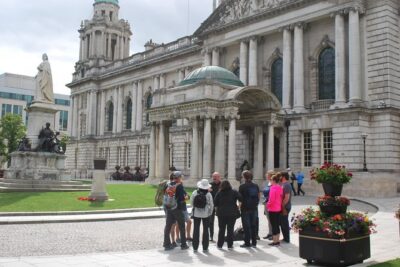
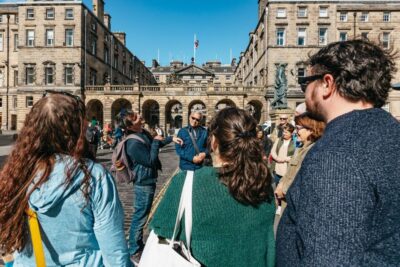
A History of Terror – Belfast City Centre Walking Tour
Read our review →
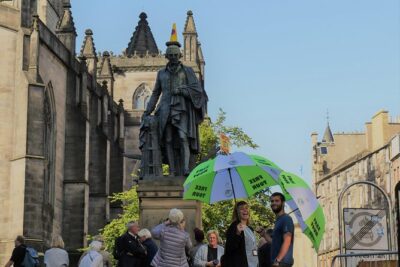
Old Town Walking Tour History and Tales in Edinburgh
Read our review →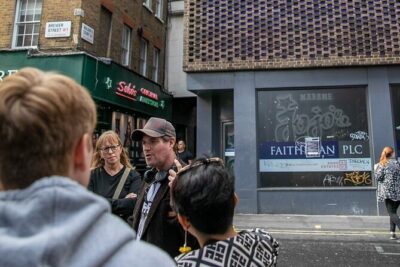
Browse the lists this tour appears in