

Review · HOBART
Historic Battery Point
History has a human face here. This two-hour walk through Hobart’s Battery Point links grand Georgian homes, workers’ cottages, Parliament House, Arthur Circus, and Salamanca Place with lively stories from a local guide. I like the small group of up to eight people, which should make it easier to ask questions, and I like the gentle pace through a neighborhood best seen on foot. The main consideration is that this is an outdoor walking tour in all weather, so rain, wind, or cold can affect your enjoyment.
The tour costs $27.26 per person, a fair price for a professional guide and two hours of local storytelling. Guides Lisa and Bec receive especially warm praise for their humor, energy, and command of Hobart’s past. If you arrive by cruise ship, allow plenty of time, since missed tours caused by a late or absent ship are not refundable.
Key points at a glance

- Arthur Circus reveals Battery Point’s village-like heart, with cottages arranged around an open green.
- Governor Arthur’s property dealings add a touch of scandal to the area’s polished colonial image.
- Reverend Knopwood’s downfall brings a colorful personal story to Hobart’s early years.
- Alexander MacGregor’s grand Georgian home shows how trade money changed the district.
- The route finishes at Salamanca Place, near the Saturday market and cafés.
- A maximum of eight people keeps the walk personal, with room for questions and conversation.
Why Battery Point works best with a guide

Battery Point can look simple at first glance: quiet streets, old houses, tidy gardens, and views toward Hobart’s waterfront. The value of this walk is learning how those pieces fit together.
The district was once farmland known as Cottage Green. Later, money flowed into the area through trade and the British Royal Navy, which shipped timber, wool, and rum from the docks and warehouses around Salamanca. That change left its mark in the housing. You see polished colonial estates near modest cottages built for workers, all within a fairly compact area.
I like tours that explain more than the age of a building. Here, the guide connects architecture with the people who lived in it and the trade that paid for it. A plain cottage is not just an old house. A grand Georgian residence is not just an attractive facade. Each helps explain how Hobart grew and who benefited from that growth.
The guides are a major part of the appeal. Lisa is praised for answering questions with humor and for pointing out details you could easily miss with a guidebook. Bec is also noted for her local knowledge, good humor, and contagious energy. Since the group is capped at eight, you should have a better chance to hear clearly and speak with the guide than on a large city walk.
A few more history tours around Australia worth a look
- Ultimate Melbourne Walking Tour: History, Laneways & Culture
★ 5.0 · 1,451 reviews - Puffing Billy Railway: Heritage Steam Train Journey
★ 4.6 · 1,195 reviews - Morning World Heritage Cruise on the Gordon River from Strahan
★ 5.0 · 1,193 reviews
Starting outside Parliament House
The walk begins outside Parliament House at 1 Salamanca Place, near the waterfront. This is a practical meeting point, especially if you are already exploring Salamanca or arriving from central Hobart.
Starting here gives the tour an immediate sense of place. Parliament House represents the civic side of Hobart, while the nearby warehouses and waterfront tell the story of trade. From the opening minutes, the route places Battery Point between government, shipping, commerce, and domestic life.
You should arrive ready to walk rather than expecting a sightseeing bus with frequent stops. The tour follows city pavements for about two hours. It is described as easy and not especially strenuous, and there are places to sit or perch along the way, but comfortable shoes still make sense.
There is no hotel pickup or drop-off. You make your own way to Parliament House and leave the tour at Salamanca Place, so the route is convenient if you plan to continue around the waterfront afterward.
Cottage Green and the early neighborhood
Battery Point’s earlier identity as Cottage Green helps explain the contrast you see in its streets. The area was not created as one uniform estate. It developed over time, with homes for different classes of residents appearing beside one another.
This gives the walk more texture than a parade of grand houses. You can look at architectural styles ranging from colonial estates to small workers’ cottages. The guide’s job is to point out why those differences matter and how residents shaped the district.
I especially like this kind of neighborhood walk because the best details are often easy to miss. A change in scale, a narrow lane, or a modest cottage can say as much about the past as a famous building. Without local explanation, you might simply admire the street. With the stories, you begin to read it.
The leisurely pace is important. You are not rushing from one major sight to another. Instead, the guide can pause to explain residents, homes, and events tied to the area. That slower rhythm suits Battery Point, where the pleasure comes from looking closely.
Arthur Circus and the village feel

Arthur Circus is one of the tour’s key stops. Its layout gives Battery Point a distinctly intimate feel and helps you picture how a small residential community worked in earlier times.
The circus is also tied to stories about Governor Arthur and questionable property dealings. That detail gives the tour a useful edge. Hobart’s colonial past was not only a story of orderly expansion and elegant homes. It also involved power, land, and decisions that could benefit some people more than others.
This is where a guide can add context that a photograph cannot. You get the visual pleasure of the space, then hear about the decisions and personalities connected with it. That combination makes the stop more memorable without turning the walk into a dry lecture.
Arthur Circus also provides a natural break in the route. There are places to sit or perch along the way, which helps if you need a short rest. The tour is suitable for most people with a basic level of fitness, but anyone who finds two hours on city pavements difficult should take the duration seriously.
Same place, a different slice of the past:
- Strahan: World Heritage Cruise on Gordon River with Lunch
★ 4.8 · 1,143 reviews - Sydney: The Rocks 90-Minute History Walking Tour
★ 4.7 · 1,092 reviews - Experience History onboard The Mary Valley Rattler
★ 5.0 · 963 reviews - Snorkel & Dive the Reef: Sustainable, Scientific & Cultural Tour
★ 4.5 · 841 reviews
Reverend Knopwood and the less-polished past
The story of Reverend Knopwood adds a more personal and surprising note to the walk. His fall from favor, linked to a life of carousing, shows that early Hobart was not populated only by respectable officials and careful merchants.
Stories like this help keep the tour grounded. Historic districts can sometimes feel too polished, as if every former resident behaved perfectly and every old building came from a noble plan. Knopwood’s story brings in human weakness, social judgment, and the gap between public respectability and private behavior.
The guide’s humor matters here. Lisa is repeatedly praised for making the past interesting and fun, while Bec is noted for her energy and good humor. Those qualities should suit stories that need a light touch without losing their historical point.
You should not expect a theatrical performance or a museum-style presentation. The appeal is live commentary from a local guide who can answer questions as they arise. If you enjoy asking how people lived, worked, argued, or gained influence, this part of the tour should be particularly rewarding.
Alexander MacGregor’s Georgian house

The route also introduces Alexander MacGregor, a shipbuilding tycoon whose grand Georgian home reflects the money flowing into Battery Point. His house provides a clear example of how maritime trade could translate into social status and impressive domestic architecture.
This is one of the strongest links between the buildings and the wider story of Hobart. The home is not simply attractive because of its proportions or period details. It represents the commercial world that helped finance the district’s more imposing residences.
At the same time, the nearby cottages keep the story from becoming too focused on wealthy owners. Battery Point’s character comes from the mix. You see the homes of people with money and influence, but also the smaller dwellings connected to workers and ordinary families.
I would pay close attention to the guide’s explanation of who lived where and why. The tour’s real value is not memorizing a list of names. It is understanding how trade, shipping, government, and housing came together in one compact part of Hobart.
From Salamanca’s docks to Battery Point’s homes

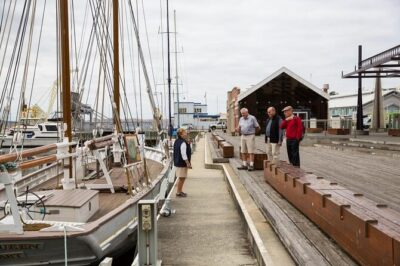
The walk explains how wealth reached Battery Point from the waterfront. British Royal Navy shipping moved timber, wool, and rum through the Salamanca docks and warehouses. That activity brought money, workers, goods, and social change to Hobart.
This context makes the route more than a residential stroll. You are tracing a connection between working waterfront and quiet neighborhood. The elegant homes make more sense when you know what economic activity supported them.
The tour ends back at Salamanca Place, the area associated with the waterfront warehouses and the Saturday market. The ending is well chosen because it gives you a practical next step. You can continue exploring, visit the market if it is operating, or stop at one of the cafés the guide recommends for coffee.
The Saturday market is described as the oldest market in Australia, so timing matters if you want to combine the walking tour with it. The tour itself does not include food or drinks, and the market is not part of the ticket, but ending nearby makes it easy to plan around both.
What the $27.26 price gets you

At $27.26 per person, this is a modestly priced guided activity for a two-hour city walk. The ticket includes a professional local guide, live commentary, and a small group limited to eight people.
The value depends on what you want from Hobart. If you mainly want to stroll through pretty streets at your own pace, you can explore Battery Point without paying for a guide. But you will miss the connected stories about Governor Arthur, Reverend Knopwood, Alexander MacGregor, shipping, housing, and local residents.
I think the fee is easiest to justify at the start of a Hobart visit. The walk can help you understand the city’s layout and give you ideas for places to revisit later. It also suits anyone who prefers local explanation over reading plaques or searching online while walking.
Food, drinks, and hotel transportation are not included. That keeps the price down, but you should budget for your own coffee or meal afterward. Since the walk finishes at Salamanca Place, adding a café stop is simple.
Who should book this walk
I would recommend it to you if you enjoy architecture, local personalities, and history told through ordinary streets. It is also a good choice if you want an introduction to Hobart that does not require a full-day commitment.
The tour should suit:
- First-time visitors who want to understand Battery Point quickly.
- Cruise passengers with enough time to reach Parliament House and complete two hours on foot.
- Couples and small groups who prefer a quieter, personal tour.
- Visitors interested in colonial homes, shipping, civic history, and local residents.
- People with a basic level of fitness who are comfortable walking on city pavements.
It may be less suitable if you want interiors, a meal, hotel pickup, or a tour built around major attractions with very little walking. The route is outdoors and runs in all weather, so dress for Hobart’s conditions. Children must be accompanied by an adult.
The tour is accessible to most participants, and service animals are allowed. Still, the activity remains a two-hour walk, so anyone with limited mobility should consider the pavement route and the available sitting points before booking.
Timing, weather, and cruise-ship planning
The tour lasts about two hours, and the pace is deliberately easy. Even so, I would avoid scheduling it too tightly against another activity. You need time to reach Parliament House, check in, and finish the walk without watching the clock.
Cruise passengers should be especially careful. A late or non-arriving ship does not qualify for a refund, so do not book this as a close connection with your ship’s departure. The start point near Salamanca Place is convenient, but convenience does not remove the need for a generous time buffer.
The walk operates in all weather. Bring clothing suited to the forecast, since the experience takes place outside and there is no promise of shelter. The good news is that there are places to sit or perch, and the route is not considered strenuous.
Free cancellation is available if you cancel at least 24 hours before the start time. Changes or cancellations made inside that window are not refunded, and the tour requires a minimum number of participants. If that minimum is not reached, you are offered another date or experience, or a full refund.
Should you book Historic Battery Point?
Book this tour if you want personal local storytelling in a small group, with architecture and people at the center of the experience. Lisa and Bec sound like the kind of guides who make a familiar street feel worth a second look, and the route covers several of Battery Point’s most useful stories without taking half a day.
I would be more cautious if you dislike walking, need indoor attractions, or have a cruise schedule with little spare time. For most visitors, though, $27.26 is a sensible price for two hours of context, conversation, and a gentle introduction to one of Hobart’s most distinctive neighborhoods.
FAQ
How long is the Historic Battery Point tour?
The walking tour lasts approximately two hours.
Where does the tour begin?
It begins outside Parliament House at 1 Salamanca Place, Hobart, near the waterfront.
Where does the tour finish?
The tour ends at Salamanca Place.
What is included in the price?
The price includes a professional local guide and live commentary during the walk.
Are food and drinks included?
No. Food and drinks are not included, although the guide can recommend nearby cafés for coffee after the walk.
Is the tour suitable for people with limited fitness?
The walk is described as easy and not too strenuous, and most people can participate. It follows city pavements, lasts two hours, and includes places to sit or perch.
What happens if I need to cancel?
You can cancel up to 24 hours before the start time for a full refund. Cancellations or changes made less than 24 hours before the start time are not refunded.
Just added around Australia
- Hobart History, People & Places – 2 hour city walk★ 5.0 · 224 reviews
- Cascades Female Factory Historic Site [official]★ 4.5 · 110 reviews
- Cascade Historic Tour★ 5.0 · 38 reviews
- Darwin Heritage Walk★ 4.5 · 101 reviews
- Darwin History and Wartime Experience Tour★ 5.0 · 144 reviews
- Bombing of Darwin WWII Heritage Tours★ 5.0 · 261 reviews
- Private Half Day Tour: World Heritage Rainforest & Waterfall★ 5.0 · 19 reviews
- Authentic Indigenous Cultural Tour Including Scenic River Cruise★ 5.0 · 88 reviews
Hobart History Tours, compared.

Derwent River Historic Harbour Cruise From Hobart
Read our review →
Tasman Island Cruises and Port Arthur Historic Site Day Tour from Hobart
Read our review →
Tasman Peninsula Tour, Cruise & Port Arthur Historic Site
Read our review →

Hobart History, People & Places – 2 hour city walk
Read our review →
Cascades Female Factory Historic Site [official]
Read our review →
Browse the lists this tour appears in