
Review · NEW DELHI
Delhi’s historical 7 hours experience tour
Delhi rewards a curious eye. This seven-hour private tour gives you a practical way to connect Old Delhi’s spice lanes, Mughal monuments, British-era avenues, and modern religious landmarks without trying to solve the city on your own. I especially like the private air-conditioned vehicle and the chance to ride through Chandni’s tight lanes by tuk-tuk or rickshaw. The main caution is pace: with as many as nine sights on the route, some stops may feel more like focused visits than long explorations.
I also like the mix of major monuments and everyday Delhi. You get Jama Masjid and Humayun’s Tomb, but you also smell the spices at Khari Baoli, see local life around Chandni Old Bazaar, and pause at Raj Ghat. The tour can be adjusted to some degree, and guides such as Shahnawaz and Sameer have been praised for clear explanations, patience, and friendly service. The exact order and time at each stop may change, especially when optional visits are included.
Key things to know before booking
- Khari Baoli brings Delhi’s daily trade to life: The spice-market section is not just a photo stop. It adds the sounds, smells, and working rhythm of Old Delhi.
- The tour covers several eras in one day: Mughal, Sultanate, British, Sikh, Baháʼí, and modern Indian history all appear along the route.
- Private transport saves time: Hotel pickup, an air-conditioned vehicle, parking, and bottled water are included.
- The rickshaw ride is brief but memorable: A tuk-tuk or open rickshaw helps you enter streets that are difficult to cover comfortably by private car.
- Entrance fees need attention: Jama Masjid, Humayun’s Tomb, and Qutub Minar are listed with admission not included unless you choose the option that includes monument fees.
- The low price is strongest for small groups: At $29 per person, the value improves when you share the private vehicle with family or friends.
Why this route works for a first day in Delhi
Delhi can feel like several cities placed side by side. Old Delhi grew around the Mughal capital of Shahjahanabad, while New Delhi was shaped under British rule with broad avenues, official buildings, and formal gardens. This tour puts those contrasts into one long day.
I like that the route does not focus only on famous monuments. You move from the grand façade of Jama Masjid into the working streets near Khari Baoli, then back into open spaces at Raj Ghat and India Gate. Later, the route shifts to carefully planned tomb gardens and the red sandstone tower of Qutub Minar.
The private format matters here. Delhi’s traffic can eat up time, and a dedicated vehicle lets your group move between distant parts of the city without figuring out several local connections. Hotel pickup is offered, and the vehicle is air-conditioned. Bottled water and parking fees are also included.
The trade-off is breadth. Seven hours is enough to see a lot, but not enough to examine every monument at length. If you want a slow visit inside the Red Fort, a long walk through Humayun’s Tomb gardens, or extended time at Qutub Minar, ask the guide to prioritize. The tour is at its best when you accept it as a carefully packed introduction.
A few more history tours around New Delhi worth a look
- The Great Indian Food Tour: Old Delhi Food and Heritage Walk
★ 5.0 · 1,698 reviews - Old Delhi Food, Heritage&Cultural Walk with Rickshaw ride to Masterji Kee Haveli
★ 5.0 · 742 reviews - Old Delhi Heritage Walking Tour
★ 5.0 · 247 reviews
Jama Masjid and the first look at Old Delhi
Jama Masjid is a strong opening stop. Shah Jahan built the mosque between 1650 and 1656, using red sandstone and white marble. It is described as India’s largest mosque, and its scale gives you an immediate sense of Mughal ambition.
You are scheduled for about 30 minutes. That is enough to take in the main structure and hear the basic story, but it is not a long architectural study. Admission is not included in the standard arrangement, so check the selected option before departure.
The mosque also sets up the rest of the morning. From this formal Mughal monument, you soon move into the narrow commercial streets of Old Delhi. That contrast is one of the clever parts of the route: royal power first, ordinary commerce next.
Dress and behavior matter at a religious site. The supplied information does not specify a dress code, so ask the guide what is expected on the day. A little preparation helps you spend your short visit looking at the building instead of sorting out site rules.
The rickshaw ride through Khari Baoli
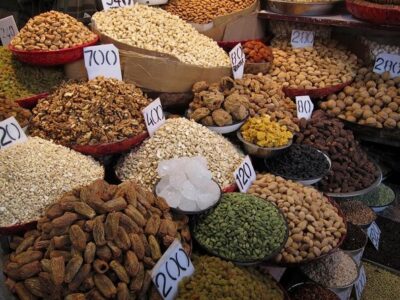
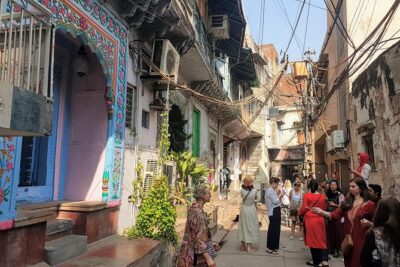
This is the most local-feeling part of the day. You ride an open tuk-tuk or rickshaw through the narrow streets around Chandni Old Bazaar and Khari Baoli, a major spice market in Delhi.
The ride is listed at about 45 minutes and includes admission. The point is not simply to pass through quickly. You get a view of traders at work and the changing texture of Old Delhi, with the smell of spices hanging in the air. The route brings you close to the day-to-day business that keeps this part of the city moving.
I would pay close attention here. The market is easy to remember because it uses your senses, not just dates and dynasties. You might notice sacks, shopfronts, traffic, and the movement of goods, but the supplied details do not promise specific purchases or a formal tasting session. Think of it as a guided street experience rather than a shopping tour.
This segment also explains why private support is useful. A guide can help you understand what you are seeing while the driver handles the tight streets. The ride is short, so keep your camera ready, but do not let photography distract you from the market itself.
Red Fort and the Mughal capital
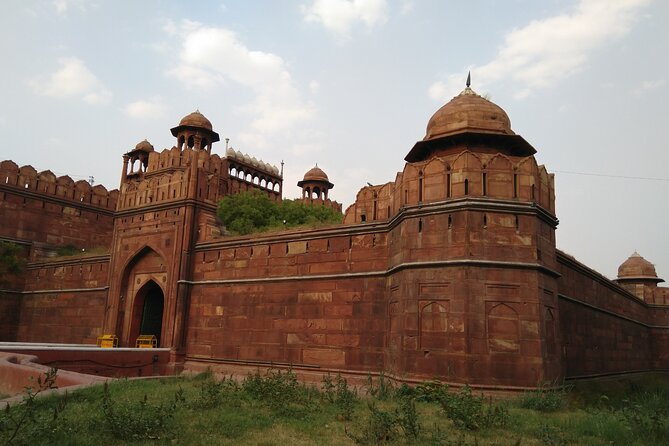
The Red Fort is a massive red sandstone citadel built by Shah Jahan in 1648 as part of Shahjahanabad, his capital city. It sits on the eastern side of Old Delhi and is one of the clearest reminders that this was once the center of Mughal power.
The provided schedule does not give a fixed time for the Red Fort, even though it is an important part of the route. That makes it a good place to discuss your priorities with the guide. One guide, Shahnawaz, has been praised for taking time to explore the Red Fort thoroughly, but the total seven-hour limit still applies.
If you want the fort to be more than a quick exterior view, say so early. The route contains many stops, and some may be shortened to make room. Admission arrangements should also be checked, since not every monument fee is included in the basic price.
The Red Fort works best when you connect it to Jama Masjid and the market. Together, these places show the Mughal city from three angles: worship, government, and trade.
Same place, a different slice of the past:
- Old Delhi Food-Spice Market-Temples Tour Soon Featured on NETFLIX
★ 5.0 · 304 reviews - 3-hour Old Delhi Heritage Walking tour with Rickshaw Ride
★ 5.0 · 240 reviews - Old Delhi: Spices, Heritage and Bazaars Walking Tour
★ 5.0 · 173 reviews - 3-Hour Old Delhi Heritage Walking tour with Rickshaw ride
★ 4.6 · 158 reviews
Raj Ghat and the memory of Gandhi
Raj Ghat is the cremation site of Mahatma Gandhi, where his final rituals were held after his assassination. It is now a garden visited by people who come to reflect on Gandhi’s life and sacrifices.
The stop lasts about 30 minutes and has no admission charge. After the tight streets of Old Delhi, the open garden offers a quieter change of pace. I find that contrast useful, especially on a full day when the city’s noise can become tiring.
This is a place for respectful attention rather than a rushed checklist. The guide can provide context, but the setting itself is simple. Give yourself a few calm minutes instead of treating it only as another photograph.
Agrasen Ki Baoli, an unexpected city pause
Agrasen Ki Baoli is a historic stepwell in New Delhi, built to collect rainwater for local use. It is associated with the Lodhi or Tughlaq period, though the supplied description notes uncertainty about exactly who built it.
The visit lasts about 20 minutes and is free. That is enough time to see the structure and understand how a water reservoir once served a local community. It also shows a less monumental side of Delhi’s past, where practical engineering mattered as much as royal display.
This stop is especially useful if you like unusual urban sites. It is not presented as a major palace or temple, and that is precisely its appeal. You get a quick look at how water was gathered in earlier Delhi.
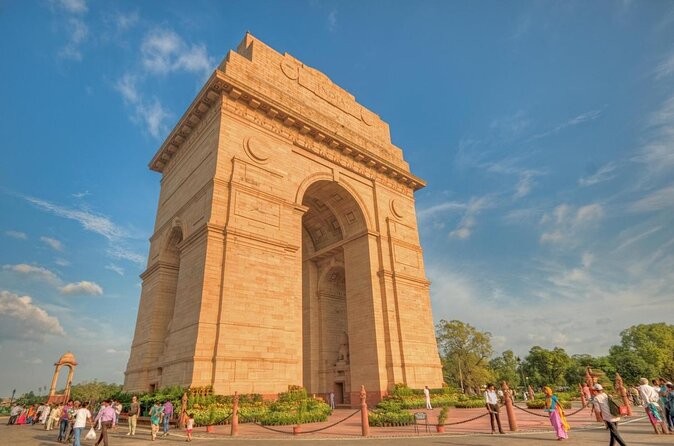
India Gate and the New Delhi plan
India Gate is a 42-meter-high memorial set in a garden, with the President’s House to the west. The stop lasts around 30 minutes and is free.
The monument helps explain the form of New Delhi. The broad setting and formal avenues feel very different from Chandni Old Bazaar. I like having both in the same tour because the change is not just visual. It reflects a change in political power and city planning.
You may not spend long inside any building here. This is primarily an exterior and garden stop, so it works well as a photo opportunity and a chance to hear how New Delhi developed. Traffic and timing can affect the visit, so do not assume every stop will run exactly to the minute.
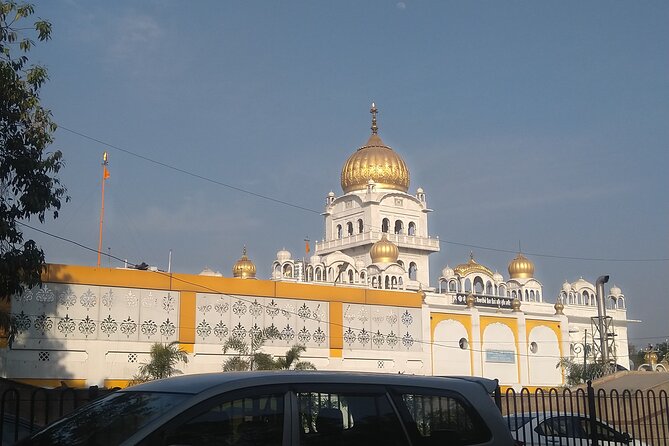
Gurudwara Bangla Sahib, an optional Sikh landmark
Gurudwara Bangla Sahib is an optional stop. It is identified as Delhi’s largest gurudwara among nine historic Sikh gurudwaras in the city. The word gurudwara means a gateway to the Teacher, and the site offers a chance to learn about Sikh faith and practice.
The scheduled visit is about 30 minutes and admission is free. Since it is optional, you can discuss whether it fits your interests and the remaining time. If your priority is architecture and religious history, it adds a useful tradition to a day otherwise dominated by Mughal and British-era sites.
As with Jama Masjid and the Lotus Temple, respectful conduct is important. Ask the guide about current expectations before entering.
Humayun’s Tomb and the best garden setting
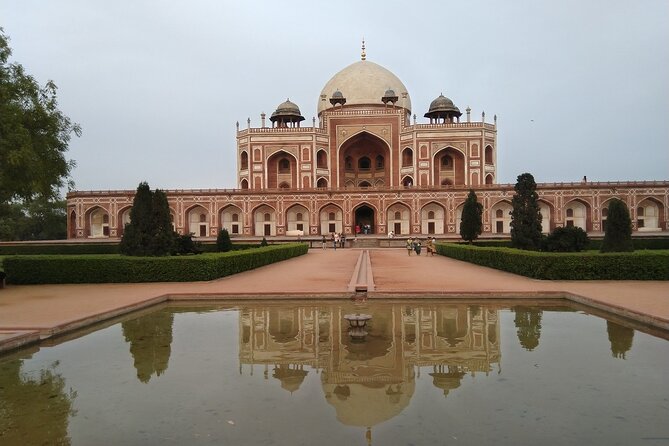
Humayun’s Tomb is the resting place of the second Mughal emperor of India. The monument sits in a lush garden with paths and water channels around the main tomb.
The scheduled visit lasts about 45 minutes. Admission is not included unless you choose the option with monument entrances. I would make this one of the day’s priorities because it gives you time to appreciate both the tomb and its setting.
The garden plan is a major part of the experience. Instead of seeing only a large building, you walk through a designed space where water, paths, and symmetry frame the tomb. One account of the tour singled out Humayun’s Tomb as the best part of the day, which makes sense if you enjoy architecture that rewards a slower look.
Ask for enough time to walk rather than stopping only at the main viewpoint. Still, remember that Qutub Minar and other sites remain ahead, so you may need to choose between depth and coverage.
Lotus Temple, a calm optional stop
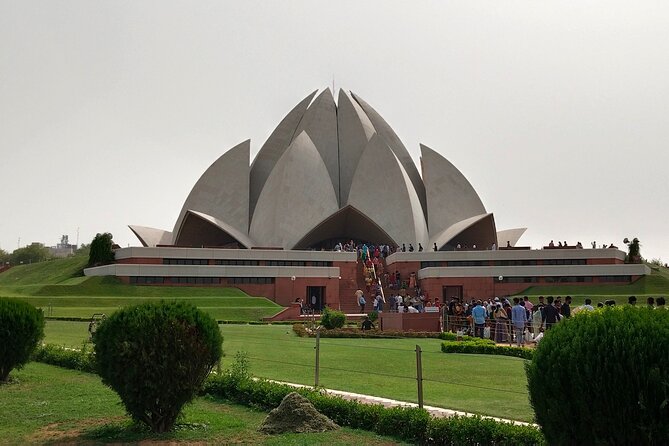
The Lotus Temple is an optional visit and is closed on Mondays. Its white marble structure is shaped like a lotus flower and serves as a house of worship for the Baháʼí faith. The temple is near Nehru Place, known for its computer market.
The visit is planned for about 30 minutes and is free. It adds a modern religious site to a route filled with older monuments. I like that contrast, but you should confirm the day of the week before counting on it.
Because the stop is optional, the guide may leave it out if the schedule is tight or if you prefer more time at the major historic sites. It is a good choice for visitors who want variety, quiet, and a look at Delhi beyond Mughal and Sultanate architecture.
Qutub Minar closes the historical arc
Qutub Minar is an 800-year-old brick and red sandstone tower built by Qutbuddin Aibak in the 12th century. It commemorates the dominion of the Sultan dynasty and gives the tour a final period of history before the day ends.
The planned visit lasts about 40 minutes. Admission is not included in the basic arrangement unless you choose the entrance option. That cost is worth checking before booking because this is one of the principal paid monuments on the route.
The tower also completes the historical sequence nicely. You begin with Mughal Delhi, pass through the city’s later imperial and national landmarks, and finish with an earlier Sultanate monument. Forty minutes will give you an introduction, but not a leisurely study of every feature in the complex.
Guide quality, timing, and comfort
The strongest part of this experience is the guide service. Shahnawaz is praised for clear historical explanations, flexibility, and a willingness to adjust the pace. Sameer is also described as a good guide, and one visitor specifically appreciated Japanese-language explanations. That does not guarantee a particular guide or language, so confirm your needs when booking.
The private format means only your group participates. That makes it easier to ask questions, request a change, or slow down at a site that interests you. Guides have also been praised for friendly, patient service and for helping make a short Delhi visit feel organized.
There is one important warning. A pickup once began late because of a Delhi election holiday and a failure to check the schedule. The company apologized, but I would still confirm the pickup time and location the day before. This is simple advice, yet it matters when nine possible stops must fit into seven hours.
The tour includes private transportation, an air-conditioned vehicle, bottled water, and parking fees. Lunch is not included. Plan to buy lunch separately or ask the guide for a suitable place during the day.
Is $29 a good value?
At $29 per person, this is a strong price for a private seven-hour tour with hotel pickup and transportation. The value is especially good if you are sharing the vehicle with companions, since the cost includes services that would be difficult to arrange efficiently across Old and New Delhi.
The price is less complete than it first appears because lunch is excluded and monument admission may cost extra. Jama Masjid, Humayun’s Tomb, and Qutub Minar are each marked as not included unless you select the option with entrance fees. Check that choice carefully before paying.
I would not judge the tour by the number of monuments alone. The real value is the combination of a local guide, private transport, and the Old Delhi rickshaw ride. If you tried to arrange those pieces separately, you would spend time managing traffic, directions, and site choices.
Who should book this Delhi tour?
I would recommend it to a first-time Delhi visitor with one busy day, a short stop in the city, or a strong interest in history. It also suits families and small groups who want a private vehicle instead of a large coach.
It is a good match if you want both famous sights and ordinary city life. The spice market and rickshaw ride keep the day from becoming a parade of monument entrances.
I would be more cautious if you dislike early starts, traffic, or a packed schedule. You should also consider another plan if your main goal is to spend several hours at only one or two monuments. This route gives you range, not maximum time at each site.
Final verdict
Book this tour if you want an efficient first look at Delhi with private transport and a guide who can connect the city’s many historical periods. I especially value the Khari Baoli market, the rickshaw ride, Humayun’s Tomb, and the mix of Old and New Delhi.
Before confirming, check three things: which monument fees are included, whether the optional stops fit your priorities, and the exact pickup time. If you accept the brisk pace and plan separately for lunch, the $29 price offers very good value for a private introduction to Delhi.
FAQ
How long does the Delhi historical tour last?
The tour lasts approximately seven hours.
Is hotel pickup available?
Yes. Pickup is offered, and private transportation is included.
Is this a private tour?
Yes. Only your group participates in the activity.
Is lunch included?
No. Lunch is not included in the tour price.
Is the Lotus Temple always visited?
No. The Lotus Temple is optional, and it is closed on Mondays.
Are monument entrance fees included?
Monument fees are included only when you choose the option with entrance fees. Jama Masjid, Humayun’s Tomb, and Qutub Minar are otherwise listed with admission not included.
Is the Old Delhi rickshaw ride included?
Yes. The approximately 45-minute Old Delhi rickshaw or tuk-tuk ride is included.
What happens if the weather is poor?
The experience requires good weather. If it is canceled because of poor weather, you will be offered another date or a full refund. You can cancel for a full refund up to 24 hours before the start time.
Just added around New Delhi
- Unveil Old Delhi’s Food, Spice Market & Heritage Walk★ 5.0 · 26 reviews
- Old Delhi Heritage Walk with Rickshaw Ride★ 5.0 · 68 reviews
- Timeless Treasures: An Old Delhi Heritage Walking Tour★ 5.0 · 69 reviews
- Same Day Tour of Taj Mahal with Our Real Historical Experience★ 5.0 · 42 reviews
- From Delhi: Skip the line Taj Mahal, Agra Tour by Express Train★ 5.0 · 84 reviews
- Discover Delhi’s Cultural Heritage in a Day with Food Tasting★ 5.0 · 32 reviews
- 3-hour Old Delhi Heritage Walking tour with Rickshaw Ride★ 5.0 · 240 reviews
- Old Delhi Heritage Walking Tour★ 5.0 · 247 reviews
New Delhi History Tours, compared.
The Great Indian Food Tour: Old Delhi Food and Heritage Walk
Read our review →
Old Delhi Food, Heritage&Cultural Walk with Rickshaw ride to Masterji Kee Haveli
Read our review →
Old Delhi Food-Spice Market-Temples Tour Soon Featured on NETFLIX
Read our review →
3-hour Old Delhi Heritage Walking tour with Rickshaw Ride
Read our review →
Old Delhi: Spices, Heritage and Bazaars Walking Tour
Read our review →3-Hour Old Delhi Heritage Walking tour with Rickshaw ride
Read our review →
13 Nights 14 Days Private Tour of Heritage Rajasthan from New Delhi
Read our review →Browse the lists this tour appears in